The Tighter You Hold the Plan, the More of It You Lose
By Derek Neighbors on November 11, 2026
A database migration is 40 percent done when it hits a shape of data nobody planned for. Rows start failing. The launch date was promised to customers two weeks ago, and the team lead has written “we ship Friday” in every Slack update since. So the team rolls forward. They point their agents at the failures, patch the script, rerun it, and patch it again. Rolling back would mean admitting the date is gone, and nobody wants to be the one who says it. Six hours later, at three in the morning, they roll back anyway. The date is gone, and so is a good piece of the customer trust that the date was supposed to protect.
The team had plenty of commitment, and they pointed all of it at the plan. When the plan stopped matching the world, they kept defending it, and the defense cost them the thing they were defending it for.
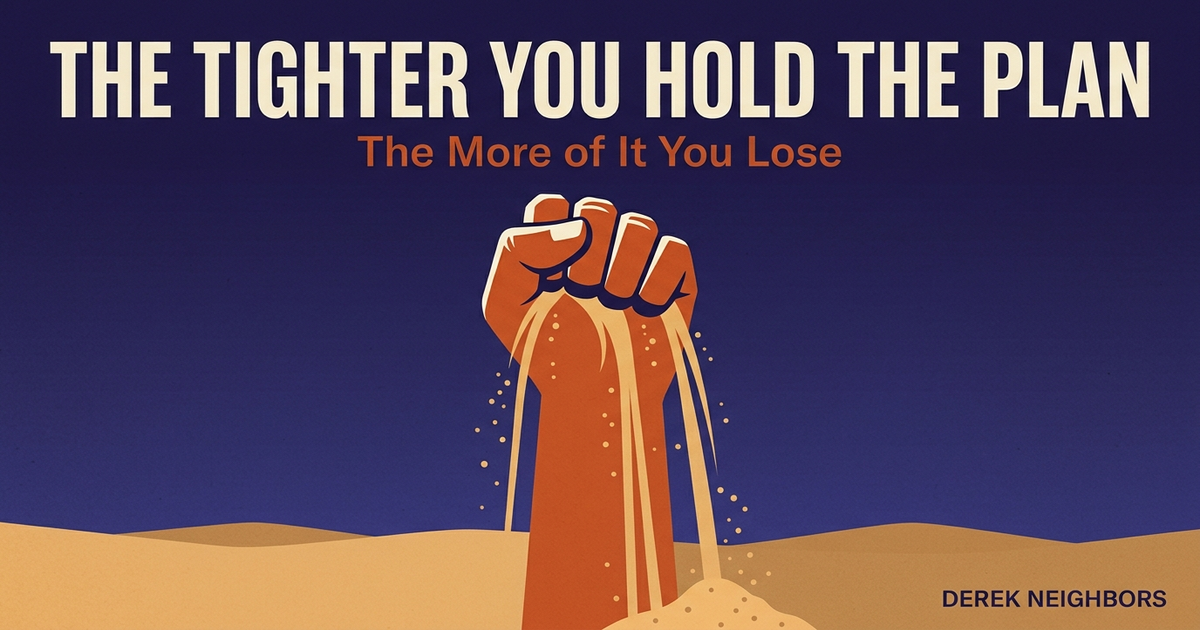
The tighter you hold the plan, the more of it you lose. Plan as hard as you like and care as much as you like. The trouble is the grip, and the Stoics had a precise way to commit without it.
Commit Hard or Accept What Comes
Most of us were handed two pieces of advice that seem to cancel each other out. The first says commit: set the goal, make the promise, and do not let a little trouble talk you out of it. The second says accept: some things are outside your control, and fighting them only makes you miserable.
People tend to pick one and treat the other as weakness. Hard chargers hear “accept” as permission to quit. People who value calm hear “commit” as the source of all their stress. So the hard charger rolls forward until three in the morning, and the calm person never makes a promise worth keeping.
Viktor Frankl is a useful witness here, because nobody can accuse him of soft acceptance. In 1946, less than a year after he was freed from the camps, he gave a series of lectures in Vienna that were later published as Yes to Life. His argument was that you can say yes to life as it is, including the parts that are terrible, and still owe it your full effort. In Man’s Search for Meaning he put the point in one line: “When we are no longer able to change a situation, we are challenged to change ourselves.” Acceptance, for Frankl, was where the work started.
Why Rigidity Breaks the Plan It Was Meant to Protect
A plan is a tool for a goal. The launch date exists to protect customer trust, and a race plan exists to get you to the finish in good shape. Rigidity flips that relationship. The plan becomes the thing you protect, and the goal becomes something you will get back to after the plan is safe.
Holding a plan through discomfort is often the right call, and a team that rewrites the plan at the first bad hour does not really have one. The test is what the plan is for. Steadfastness means holding the plan while it still serves that end, and rigidity means holding it after it has stopped. Discomfort alone tells you nothing, so hold the plan through it, and change it when the evidence says the goal needs something else.
I see this most clearly on long runs in the desert. You leave with a pace in your head, and the pace is there to get you home. Some mornings the heat shows up an hour early. If you hold the planned splits anyway, you are protecting the number at the expense of the run it was meant to serve, and you walk the last hour. The runner who slows down at mile four and finishes strong kept the part of the plan that mattered.
I call it the rigidity tax: the time and damage between “this happened” and “okay, now what.” Every minute you spend arguing with what already happened is a minute you are not spending on it. The migration team paid six hours of it, and the runner pays in the last miles. Most of us pay it in smaller amounts all day, in the meeting where we keep defending the estimate after the scope changed, or the hour we spend being annoyed that the flight is late instead of rebooking.
It shows up at my desk too. I give an agent a spec with an approach in mind, and it comes back with a different approach that is better. The rigid move is to reject the diff because it is not what I planned. The plan was there to get working software, and the better diff gets me more of it. When I hold my approach over the result, I am taxing my own work.
Steven Hayes and the researchers behind acceptance and commitment therapy have a name for the opposite of this. They call it psychological flexibility: staying in contact with what is happening, including the facts and feelings you do not want, and continuing to act on what you care about. Decades of their work link inflexibility, the habit of avoiding or arguing with unwanted facts, to worse outcomes across a wide range of problems. Their research is the measured version of the rigidity tax, and it covers far more of life than missed launches.
This is a different question from how much pressure a person can carry. I wrote about why some people hold under pressure and others snap, which is about the tension you keep inside you. The rigidity tax is about what you demand from events outside you.
The Stoic Reservation: Commit With “Unless”
The Stoics solved the contradiction with a condition. Their term for it was hupexairesis, usually translated as reservation, and it describes how a wise person reaches for anything in the world.
Near the start of his Handbook, Epictetus gives the instruction. For now, he tells his students, reach toward things and away from them lightly, with reservation, and without strain. Seneca gives the working version in On Tranquility of Mind. The wise person, he says, sets out on everything with a condition attached: “I will sail unless something prevents me.” I will win the office unless something prevents me. The business will succeed unless something gets in the way. That is why, Seneca says, nothing happens to the wise person against their expectation, since they allowed for the possibility from the start.
This is easy to misread as a hedge. The effort stays total: you still prepare the ship, check the weather, and sail. The condition applies only to your demand that the world cooperate. Your effort and your judgment are up to you and the outcome is not, which the reservation admits before you leave the dock. Epictetus states the same idea in its strongest form a few chapters later: do not ask for things to happen as you wish, but wish for them to happen as they do happen, and your life will go well.
Seneca preserves a line from the older Stoic Cleanthes, translating it into Latin in one of his letters: the fates lead the willing and drag the unwilling. Both arrive in the same place, and only one of them gets to use the trip.
The reservation is also right when it saves nothing. Say the team writes the “unless” in, rolls back at the first failed batch, and the customer leaves anyway. The team still did the part that was theirs, because they judged well and told the truth early, and that part was the whole of what they ever controlled.
Two lines need drawing here, because this site has argued things that sound close. In Your Backup Plan Is Why Your Main Plan Keeps Failing I argued against building escape routes. A backup plan is a way out of the goal, while a reservation keeps you on the goal and lets the route change. And in the difference between grit and stubbornness I wrote about deciding in advance when to quit a pursuit. That post was about whether to keep going, and this one is about what to do when the route breaks while you are.
What Changes When You Hold It This Way
The biggest change is that you stop being surprised, and surprise is a large share of the tax. The migration team lost six hours because rolling back felt like a betrayal of the plan. If “we ship Friday unless the migration fails on real data” had been part of the plan from the start, the rollback would have been the plan working. Somebody would have called it at the first failed batch, and the customer would have heard about a new date that morning.
That is the second change: you decide in advance what “something prevents” would look like. Good engineering teams already do this with rollback thresholds. If error rates pass a number, the deploy reverses and nobody argues. You can do the same with any commitment. Set the heat at which you slow down before the run, and decide what an agent’s diff would have to show for you to drop your own approach before you read it. The “unless” has to be specific, and it has to exist before the trouble does. A vague “unless something comes up” will excuse anything, and an “unless” written after the migration starts failing is an excuse too.
If you lead people, the reservation changes what your team is allowed to say. On a team where the plan is sacred, the person who sees it breaking stays quiet, because saying it out loud sounds like disloyalty. Writing “unless” into the plan makes reporting the break part of the job, so you find out at the first failed batch instead of at three in the morning.
Your own test is simple. How long is your gap between “this happened” and “okay, now what”? Hours means you are paying a heavy tax, and minutes means the reservation is working. You will still feel the first jolt when the news lands, and nobody gets past that. What you can shrink is how long you keep paying for it afterward.
What to Do This Week
- Write the “unless” into your next plan. One line per commitment: we ship Friday unless the migration fails on production data. Say it in the kickoff, so nobody hears it later as an excuse.
- Write what the plan is for. One sentence at the top: this date exists to protect customer trust. When the plan and that sentence conflict, the sentence wins.
- Time your gap. The next time something breaks, note when it happened and when you started working on the new reality. Do not judge it yet. Just measure.
- Name the likely break before it comes. Before the week starts, write one paragraph about the thing most likely to go wrong and what you will do when it does. The Stoics practiced this deliberately, and it is the fastest way to shrink the surprise.
- Say the plan changed, early and out loud. Tell the team, the customer, and yourself. People forgive a broken plan far more easily than a late announcement of one.
FAQ
What does it mean to act with reservation in Stoicism?
Acting with reservation means committing fully to an action while holding the outcome on a condition. Seneca describes the wise person saying “I will sail unless something prevents me.” Epictetus tells his students to reach for things lightly and with reservation. The effort is total, but the demand that events cooperate is conditional, so when something does prevent you, you are not surprised and can act on the new situation right away.
What is the difference between accepting reality and giving up?
Giving up drops the goal. Accepting reality drops the argument with what already happened and keeps the goal. A team that accepts a failed rollout still wants the launch; it rolls back, fixes the problem, and sets a new date. Viktor Frankl put it this way: when we can no longer change a situation, we are challenged to change ourselves. Acceptance is where the next useful action starts.
Why does rigidity make things worse?
Rigidity makes the plan the thing you protect, instead of the goal the plan was for. When conditions change, the rigid person spends time and effort defending the old plan, and that time is taken from dealing with what actually happened. Psychologists studying psychological flexibility have linked rigid avoidance of unwanted facts and feelings to worse outcomes across many kinds of problems.
Final Thoughts
Commitment and acceptance only look like opposites when the commitment is aimed at the plan. Aim it at the goal, and acceptance becomes the fastest way back to work when the plan breaks. The Stoics built that into one habit: plan hard, sail with everything you have, and say from the start that you will sail unless something prevents you. Under the date and the finish line sits the end no broken plan can take from you, which is doing the work well and telling the truth about it. When something does prevent you, you lose the route and keep that, and you are already working on what to do next.
Holding a hard commitment without gripping it is a practice, and it goes better with people who are working on the same thing. That is what MasteryLab is for.