Metameleia (μεταμέλεια): Meaning, Definition & Modern Application
meh-tah-MEH-lay-ah
The emotional experience of regret or remorse after an action, distinct from rational reconsideration. It is the painful recognition that a past choice has caused harm or fallen short of one's values.
Etymology
From the verb metamelomai, ‘to regret’ or ‘to change one’s mind afterward,’ built from meta (after, change) and melei (‘it is a care to,’ ‘it concerns’). The root picture is a change in what you care about once the act is done. Aristotle uses the noun in the Nicomachean Ethics, most memorably in IX.4, where he says base people are full of regret because they are at odds with themselves, and in VII.8, where he notes the incontinent person is prone to regret while the self-indulgent person is not.
Deep Analysis
The Greeks understood that moral development requires more than intellectual assent to virtue. You must feel your failures, not merely catalog them. Metameleia occupies a peculiar space in ancient moral psychology: it is simultaneously a passion to be moderated and a necessary companion to ethical growth.
Aristotle treats metameleia in the Nicomachean Ethics as the affective dimension of moral error. When discussing akrasia, or weakness of will, he notes that the incontinent person feels metameleia afterward, distinguishing them from the licentious person who feels no regret at all. This distinction reveals something crucial: the presence of regret indicates that one’s rational understanding of the good remains intact, even when one’s action betrayed it. The akratic individual knows better, fails to do better, and suffers the sting of that gap. The licentious person has corrupted both action and judgment.
This insight carries profound implications. Metameleia functions as a kind of moral compass needle. When you act against your values and feel nothing, something more serious than a single bad choice has occurred. Your value system itself may have degraded. The pain of regret, uncomfortable as it is, signals that your moral perception remains functional.
The Stoics complicated this picture. Seneca and Marcus Aurelius counseled against excessive remorse, which they saw as unproductive self-flagellation. In his Letters to Lucilius, Seneca writes about the futility of dwelling on past errors when such dwelling produces only suffering without change. The Stoic position is not that regret should be absent, but that it should be brief and instrumental. Feel the sting, extract the lesson, adjust future behavior, release the emotion.
This Stoic refinement addresses a genuine danger in metameleia: its potential to become recursive and paralyzing. Regret about regret, shame about shame, these spirals trap people in emotional loops that prevent forward motion. The disciplined practice involves processing regret efficiently, like a feedback signal in a system. Register the input, make the adjustment, return to equilibrium.
Yet there is tension here with the Aristotelian view that character development requires habituation over time. Virtue is not a single adjustment but a gradual reorientation of desire and perception. Perhaps metameleia must recur, must be felt again when similar circumstances arise, until the new pattern becomes second nature. The quick Stoic processing may work for the sage, but those still on the path may need the repeated emotional reminder.
Plato offers another dimension through his treatment of the thymic part of the soul in the Republic. The spirited element, when properly trained, feels shame at base actions and pride at noble ones. This emotional responsiveness serves reason, not as its slave but as its ally. Metameleia, in this framing, is thymos responding appropriately to moral failure. A soul without this capacity would be defective, unable to police itself through feeling.
The connection to hamartia deserves attention. Aristotle’s famous concept of ‘missing the mark’ implies that error is often about miscalculation rather than malice. Metameleia appropriate to hamartia should therefore be corrective rather than self-destructive. You missed the target; now you know something about your aim that you did not know before. This knowledge improves your next attempt.
Modern psychology validates this ancient wisdom. Research on ‘counterfactual thinking’ shows that regret can enhance future decision-making when focused on behaviors within one’s control. But rumination, the endless replaying of regret without resolution, correlates with depression and paralysis. The Greeks anticipated this distinction without our vocabulary.
The practical challenge is calibration. Too little metameleia and you learn nothing from your errors. Too much and you become trapped in the past, unable to act for fear of future regret. The Aristotelian mean applies here as elsewhere: the virtue lies in feeling regret to the right degree, at the right times, about the right things, in the right way.
Modern Application
You experience metameleia when past decisions haunt you, not as abstract mistakes but as felt wounds. Rather than suppressing this discomfort, you can harness it as moral feedback. Genuine regret, properly processed, becomes the catalyst for behavioral change and character refinement.
Historical Examples
Socrates modeled a distinctive relationship to metameleia through his famous response to his death sentence. According to Plato’s Apology, when given the opportunity to propose exile or silence as alternative punishments, Socrates refused, stating he would not regret having lived as he did. His lack of metameleia was not callousness but conviction: he had examined his life and found it aligned with his values. This stance demonstrates that the absence of regret requires genuine self-examination, not mere rationalization.
Alcibiades presents the opposite case. Plutarch records in his Parallel Lives how this brilliant Athenian general oscillated between Athens, Sparta, and Persia, betraying each in turn. His charm allowed him to escape consequences temporarily, but his biography reads as a study in metameleia avoided. He never allowed regret to take root because he never acknowledged the pattern of self-serving betrayal. His eventual assassination by multiple enemies he had wronged suggests that metameleia deferred becomes destruction received.
Marcus Aurelius in his Meditations repeatedly processes what appears to be metameleia about his responses to people. At the opening of Book 2, he prepares himself to meet difficult people and reminding himself of their nature. The subtext suggests regret about losing his equanimity, about failing to maintain the Stoic ideal when provoked. His writing practice itself appears to be a technology for processing metameleia: acknowledging the failure of yesterday’s resolve, recommitting to tomorrow’s intention. This exemplifies the Stoic approach of brief, instrumental regret directed toward character refinement.
How to Practice Metameleia
Begin each evening with a five-minute regret inventory. Write down any actions from the day that produced the sting of metameleia. Do not judge or minimize these feelings. Simply acknowledge them.
For each regret identified, ask three questions: What value did I violate? What triggered the choice? What would alignment look like?
Create a ‘repair protocol’ for recurring regrets. If you consistently regret speaking harshly under stress, design a specific intervention: pause, breathe, rephrase. Test it tomorrow.
Practice ‘regret differentiation’ weekly. Review your inventory and sort regrets into two categories: those arising from actions against your values (productive metameleia) and those arising from others’ disapproval (performative metameleia). Only the first category deserves your attention.
Seek feedback from trusted colleagues about blind spots. Sometimes metameleia fails to arise when it should. Ask: ‘What might I be missing about my impact?’
Track patterns monthly. Which contexts produce the most regret? Which relationships? Use this data to redesign environments and boundaries rather than relying solely on willpower.
Application Examples
A CEO discovers that a cost-cutting decision she championed led to safety incidents in manufacturing. Though legally protected, she cannot shake the knowledge that her choice prioritized margins over worker wellbeing. She lies awake reviewing the decision.
Metameleia that cannot be rationalized away often points to genuine value violations, not merely suboptimal outcomes. This regret signals the need for systemic change, not defensive justification.
A father realizes he spent his children’s early years pursuing career advancement, missing countless moments that cannot be recovered. His adult children are polite but distant, and he feels the weight of his absence in every strained conversation.
Some metameleia arrives too late for direct repair. Its proper use becomes shaping what remains: deepening present relationships, mentoring younger colleagues toward different priorities, accepting the irreversibility without collapsing into despair.
A team lead publicly criticized an employee’s failed project in a meeting, intending to set standards but instead humiliating them. The employee’s subsequent resignation and the team’s newfound guardedness produce persistent regret in the leader.
Metameleia reveals the gap between intent and impact. The leader intended accountability but delivered shame. This distinction becomes visible only through the painful aftermath.
A consultant sold a client on an approach she privately doubted because it meant a larger contract. When the implementation struggled, she felt compromised, having prioritized revenue over honest counsel.
Metameleia arising from self-betrayal differs from regret about honest mistakes. The consultant violated her own standards, not merely a best practice. This form of regret demands rebuilding integrity, not merely improving technique.
A board member voted to approve a development project after minimal due diligence, swayed by a colleague’s enthusiasm. Years later, environmental damage to the community becomes apparent, and she cannot escape her complicity.
Collective decisions distribute but do not eliminate personal responsibility. Metameleia properly extends to our failures of independent judgment, especially when we deferred to avoid conflict.
Common Misconceptions
Many people treat metameleia as evidence that a decision was wrong. But regret and error do not correlate perfectly. You can make the correct decision with the available information and still feel regret when it produces painful outcomes. Confusing regret with wrongness leads to decision paralysis and hindsight bias.
Another confusion involves equating metameleia with guilt. Guilt focuses on having violated an external standard or harmed another person. Metameleia is broader: it includes regret about actions that harmed yourself, missed opportunities, failures to act, and choices that violated your values even if no one else was affected. Processing regret requires distinguishing which variety you are experiencing.
Some assume that repeated metameleia about the same pattern indicates moral seriousness. In truth, recurring regret without behavioral change becomes a substitute for change. The person who constantly regrets their anger but never develops new responses is using regret as penance rather than catalyst. Genuine metameleia produces altered behavior, not just emotional display.
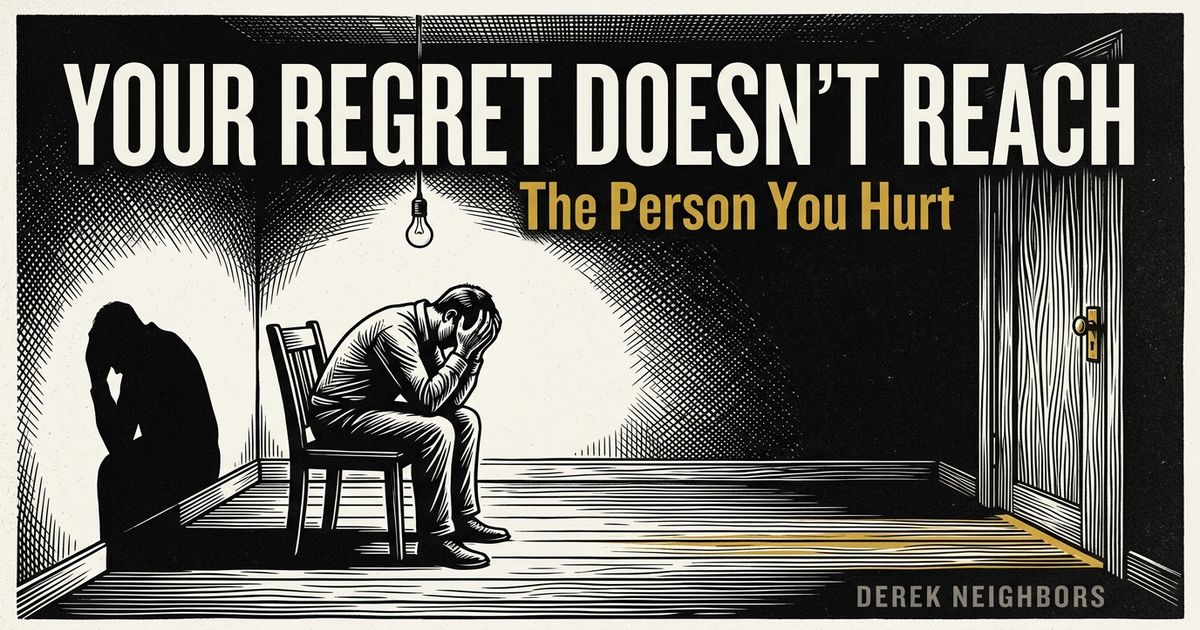
I am very good at regret. I can replay a bad meeting for a week, rehearse the better thing I should have said, and feel thoroughly awful, and none of that does anything for the person on the other end of it. That is what makes metameleia worth naming. It feels like moral work because it hurts, and it can run indefinitely without ever leaving my head.
The test I use now is simple. Who is the sentence in my head about? If it is about me (how could I, I am better than that), I am still in regret. If it is about them (what that cost her, what he had to redo), I am closer to remorse, and remorse has somewhere to go: a plain sentence to the person, a fix they can see, a changed habit.
Aristotle’s line in Book IX stays with me because it refuses the flattering reading. In his account heavy regret is what being at odds with yourself feels like, and I have found the way out runs through less of it, spent faster, on the way to the person who was hurt.
Frequently Asked Questions
What is the difference between metameleia and metanoia?
*Metameleia* is the emotional experience of regret, the felt pain after a poor choice. *Metanoia* is the deeper transformation of mind and character that may follow. Metameleia is the wound; metanoia is the healing that changes you fundamentally.
Is regret always productive in Greek philosophy?
The Stoics were skeptical of excessive regret, viewing it as a passion that disturbs tranquility. Aristotle saw moderate metameleia as natural and useful for moral development. The key is whether regret leads to change or merely to self-torment without growth.
How do I stop feeling regret about things I cannot change?
Greek philosophy suggests distinguishing between what is 'up to us' and what is not. Extract the lesson, commit to different future action, then release attachment to the unchangeable past. Metameleia has served its purpose once it produces insight and resolve.