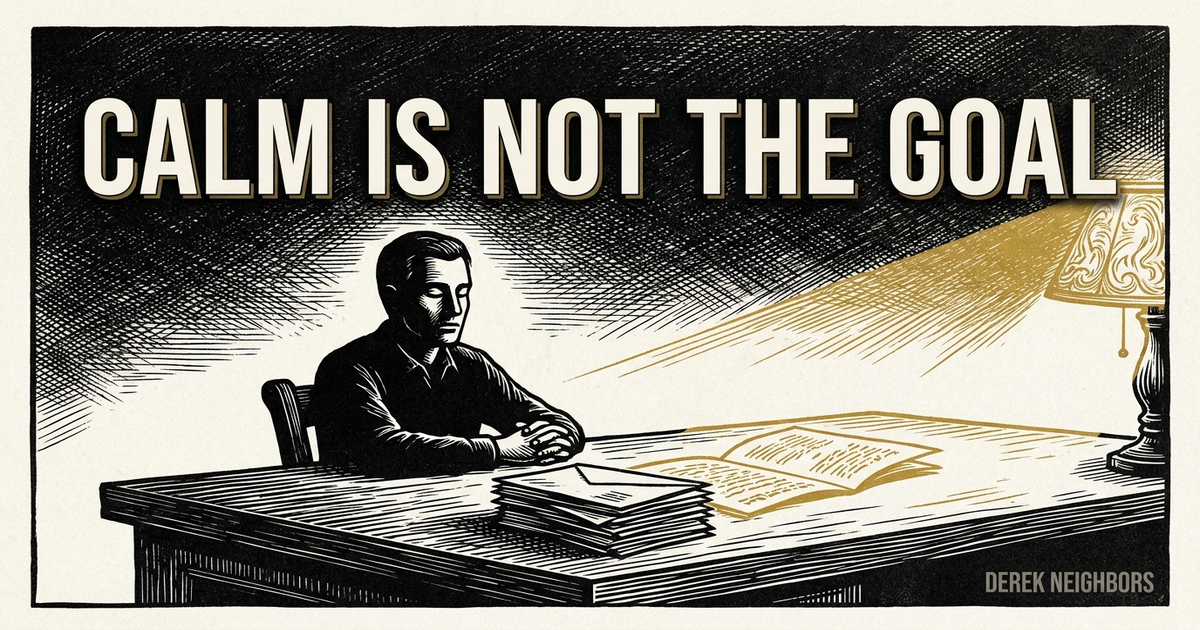
Calm Is Not the Goal
By Derek Neighbors on September 12, 2026
I sat in a status meeting last month where the launch was “on track.” Staging had been down for a week, and the people in that room knew it. After we hung up, someone on the thread said they were staying stoic about it. They meant they were staying pleasant. The date was false, and the room stayed smooth.
That is what I keep watching people choose when they reach for modern Stoicism: a way to feel less and keep the afternoon polite, plus a quote before standup so nobody has to say the build is broken.
The old practice ran the other direction. Calm is not the goal of that work. It trained you to say the thing that costs you the room.
They Sold You a Mood
Open the feed and count the promises: less anxiety, a calmer morning, inner peace before your first meeting. The vendor will sell you that feeling. You still choose to buy it, and you choose it because the afternoon gets easier. The feeling has a name. ataraxia is freedom from disturbance, the still water. Some later schools treated that stillness as a mark of a well-run mind. Making it the thing you buy flips the work. You start protecting the water. The first casualty is the sentence that would ripple it.
I have done this at my own desk. I will read a line about what I do not control, feel a click of relief, and still not write the update that says the feature is late. The quote did a job. It put a lid on a problem I had not named.
Cicero’s Academy never promised you would feel better. It promised you would weigh reasons, not authorities. That move costs peace when the reason is ugly and the person with the title wants the pleasant version. Massimo Pigliucci has been saying a version of this in public for years: a philosophy that makes feeling better the highest good will drop the truth the moment they conflict. I am not asking you to take his word. Watch your own week. Watch what you protect when the two collide.
I already wrote about flourishing as something other than a mood. eudaimonia is activity in accordance with character, not a state you sit in. This piece is about a narrower theft. A specific practice got packaged as a calm delivery system, and a lot of serious people bought the box because the calendar was full and they wanted a quieter body.
Chasing happiness directly fails for a different reason. This is not that essay. This is about what happens when you take a discipline built to keep you honest and run it as sedation.
Four Ways You Use It to Stay Quiet
The Control Dodge
“That’s outside my control” is a real tool. The weather is outside your control. A customer’s budget is outside your control. Last week’s outage, the date you published, and the person on your team who cannot do the job are not. I keep seeing the line used in Slack to end a thread that still needed an owner. The sentence sounds like wisdom. It functions as a door closing.
If you can send the message, book the call, or change the date, it was never outside your control. You used the line to stay comfortable.
The Morning Lid
A quote or a ten-minute sit can steady you for work. It can also be a lid. You close your eyes, you feel the edges soften, and you never open the doc that says the launch slips a week. I have used the sit that way. The morning felt better. The problem was still sitting in the repo at 5 p.m.
If the practice ends and you still have not written the true sentence, you delayed.
The Unbothered Leader
Some rooms treat unbothered as the mark of the senior person: a flat voice, a still face, and “we’ll get there” while the build is on fire. People copy it because it looks like command.
It reads as command for about two weeks. Then, in rooms I have sat in, the people closest to the work stop bringing you the truth, because they have learned you will not say it either. Steadiness is useful. Silence about a known miss is a different move, and I have watched it train a team to lie in your direction.
I wrote about grief and the Stoic refusal to go numb on purpose. That piece is about loss. This one is about the status meeting, and the rooms do not travel.
The Feeling Scoreboard
You grade the week by how calm you felt. Tuesday was a good day because your chest stayed quiet. Thursday was a bad day because you were angry in the 1:1. The scoreboard is a mood log.
A better scoreboard is shorter: what you said that was true, who heard it, and what changed because they heard it. If those answers are thin and the mood log is glowing, the practice is doing entertainment.
What Actually Works
When honesty and calm conflict this week, keep honesty. That is the whole method. The rest is how you run it so it does not stay a slogan. A judgment that hides the facts cannot be the activity eudaimonia names, so honesty is the condition of the work, not a mood you pick when it feels good.
A practice is a repeated act that makes your judgment more accurate. A product is something you consume to change a feeling. You control whether you send the sentence, and you do not control whether the room stays pleasant after.
Write the sentence you are avoiding. One sentence. If you do not have the facts yet, or the news is someone else’s to tell, the honest move is to say that. Staying pleasant and saying nothing is the dodge. “Staging has been down for a week and the date is a lie.” “I cannot staff this launch with the people I have.” “This pull request is not ready and shipping it will bounce.” Put it in the channel that can act. Do it before the afternoon sit, not after. The sit can come later, when the sentence is out of your head and in someone else’s.
Score the week by conversations, not by smoothness. Three true sentences sent to people who can move the work beats five calm mornings with a closed laptop. I will take the week where I was sharp in two threads and slept badly over the week where I was pleasant and the date slipped another five days.
Keep the practices that make you more accurate and drop the ones that make you quieter. A morning page that names the risk is practice. A quote you use to talk yourself out of the update belongs in the trash. If there is no Slack and no standup, write the sentence in a note only you will see. The obligation is the true account, not the audience. Calling the hard choice a sacrifice is a different error. This one is simpler. You know the sentence. You are using a philosophy brand to postpone sending it.
Four Questions for This Week
Run these on the last meeting you left feeling proud of how composed you were.
What true sentence did you owe that room, and did it get said.
Where did you use “outside my control” on something you could have written down and sent.
What did you measure at the end of the day, your chest or the update.
If a junior copied your tone this week, would they become more honest or more pleasant.
If any answer is “I stayed pleasant,” the practice is pointed at the wrong target. Turn it. The target is the sentence, not the stillness.
Final Thoughts
Calm can show up after a clean week. You said the thing, the date moved, the right people are angry at the right problem. Your body gets quieter because the lie is no longer sitting in your lap. That quiet is a receipt. It is a terrible goal.
If your Stoicism made you easier to sit next to and harder to get a straight answer from, you bought the product. The status meeting is the example. The stake is whether you will hide a fact from yourself to keep a feeling, at a desk or anywhere else. Put the quote down. Write the sentence. Send it before you try to feel better.
If you want a room that will not let you trade honesty for a smoother afternoon, MasteryLab is where that standard gets said out loud.
FAQ
What did ancient Stoicism actually aim at?
The aim was character, not a mood. The work was training judgment so you could tell the truth about what is in front of you and act on it. Feeling unbothered can arrive later, after the ledger is clean. Treating that feeling as the product is how the practice turns into a lid.
What is ataraxia, and why isn’t it the goal?
ataraxia means freedom from disturbance, the still water. Some later readers treated it as the mark of a finished mind. Aim at the water and you will start protecting it, and the sentence that would ripple it gets postponed, then dropped. The stillness worth keeping is the one that is still there after you sent the true sentence.
How do I know if my Stoic practice is making me quieter instead of more honest?
Look at the last conversation you owed. If a quote, a control line, or a sit helped you delay writing the problem down and sending it, the practice pointed the wrong way. Grade the week by what you said and who could act on it. A glowing mood log with a thin list of true sentences is the tell.
Did Cicero reject tranquility as the highest good?
His Academy sold a habit, not a calmer nervous system: weigh the reason, not the title in the room. That habit costs peace when the reason is ugly. A philosophy that ranks feeling better at the top will drop the reason the moment the mood is at risk. Watch which one you keep this week.