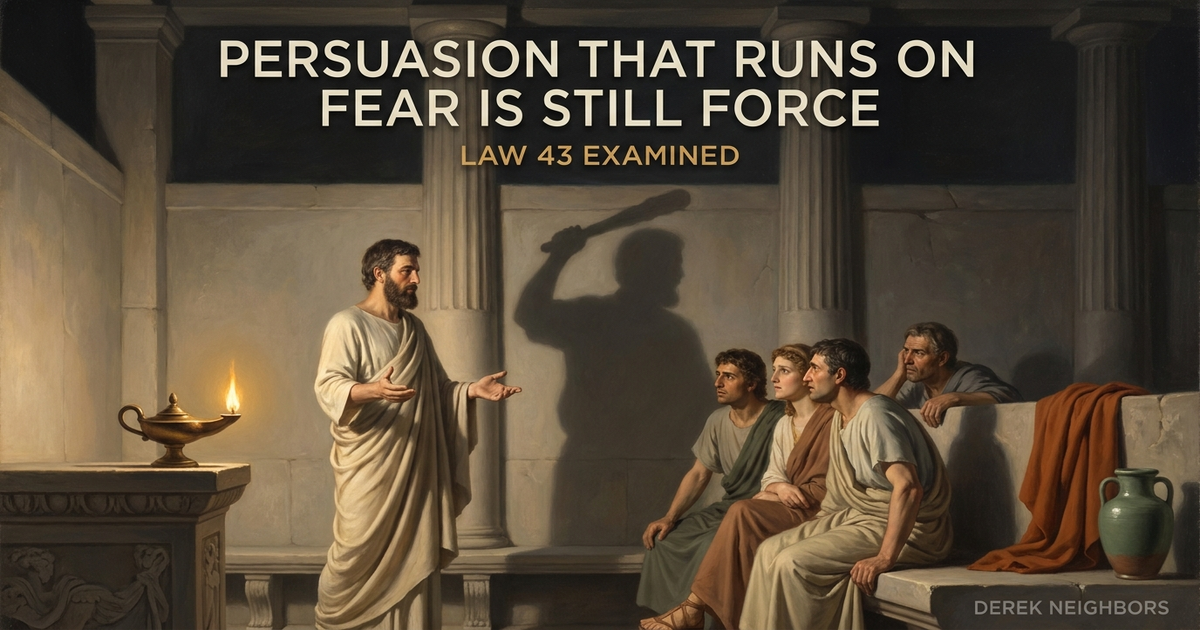
Persuasion That Runs on Fear Is Still Force
By Derek Neighbors on October 26, 2026
Power vs. Virtue: The 48 Laws Examined
A year-long examination of Robert Greene's 48 Laws of Power through the lens of ancient virtue ethics. Some laws we affirm, some we reframe, some we reject entirely.
Law 42 was about removing the one person a team follows. Law 43 of the 48 Laws of Power, Work on the Hearts and Minds of Others, is about getting the whole team to follow you, and it sounds like the kindest law in the book.
Greene’s advice here is to stop forcing people. That part is good advice, and most leaders could use more of it. The trouble is in what he tells you to do instead, because one of the tools he hands you is the other person’s fear. I think a yes you get that way is still taken from the person, and they usually figure that out.
The Law: Work on the Hearts and Minds of Others
Law 43: “Work on the Hearts and Minds of Others.”
Greene’s judgment runs like this. Coercion creates a reaction that will eventually work against you. So instead of forcing people, seduce them into wanting to move in your direction. A person you have seduced becomes a loyal pawn. The way to do it is to work on each person’s psychology and weak points. Soften the ones who resist by working on their emotions, on what they love and what they fear. Show people how your plan serves their interest. Ignore their hearts and minds and they will come to hate you.
The phrase itself is older than Greene. The modern use is usually credited to Gerald Templer, the British high commissioner in Malaya in the early 1950s, who said the war would be won in the hearts and minds of the people and not by sending more troops into the jungle. American officials picked up the phrase in Vietnam, where it came to be used for programs that many people on the ground saw as propaganda. The phrase has meant both of those things ever since, and Greene’s law contains both.
The Tactical Truth
Force makes enemies, and Greene is right about it.
Most leaders have watched a mandate fail. A memo goes out saying every engineer will use the new AI tools, and usage will be part of the performance review. Usage goes up. So does the number of engineers who open the tool, ask it something trivial, and close it so the dashboard counts them. The people you forced do the minimum, and they remember who forced them. I have seen more AI rollouts die this way than any other.
He is also right about self-interest. The fastest way to get someone to try something is to show them how it helps them, and the strongest version is to show them on their own work. People work harder for a thing they chose than for a thing they were handed. And emotion is part of how anyone decides. A leader who thinks a good spreadsheet should be enough has never watched a good spreadsheet lose to a story about a customer.
The Greeks knew the two options well. They had a goddess of persuasion, peitho, and they set her against Bia, force. Herodotus tells of Themistocles, after the great sea victory at Salamis, sailing to the island of Andros to collect money. He told the islanders that Athens had come with two great gods, Persuasion and Compulsion, so they had better pay. The Andrians answered that their island had two useless gods of its own, Poverty and Helplessness, so they could not. Athens laid siege to the island.
Notice what Themistocles brought with him. He came with Persuasion, and he brought Compulsion in the same ship, in case she was not enough. Greene’s law asks you to leave Compulsion on the dock, which is an improvement. The trouble is what he loads on in her place.
So keep two lists apart. Whether a person says yes belongs to them. Whether you gave them true reasons, emotions that fit the facts, and a real way to say no belongs to you. Greene’s law puts its effort into the yes and almost none into the second list.
The Character Cost
Start with the act, before any of the costs. Getting a yes by working on a fear or a weakness the person would object to if they saw it treats their judgment as an obstacle to get around. They believe they made the call, when you made it for them, and that is wrong even if they never find out and even if what you wanted from them was good.
There is a simple test for it. Imagine the person reads your notes on how to bring them around. Would they feel understood, or handled? “She cares about the customers in Europe, so lead with the latency numbers” reads as understanding. “He is scared of looking behind the other leads, so mention that two of them already signed on” reads as handling, and he would be right to be angry. The two signatures may be real. The trouble is that you picked that fact to hit his fear of looking behind, when it should be there to help him judge. The honest version tells him why the two leads signed on and lets him decide whether their reasons apply to his team. I made a related point about leading someone out of denial: the moves that last are the ones you could make out loud.
The first cost is that Greene’s seduction is force by another road, and an early teacher of persuasion said so. Gorgias, one of the most famous speech teachers of fifth-century Greece, wrote a short defense of Helen of Troy as a showpiece. One of his arguments is that if Helen was persuaded to go with Paris, she is not to blame, because speech is a powerful master. He says words work on the soul the way drugs work on the body, and a person persuaded that way was compelled. Gorgias meant it as praise for his own craft, and it reads better as a warning. When persuasion works on a fear the person cannot see, it takes the choice away the same way force does, and nobody sees it happen. And the reaction Greene wanted to avoid arrives anyway. It arrives later, when people work out what was done to them, and it is often bigger, because they feel stupid as well as pushed.
Second, a yes that runs on fear lasts as long as the fear. The AI rollout shows this better than anything. “Adopt it or get left behind” works for a few weeks in the rollouts I have watched. Usage spikes, everyone is anxious, and then the anxiety fades because nobody got fired, and usage sinks back to where it started. Nobody on the team saw the tool help them, so there was nothing holding the habit in place once the fear wore off. You spent your credibility on a scare and got a few weeks.
Third, Greene’s word for the result is pawn, and a pawn cannot tell you that you are wrong. If you brought someone around by working on what they fear, you never heard their actual objection. You went around it. The objection was often the most useful thing they had. The senior engineer who resisted the migration might have known about the three services that would break. You softened her up instead of asking, and you will meet those three services in production.
Fourth, the room learns your method. A leader who works on people’s fears teaches the team that this is how influence works here. Soon your directs are working on you: flattering your pet project in the planning doc, timing bad news for when you are in a good mood, mentioning what the CEO thinks when they want something from you. I wrote about where that leads in Law 33. A team where everyone is working on everyone has no honest conversations left in it, and you built it.
Fifth, you stop hearing people. After a few years of this, every conversation turns into a search for the lever. Someone tells you about a problem and you listen for the fear underneath it instead of the problem. You also lose the ability to be persuaded yourself, because you assume anyone making a case to you is working you the same way. A leader who cannot be moved by a good reason has lost half of what it means to be reasonable, and that is a smaller life whether or not it ever costs you a deal.
The ARETE Alternative
The Greeks treated persuasion as the alternative to violence, and they put it on stage.
The last play in Aeschylus’s Oresteia, the Eumenides, ends with the Furies, ancient goddesses of vengeance, furious at losing a trial in Athens. They threaten to poison the city’s soil. Athena, who presided at the trial, mentions that she is the only god who knows where Zeus keeps his thunderbolt, and then says there is no need for it. Instead she offers them something real: a home under the city, honor from its citizens, and a part in its future. She keeps offering, patiently, until they accept. When it is over she thanks Persuasion for watching over her words. She won them over with a true offer, and the offer was good for them.
Aristotle wrote the manual for doing this honestly. In the Rhetoric he says a speaker persuades in three ways: through the speaker’s character, which the Greeks called ethos; through putting the audience in the right frame of mind; and through the argument itself. Emotion is on the list, with a condition. In Book I he criticizes the handbook writers of his day, who taught little besides how to stir up anger and pity that had nothing to do with the matter. Emotion that fits the case is part of persuading, and emotion stirred up apart from the case is what he objects to.
He also says why audiences trust a speaker. People believe a speaker who shows practical wisdom, phronesis; good character, arete; and goodwill toward them, eunoia. Goodwill is the one Greene’s law cannot fake for long. A team can tell whether a leader wants good things for them or only wants something out of them, and it usually works that out sooner than the leader expects.
Aristotle’s definitions of the emotions give you the line between honest emotion and a lever. Fear, he says, is pain at the picture of a destructive evil that is close at hand. That definition has facts in it. If the danger is real and near, making people feel it is part of telling the truth. If you invented the danger, or made it bigger than it is, or pointed at a danger that has nothing to do with your plan, you are pulling a lever. Fear sized to what you want from them, instead of to the facts, is the thing Gorgias described.
Self-interest works the same way. Greene is right that it works, and nothing about it is shameful when it is true and said out loud. “This will cut your on-call pages in half” is a fine reason to give someone, if it will.
Put together, honest persuasion gives people true reasons and the emotions the facts warrant, leaves them a real way to say no, and uses nothing they would object to if they saw what you were doing.
At work, that comes down to five habits.
Give the reason you would give if they could check everything. Before you pitch, write down the real reason you want this. If it is different from the reason in your pitch, fix the pitch. People can usually smell the gap, and when they cannot, they find out later. And if the true reasons do not persuade anyone, look at the plan before you look for a better pitch. A plan that needs a lever to get through the room may not deserve to get through it.
Match the emotion to the facts, with the number. If the risk is real, say how real. “The certificate expires in nine days and we have no rotation” is a fear worth feeling. “Things could get really bad if we don’t act” with nothing behind it is a lever, and your team has heard it before.
Show it on their work. This is how I bring engineers around to agents now, and it has replaced every slide I used to use. Sit with them, open their repo, pick the oldest ticket in their backlog, and let them drive Claude through it. You do not need a fear campaign, because the model’s work is that good. Twenty minutes on their own code does what a quarter of mandates never did, and the yes belongs to them.
Ask the model what your pitch is doing. Before an announcement goes out, I paste it into Claude and ask which lines work on fear, vanity, or wanting to belong instead of giving a reason. It has no stake in my plan and no interest in my feelings. If it flags a line and I would be embarrassed to explain that line to the person reading it, the line comes out.
Leave a real no, and ask what would change their mind. If saying no carries a cost you are hiding, you are not asking. Ask the person who resists what they would need to see. Sometimes the answer is evidence you can get. Sometimes it is the objection you needed, the one that saves you from the three broken services.
None of this depends on rank. The staff engineer pitching a migration by telling the team “the other platform group already thinks we’re behind” is following Law 43. So is the new engineering manager who announces an on-call change by hinting that people who complain will look like they are not team players. So is the founder who runs the all-hands on fear about the competition because fear gets the room moving faster than the plan does. The intern who asks for a code review by explaining exactly what they are unsure about is persuading the way Aristotle described.
If you are the one being worked on, Gorgias’s excuse does not cover you either. A leader who plays on your fear explains why you said yes, and it does not make the yes someone else’s. Your agreement is the one thing in that meeting that is fully yours. When you feel the push, ask for the reason. If there is no reason under the fear, say no, or say you need a day to think.
Ancient Wisdom: the drug, the thunderbolt, and the two gods
Gorgias’s Encomium of Helen is a few pages long and worth reading in one sitting. It is one of the earliest accounts of what speech does to a person, and it says outright that persuasion can work the way compulsion does. Every leader who has ever been praised for being persuasive should read it once and ask which kind they were.
Aeschylus’s Eumenides is the counterweight. Athena has the thunderbolt and does not use it, and her persuasion works because her offer is real. The Furies end the play as protectors of the city they came to destroy, and they are better off for it.
Herodotus, Book VIII, chapter 111, has Themistocles at Andros. It is the clearest picture of the two gods traveling together, and of what happens when the people you are working on have nothing left to be persuaded with.
Aristotle’s Rhetoric, Book I, chapter 2, names the three ways to persuade. Book II, chapter 1, explains why audiences trust a speaker: practical wisdom, good character, and goodwill. Book II, chapter 5, defines fear by the danger that should produce it, which is the most practical tool I know for checking whether your own pitch is honest.
Side by side, for a leader who needs a team to change course:
| Greene’s seduction | Honest persuasion | |
|---|---|---|
| What moves them | Their fears and weak points | Reasons, and emotions that fit the facts |
| Self-interest | Used as a lever | Named out loud, when it is true |
| Their objection | Softened and gone around | Asked for and answered |
| How long the yes lasts | As long as the feeling | As long as the reasons hold |
| What the team learns | Influence means working on people | Influence means making a good case |
The Test
Think of the last time you needed your team to accept something they did not want. What did you lead with?
If the people you were persuading read your notes on how to bring them around, would they feel understood, or handled?
Was the fear you used sized to the facts, or to what you wanted from them?
Did anyone who said no get a real hearing, and do you know what their objection was?
And the one that decides: if the fear went away tomorrow, would the reason you gave them still stand? If it would not, you got compliance, and compliance ends when the feeling does.
Final Thoughts
Greene is right that force makes enemies, right that people work harder for what they chose, and right that showing someone their own interest moves them. His mistake is in the toolkit. Working on what people fear, without their seeing it, takes the choice from them as surely as force does. Gorgias said so himself. The yes lasts as long as the fear, the objection you needed never reaches you, the team learns to work on you, and you lose the habit of hearing anyone.
Athena had the thunderbolt and made a true offer instead. Aristotle wrote down how it is done: be the kind of person worth trusting, give reasons people could check, and make them feel what the facts warrant and nothing more. A yes won that way rests on reasons the person can check, and it does not depend on how they feel next week.
Law 44 is next, and it is about the mirror effect.
Moving a team by giving it true reasons and a real offer, and leaving the levers alone, is part of the craft. That is what MasteryLab is for.