What You Own Is Not a Verdict on Who You Are
By Derek Neighbors on October 25, 2026
In AD 58, a Roman senator named Publius Suillius stood up and asked a question that still stings. By what wisdom, by what rules of philosophy, had Seneca gathered 300 million sesterces in four years of friendship with the emperor?
Tacitus records the attack in the Annals. Suillius had his own reasons to hate Seneca, and he threw in worse charges about wills and loans. The core question was fair, though. Seneca wrote that wealth does not make anyone good, and he was one of the richest men in Rome.
Most people read the story as a gotcha. I read it as a mirror, because I have made the same mistake from both ends.
In my thirties I drove a twenty-year-old Toyota 4Runner on purpose, and I liked what it said about me. In my forties, after the kids graduated and the economy turned, I refilled. More cars, rounds of remodels, and a story that I had earned it. In some ways I had.
Looking back, the two phases had the same flaw. In both of them I read my stuff as a grade on my character: “disciplined” when I had less, “successful” when I had more, and neither grade measured anything about me.
How much you own is a fact about your property. It says nothing about whether you are a good person, and having less does not make you better any more than having more does. That holds whether you chose to have less or a bad year chose it for you. Having less never lowers anyone.
By character I mean the settled way you choose when choosing costs something, such as whether you tell the truth or treat people fairly when it hurts you.
The Pattern: Treating Net Worth as Self-Worth
We size people up by the car in the parking lot or by their comp on levels.fyi. We do it hardest to ourselves, usually without saying a word out loud.
Epictetus caught the bad logic in a few lines. In chapter 44 of the Enchiridion, he says the sentence “I am richer than you, therefore I am better than you” does not follow. What does follow is “I am richer than you, therefore my property is greater than yours.” Then he closes it: you are neither your property nor your speech.
The Stoics had a precise way to talk about what money does have. They put wealth, health, and reputation among the adiaphora, the indifferents, which are neither good nor bad in themselves. I wrote about how that idea fixes the word “sacrifice” last month. Some indifferents are “preferred,” which means it is sensible to pick them when they are on offer. A preferred thing carries axia, the Greek word for value or worth, meaning the weight a thing deserves when you choose between options.
So money has worth of a narrow kind. It can decide whether you have a roof over your head, and it has no vote on whether you are honest.
Ask most people and they will tell you net worth and self-worth are different things. Then they check the car.
The Avoidance Patterns
Reading property as rank lets us skip the harder questions about character. It shows up in four common forms.
The Earned-It Story
The behavior: A good year turns into a purchase, and the purchase turns into proof. The bonus becomes the car, and the exit becomes the identity.
At work: A founder sells a company, and for the next decade every room treats their opinion on any subject as settled. They start to believe it too.
What it avoids: The one question money cannot answer, which is whether you got any better as a person during the years you got richer.
The truth: Getting paid more and becoming a better person are separate events, and only the first one happens without your attention.
The Medal for Less
The behavior: Owning less becomes its own scoreboard. You mention the old laptop and the folding-table desk. You notice who has more and feel a small, warm superiority.
At work: The founder who brings up their cheap office in every podcast, as if the rent were a reference.
What it avoids: Admitting you picked a second scoreboard and called it freedom.
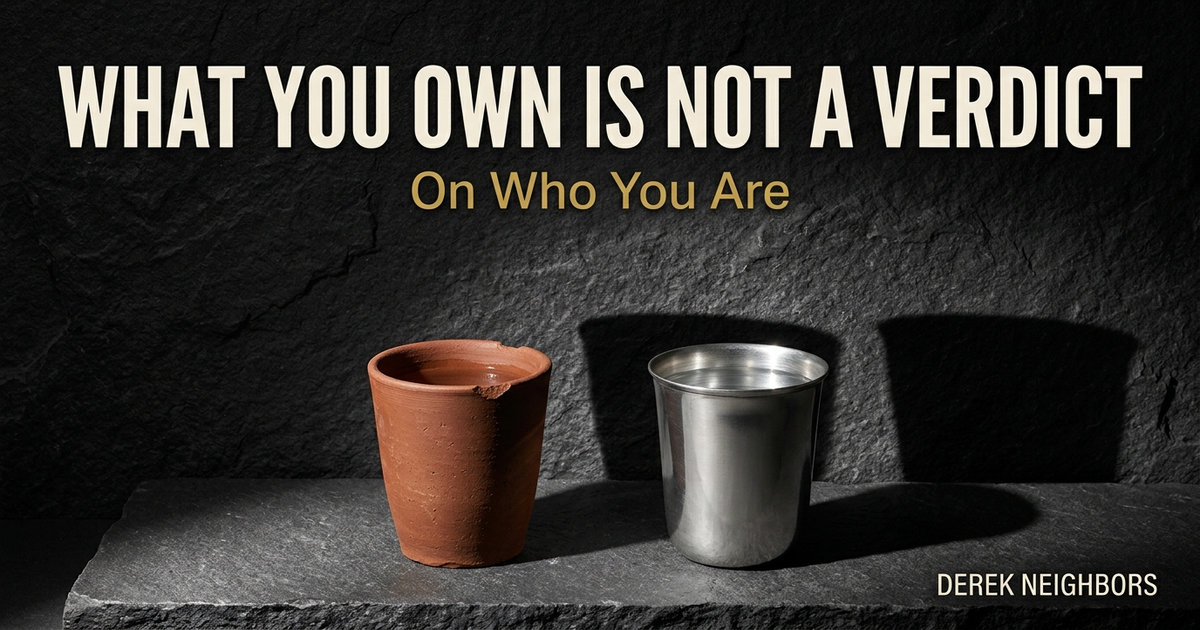
The ancient answer: Seneca saw this coming. In Letter 5 he tells his friend Lucilius not to court attention with rough clothes, uncut hair, a bed on the ground, or a public show of refusing silver plate. Philosophy asks for plain living, he says, not penance. Then the line I keep coming back to: “He is a great man who uses earthenware as if it were silver, and he is no less great who uses silver as if it were earthenware.”
The Parking-Lot Read
The behavior: Ranking other people by their stuff, in either direction. The expensive watch must mean shallow, and the old truck must mean struggling, or wise.
At work: A hiring panel treats a candidate’s last comp and the logo on their résumé as evidence of judgment. A big number from a big company tells you a market once paid them well, and that is all it tells you about what they do when a deadline and the truth collide.
What it avoids: The slower work of watching how someone behaves. Envy is one version of this habit, and it costs more than people think. Contempt is the other.
The Skipped Question of How
The behavior: Caring how much, and never asking how.
At work: A deal closes on a roadmap slide the seller knew was fiction, or a manager hits a bonus by gaming the metric it was tied to. Both make the number go up, and both say something real about the person who did it.
What it avoids: The only part of money that does carry moral weight. When pay becomes the main lever, people stop thinking about the work and start thinking about the number, and “how” drops out of the conversation.
The ancient answer: Seneca’s reply to his critics, in On the Happy Life, lands right here. Many scholars read the dialogue as his answer to attacks like the one from Suillius. He writes that no one has condemned wisdom to poverty. A philosopher may own a great deal, as long as the wealth was taken from no one, stained with no one’s blood, and gained without wronging anyone.
What Actually Works
Your money says something about you in exactly two places: how you got it, and how you hold it. Everything else is a fact about your property.
The reason is control. How much you end up with often depends on markets, timing, inheritance, and luck. How you got it and how you hold it are your choices, and your choices are the only part of the money that belongs to your character.
Seneca put the holding part in one sentence in On the Happy Life: the wise man takes riches into his house, not into his soul. A few lines later he adds that riches are a slave to the wise and a master to the fool.
Whether Seneca lived up to that is a fair fight, and historians are still having it. His standard holds either way. A doctor who smokes can still be right about lungs.
Aristotle would push back on the Stoics here. He held that a good life needs some outside goods, since you cannot be generous with nothing to give. His objection makes the holding test stronger: what money reveals is whether you use it the way a good person would.
I got a clearer view of this coming back to a smaller life in my late forties, with my wife as the anchor. She is a more disciplined minimalist than I am. Somewhere in that return my question changed. I stopped asking what a thing said about me and started asking how it got here and whether I could let it go.
That shift turned into four practices.
1. Finish the Sentence Honestly
When you catch yourself thinking “I have more than they do, so…” or “I need less than they do, so…”, finish the sentence the way Epictetus did. “…so my property is bigger.” “…so my property is smaller.” It sounds a little silly, which helps, because your mind was about to hand you a verdict it had no evidence for.
2. Audit the Getting
Pick the biggest thing you earned or bought this year, whether a raise, a bonus, a house, or a deal, and ask three questions:
- Did anyone pay a cost for this that they did not agree to?
- Did I shade the truth anywhere to get it?
- Would I be comfortable if the people involved saw exactly how it happened?
If all three answers are clean, enjoy it without apology. If one is not, you have found the part of your money that says something about you.
3. Test the Holding
Ask what you would have to stop believing about yourself if the thing went away tomorrow. If losing the title, the car, or the savings would make you feel like a smaller person, your judgment has carried the thing from your house into your soul, and it has started to run you. Losing it can cost you a lot of comfort, and it costs you character only if you had already decided it was part of who you are.
The same test works for minimalists. If someone handed you a nice car and you felt your identity shake, the lack of a car had moved in too.
4. Read People by Their Choices
In hiring and promotion, ask about the hardest call the person made with money on the line and what they turned down, then watch how they treat someone who can do nothing for them. Those answers tell you who you are hiring.
Diagnostic Questions
- When you feel proud of something you own, or something you chose not to own, who are you comparing yourself to?
- Which purchase in the last five years did you treat as proof that you had made it?
- What is one way you made money that you would not want explained in detail to the people affected?
- If your net worth dropped by half next year, what story about yourself would break?
- When you sized up the last person you met, how much of the judgment came from what they owned?
Final Thoughts
Suillius asked a good question with a bad assumption under it. A fortune that size is a fair reason to ask how it was made. He treated the size as the scandal, though, and the answer was always going to sit in how Seneca got it and whether it owned him. You can put both questions to yourself.
The car, the comp band, the old truck, and the folding-table desk all describe your property. Your character shows up in how the money came in, what it cost other people, and how easily you could let it go. Spend your attention there.
If you want to build a career and a life judged by who you are becoming, alongside people doing the same work, MasteryLab is where that work happens.
FAQ
Does having more money make you a better person?
No. Epictetus put it simply in the Enchiridion: “I am richer than you, therefore I am better than you” does not follow. All that follows is that your property is bigger. Money tells you something about a person only through how they got it and how they hold it.
Was Seneca a hypocrite about money?
His critics thought so. Tacitus records the senator Publius Suillius asking how Seneca, a Stoic, had gathered 300 million sesterces in four years at Nero’s court. Seneca’s answer in On the Happy Life is that a wise person may own wealth as long as it is taken from no one and held loosely. Whether his own life met that standard is a fair question. The standard itself holds up.
What are preferred indifferents in Stoicism?
The Stoics called things like wealth, health, and reputation indifferents, or adiaphora, because they are neither good nor bad in themselves. Some are preferred, which means it is reasonable to choose them when you can. They carry value that guides choice, which the Stoics called axia, but they never make a person good or bad.
Does minimalism make you a better person?
Not by itself. Owning less can free up time, money, and attention, which is a real benefit. It becomes the same mistake as pride in wealth when you treat it as proof of character. Seneca told his friend Lucilius to live plainly without making a show of it, because philosophy asks for simple living, not penance.