You Optimized Away Everything Worth Doing
By Derek Neighbors on September 5, 2026
The point of golf is to get the ball into the hole. Anyone can walk over and drop it in. Golf exists because you agreed to stand far away and use a stick. Take that rule out and you have not made golf efficient. You have deleted golf.
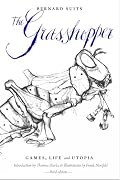
Bernard Suits put that example at the center of The Grasshopper, and then he did something most philosophers of play never manage. He gave a definition that holds. Playing a game is the voluntary attempt to overcome unnecessary obstacles. The rules make the goal harder to reach, and you accept them because without them the activity does not exist. He called that acceptance the lusory attitude.
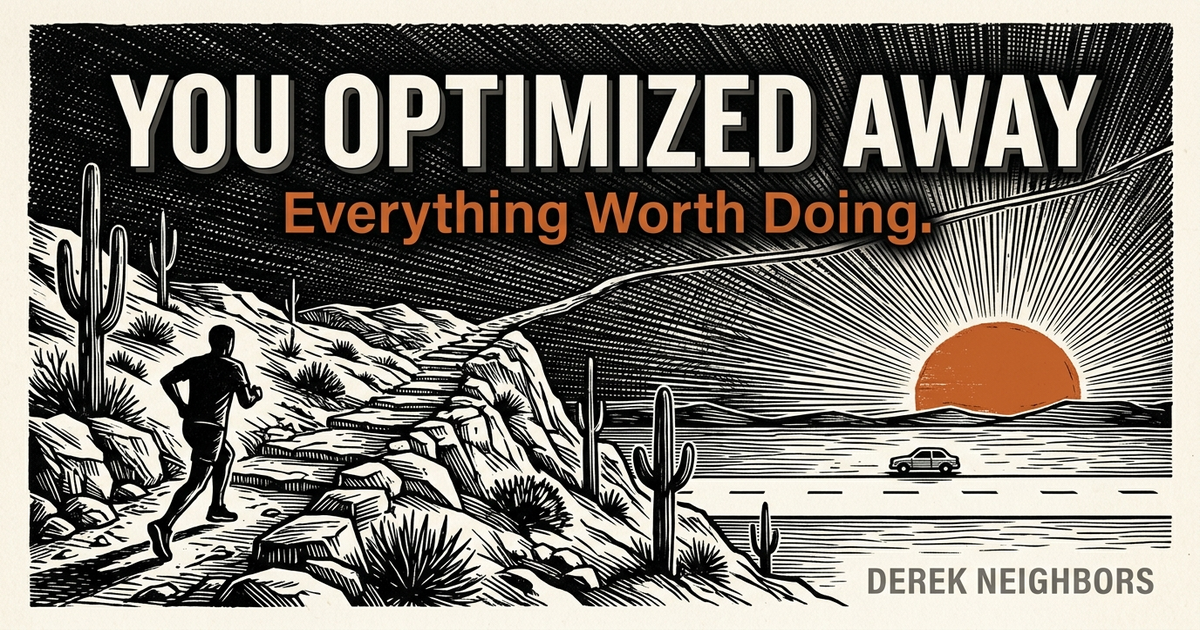
I run in the desert most mornings. Nobody needs me to. A car is parked forty feet from where I start, and it would get me to the far end of the trail in eleven minutes. I take two hours instead. The point of the run only exists because I refuse the car. Remove that refusal and there is no run, only a slow commute to nowhere.
Which brings me to two people who look the same from the outside. Both are disciplined, both work hard, and both get a lot done. One of them spends the day removing every obstacle they can find. The other spends part of the day choosing obstacles on purpose. Ten years in, they are not the same person, and only one of them has a life worth living.
Path A: The Optimized Life
Path A treats every obstacle as a defect. Find the shortest route to every outcome, automate what can be automated, and delegate the rest. Efficiency gets mistaken for wisdom, and the mistake is easy, because inside necessary work the two agree. Speed is the tell of a serious adult.
People choose it because it works, and it works because most of life is necessary work. The migration has to run. Payroll has to go out. The deploy has to ship and the bills have to be paid. Removing obstacles from necessary work is the job, and anyone who chooses an unnecessary obstacle in the middle of a production incident should be walked out of the building. I have no argument with Path A inside that territory.
The mistake is applying the same rule to everything.
You get faster at things that end. You lose every activity that only exists because of its constraint. Chess with an engine open in the next tab is not chess. A hike with a helicopter is a transfer. A codebase where the agent writes every line and you never once set yourself a rule, not even “I will do this one function without looking anything up,” is a codebase you no longer know. Path A cannot see the difference between these and the tax return, because Path A has one question, “how do I make this faster,” and that question gives the wrong answer whenever the slowness was the point.
Aristotle was suspicious of play. The Greek word is paidia, amusement, from the word for child. In the Nicomachean Ethics he argues that the good life cannot consist in paidia, because amusement is what we do to rest so we can work again, and it would be strange if the whole point of a life were a rest break. Path A agrees completely. It allows play only in that form: the weekend, the vacation, the thing you do to recover for Monday. Play recharges work, and work is the real thing.
Suits noticed where this leads. Work, he wrote, can be a ruse for avoiding ideals. The person who is always busy never has to answer what they would do if the necessary work were finished. “I would love to, but I am slammed” is a sentence that never runs out, and it protects you from ever finding out whether you have anything you would do for its own sake. Path A is the right tool for a year you have to survive. The trouble starts when the year is survived and the person keeps living as though it is not.
Path B: The Lusory Life
Path B keeps the necessary work efficient, and then deliberately chooses obstacles that make an activity worth doing on its own terms. The obstacle is what makes the thing a thing, and it was never a training load.
For me that is the desert run when a road exists. It is writing a post every day under rules a prompt would ignore: no em dashes, plain sentences, a Greek term only when it earns the line. It is building a feature by hand on a Saturday, agent closed, to find out whether I still can. Years ago, on teams I was part of, we shipped something every single week whether or not anyone had asked for it, and the rule produced more craft than any process document we ever wrote, because a rule you chose is a rule you defend.
agon is the Greek word for a contest: a chosen obstacle, with rules, in front of witnesses, and nothing about it was childish to the Greeks. Nobody needs to enter the race. That is exactly why entering counts. I wrote before about struggle as the signal that you are in the arena. This piece is about building the arena on purpose.
Path B costs time that could have been optimized. It looks irrational from inside Path A, and inside Path A’s rules it is. You could drive, or prompt, or let the framework generate the boilerplate and spend the Saturday on something with a return. What Path B gets in exchange is the only kind of activity that does not end when the outcome arrives.
Path B has its own failure, and I have committed it. The chosen obstacle turns back into a ledger. The run becomes a pace chart, the daily post a streak counter, the Saturday build a portfolio entry. The constraint stops being the game and becomes one more thing to optimize, and you are back on Path A without noticing you turned around. The test is whether you would keep doing it with no number attached. If the honest answer is no, you turned the game into a job and should admit it.
Path B pays off most for the person who has handled the necessary and does not want to spend the rest of life handling it again on a bigger screen. It is open to anyone who will hold one standard nobody required.
What Both Paths Share
Both are disciplined and exhausting, both produce a good resume, and from across the office you cannot tell them apart.
The shared failure is confusing where each belongs. Path A applied to necessary work is competence. Path A applied to everything is a life with no games left in it. Path B that slows necessary work is sabotage, and nobody wants a surgeon who chose an unnecessary obstacle mid-operation. The same surgeon can close cleaner than the checklist requires, and that is a chosen obstacle too. Inside required work the rule is simple: a constraint you pick has to exceed the required outcome, never fall short of it. Think of the commit message nobody reads, or the test you wrote for the case nobody filed. Nobody would notice if you dropped them, which is what makes them yours, and it is why the lusory attitude does not wait for a free afternoon. The afternoon only makes it visible. Path B applied to what remains after the necessary is done is the good life, and almost nobody applies it there, because by the time the necessary is done they have forgotten how to choose an obstacle they were not forced to accept.
| Path A: the optimized life | Path B: the lusory life | |
|---|---|---|
| Treats an obstacle as | A defect to remove | The thing that makes the activity exist |
| Applied to necessary work | Competence | Sabotage, unless the constraint exceeds the required outcome |
| Applied to what remains | A life with no games left | The good life |
| The activity ends when | The outcome arrives | You stop choosing it |
| Its failure mode | Optimizing everything, then facing a void | Turning the game into a ledger |
The inbox piece on this site is about refusing to save depth for after the work is done. This one is about what depth is made of once you refuse.
The Real Difference
Suits ends The Grasshopper with a thought experiment. Imagine every piece of necessary work done. Food, shelter, medicine, the deploy, all handled, forever. What is left to do?
His answer is games. Chosen obstacles, pursued for their own sake, would be the entire content of the good life. Everything else was scaffolding you climbed to get there. The part of life you spent optimizing was never the destination. It was the road you drove to reach the trailhead.
Aristotle got to the same place by a different route. schole is leisure, the activity we work in order to have, and Aristotle is careful that it means neither amusement nor rest. In the Politics he says plainly that we are busy so that we may have leisure, the way we fight wars so that we may have peace. The word became schola in Latin and school in English, which tells you what the Greeks thought leisure was for. Suits’s utopia and Aristotle’s schole share a shape: activity done for its own sake, complete while you are inside it. Aristotle would rank the philosopher’s contemplation above any game, and he would be right to ask what the game exercises. The shape is what this essay needs.
One more distinction does the work here. Aristotle separated activities that are complete at every moment you are doing them, which he called energeia, from movements that are only complete when they end. Seeing is complete while you see. Building a house is not complete until the house stands. A game is energeia: you are fully inside it at every point. An optimized task is the other thing, a movement toward being finished. Path A produces tasks, and Path B produces the activities you can be fully inside of, which are the hours people describe when you ask about the best work of their lives. Csikszentmihalyi built a research career on that pattern.
Plato was blunter than either. In the Laws he says a human being is made as a plaything of the gods and should spend life playing the noblest games, and in the same book he insists that education happens through play. To Plato and Aristotle both, the childish life was the one with no chosen games in it.
None of that depends on what happens next. A person chooses obstacles because that is what a free will is for, and the choice would be right if the agents stalled tomorrow. What has changed is the timing. The necessary work is shrinking faster than any generation has seen. Agents delete obstacles nobody chose, by the thousand. The boilerplate, the first draft, the migration script, the status report, the research pass: gone, or going. Suits’s thought experiment is arriving on a schedule, and it is arriving first for the people who build software.
Path A people are about to find that their master skill, removing obstacles, has no object left, and that they have never once chosen an obstacle in their lives. The free time will arrive as a void, and they will fill it with more optimization of smaller things. Path B people already know what they will do with a Tuesday nobody needs from them. They played on Saturdays because the game was worth it, and readiness was the leftover.
The sorting question is this. Does the activity exist because of the constraint, or in spite of it? Golf exists because of the stick. The tax return exists in spite of the forms. Optimize the second without mercy and protect the first the same way.
Two more filters keep that test honest. The constraint has to be one you chose and could drop tomorrow without anyone else objecting. Gravity is not a chosen obstacle, and neither is your manager’s process. The stick is. And the obstacle has to exercise something in you worth having, on something worth attention. Counting cracks in the pavement for two hours is a chosen obstacle, and Plato would not call it a noble game. Worth doing, in this essay, means exactly that: an activity complete while you are inside it, that you would keep with no number attached, and that makes you more of what a person can be.
How You Practice
Sort the week into necessary and chosen. The necessary gets every optimization you can find, including the agent. The chosen gets rules you agreed to and will not renegotiate on a tired day.
Name one obstacle you refuse to remove, and say why out loud. The run without the car. The post without the prompt. The feature without the framework. A rule you can state is a rule. A rule you cannot state is a lapse waiting for an excuse.
Watch for ledger creep. The moment a chosen obstacle acquires a score you are optimizing, ask whether you would keep doing it without the score. If not, the game has become a job, and you can either return it to a game or stop pretending.
Give your team a chosen obstacle. A weekly demo nobody required. A rule that every new engineer ships to production on day two. A constraint the team picked is how a team practices caring about the work instead of the ticket, and it is the only kind of constraint people defend when the manager is not in the room.
Practice for the day the necessary is gone. It is closer than it looks. Make sure you have a game before then, because you cannot pick one up on the day the work disappears any more than you can learn to swim on the day the boat sinks.
Path A will call all of this irrational. Inside Path A’s rules, it is. That is the point of a rule you chose.
Final Thoughts
The good life has the right obstacles in it, chosen, with rules, for their own sake, and it rarely has the fewest. You can drive to the end of the trail. You will arrive faster and you will have done nothing.
What arete names is the person who can tell those two apart, keeps the road for the errands, and picks up the stick.
If you want a room full of people who chose their obstacles and kept them, MasteryLab is where the necessary work stays efficient and the rest of the week stays a game.
FAQ
What is the lusory attitude?
The lusory attitude is Bernard Suits’s name for the state of mind that makes a game possible. You accept rules that make the goal harder to reach because the rules are what make the activity exist. Playing a game, in his definition, is the voluntary attempt to overcome unnecessary obstacles. Golf players agree to use a club from a distance instead of dropping the ball in by hand, not despite the difficulty but because the difficulty is the game.
What does paidia mean in Greek philosophy?
paidia is play or amusement, from pais, child. Aristotle argued in the Nicomachean Ethics that the good life cannot consist in paidia, because amusement exists to rest us so we can work again. Plato in the Laws took play more seriously, arguing that humans should spend life playing the noblest games and that education happens through play. The gap between them is the gap between play as a recharge for work and chosen striving done for its own sake.
What is the difference between schole and paidia?
paidia is amusement that refreshes you for work. schole is leisure in the Greek sense: the activity you work in order to have, done for its own sake, and the root of the word school. Aristotle says we are busy so that we may have leisure, and that leisure is neither work nor rest. Suits’s lusory attitude belongs to schole. A chosen obstacle with rules is what Monday was for, and no recharge for it.
Is choosing unnecessary obstacles the same as voluntary hardship?
No. Voluntary hardship is a training load, taken on because it makes you stronger for something else. The lusory attitude chooses an obstacle because the obstacle is what makes the activity worth doing at all. The test: if the difficulty is there to produce a later result, it is training. If removing the difficulty would delete the activity, it is play in Suits’s sense, and it belongs to the part of your life you protect from optimization.