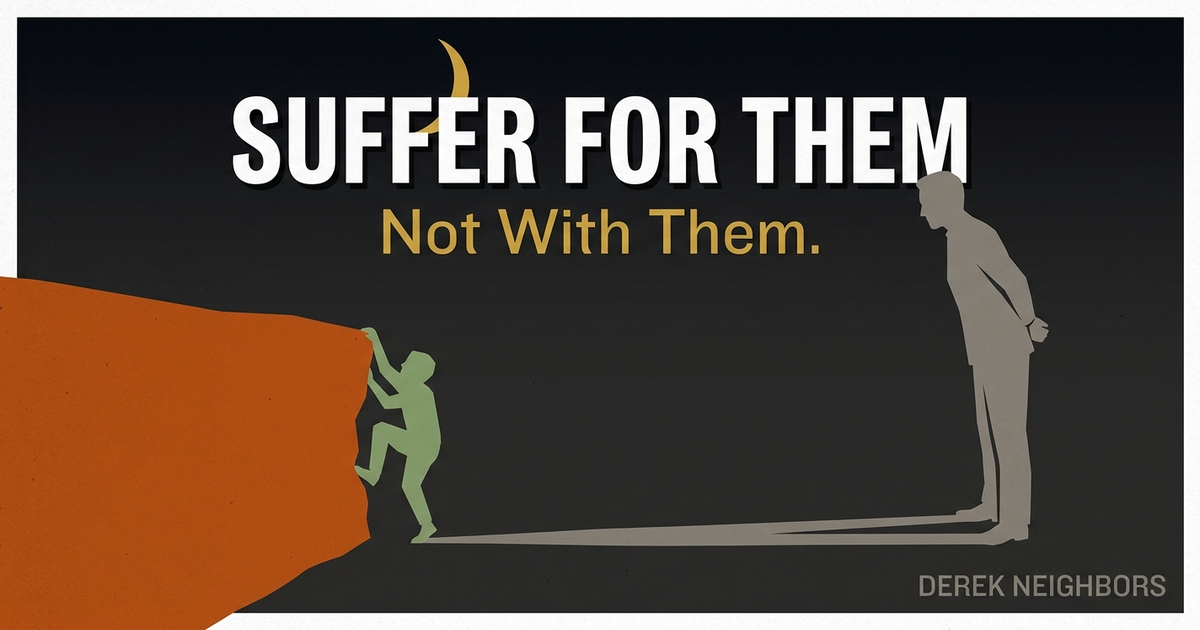
Suffer For Them, Not With Them
By Derek Neighbors on September 4, 2026
Two senior engineers watch the same junior stall on the same ticket. It is a nasty one: a migration that has to run against production data, with a rollback nobody has tested, and the junior has been circling it for two days, opening the file and closing it again.
The first senior takes it. Pulls the ticket onto their own board, knocks it out in an afternoon, tells the junior not to worry about it, and means every word. The junior is relieved, the sprint is saved, and everybody in the room would call this kindness.
The second senior leaves the ticket where it is. Clears their own afternoon. Sits two desks away, answers questions when asked, and lets the junior run the migration, watch it fail on a constraint nobody saw, sweat through the rollback, and run it again. Nobody thanks the second senior. The junior goes home rattled.
From the outside those two moves look like the same amount of care. They are opposites, and the story we tell about compassion has been getting them backwards for a long time.
The belief
Here is the belief, stated plainly enough that you can hear how reasonable it sounds. If you love someone and you have the power to stop their pain, stopping it is what love does. It looks like the parent who emails the teacher, the manager who bumps the rating so the review does not sting, the friend who covers the shortfall this once, the senior who takes the ticket. “I just don’t want them to struggle” is the sentence, and it is said by good people who mean it.
The logic looks airtight. They hurt, you can make it stop, you make it stop. And the world pays you immediately for the move. Gratitude arrives on the spot, the tension in the room drops, and you get to feel like the person you want to be, right now, with no waiting.
That last part is the tell, and it will take the rest of this piece to show why.
What actually happens
Most people have heard the story of the moth in the cocoon, the one where someone finds a moth straining through a tiny opening, decides to help, and snips the silk. The moth crawls out with a swollen body and shriveled wings and never flies. The squeeze through the narrow opening is what forces fluid out of the body and into the wings. The struggle was the formation. Remove it and you have a moth-shaped thing that cannot do the one thing a moth is for.
It is close enough to true as biology, and exactly true as a description of people.
Take the F. A failing grade introduces a sixteen-year-old to themselves in a way no A ever will. They learn what they actually do when a deadline gets close, what they say to themselves the morning after, and whether they get back up on their own or wait for someone to lift them. An A confirms what they already believed about themselves. An F tells them something they did not know, and the only way to get that information is to let the F land. What the F builds has little to do with grades. It builds the part of a person that decides and holds under consequence, judgment and nerve, and the better grade later is only the visible sign that the part exists.
Take the deploy. A junior whose mistakes always get caught upstream never learns what their own carelessness costs. Somebody in review catches it, somebody on call catches it, the migration gets quietly fixed. They ship for three years feeling competent. Then one day it is not caught, and you have a senior with a junior’s instincts and a production outage with their name on it. The rescue postponed the failure to the point where it was expensive.
I spend a lot of hours running long distances in the desert, and the sport is a clean laboratory for this. Nobody can run the miles for you. The crew that loves you most is the one that hands you a bottle at the aid station, tells you that you look terrible, and makes you keep walking. The crew that pulls you into the car at mile sixty because they cannot stand watching you hurt has done something for themselves, and you will know it by morning.
Across all of it, the same tell. Rescue someone from a difficulty that was building them, and they get more rescuable, and never stronger.
What rescuing someone from difficulty actually costs
Start with the question that ruins the myth: who does the rescue actually relieve?
Watching someone you love struggle hurts, whether it is your kid crying over a test, a junior flailing for two days, or a friend’s account going negative. That pain is real and it is yours, and rescue ends it in a single move. The compassion was genuine, and the person it relieved was the rescuer.
The Stoic word for feeling another person’s pain is sympatheia, literally “suffering with.” Marcus Aurelius used it to mean that human beings are woven together, that you cannot harm one part without harming the whole, and that the right response to someone’s difficulty is to stay rather than retreat. He did not mean it as a license to carry their load. To be clear about the title, the “with” this piece rejects is the collapsed modern version, where you feel it and then remove it. The Stoic version, staying present while someone struggles, survives intact inside suffering-for. You keep the staying and drop the removing. The modern move collapses his idea into a single reflex: I feel your pain, so I end your pain, and in ending it I take the thing the pain was building. Suffering-with was never meant to land on a child or a moth as permission to cut the cocoon.
What the rescued person learns is worse than what they failed to learn. They learn that the world bends, that effort is optional because someone else owns the outcome, and that difficulty is a signal to look around for the adult in the room, who is always there. Managers who spare people the honest review run the same experiment at company scale and get the same result, with the bill arriving years later and made out to the person they were protecting.
And it compounds. Each rescue raises the size of the next crisis, because the muscle that would have handled it was never built. An F at sixteen costs a weekend. The same lesson delivered as a firing at thirty-four, with a mortgage and a junior’s instincts, costs a year. The pain was never spared, only moved downstream, where it grew on the way.
What it means to suffer for them
Now the truth the myth was covering.
Suffer for them. Bear a cost on someone’s behalf that they cannot see and would not choose. It looks like the parent who lets the F land and then eats the kid’s anger, the teacher’s email, and the judgment of the other parents at the game. It looks like the manager who leaves the ticket with the junior and takes the delivery heat upstairs personally, in the meeting the junior never hears about, and the friend who says the true thing and loses the evening.
This is harder than rescue for one reason: rescue ends your discomfort in a single move, and suffering for someone extends it. You carry the anxiety of watching, the anger that comes at you for not stepping in, the missed date, the awkward meeting, and the long stretch where they think you were cold. Nobody thanks you for any of it, often for years. The cost lands on you and stays there. That is what the “for” means. Carry it without keeping a ledger. The anxiety of watching is yours to govern, the same way the ticket is theirs, and a steward who feels owed for the discomfort has made the whole thing about themselves again, which is the rescuer’s error arriving later.
Plato’s word for this kind of care is epimeleia. In the Statesman it is the ruler’s work, the attentive tending of a herd, and Socrates uses the same word in the Apology for care of the soul. It names attention that costs the one paying it, and warmth has little to do with it. Stewardship in this sense is chosen hardness on behalf of someone who cannot yet choose it for themselves, and the timing is the whole art. You take it up before the threat arrives. The everyday Greek sense of pronoia, forethought, the care taken ahead of the event, lives here: you train someone in the cold while the stakes are small so that their first hard winter is not their introduction to cold. Teaching them the skill is the front half of the job. Letting the test land is the back half, and most people who do the first refuse the second.
One line keeps this honest, because “let them struggle” can become its own cruelty. Some difficulty forms and some difficulty destroys. The Greeks called the forming kind ponos, the toil that builds what it strains, and they knew the difference between a forge and a fire. The forming kind has three marks: the person can meet it with effort they actually have, the damage if they fail can be recovered from, and the thing being strained is the capacity you want built. A migration that fails with a senior two desks away is a forge, and the same migration with nobody near, on a system that cannot be rolled back, is a fire. Suffering for someone includes stepping in when the thing is destroying them rather than forming them, and holding each case against those three marks is the entire skill. The rule against rescue is a rule against pulling people out of the forge, and it was never a rule about drowning.
If you are the one in the difficulty, the signal reads one way. From the other side of the table it reads like this: the thing you want to end may be the only thing that is working.
And if you are the one who got rescued, all the way up, none of this is an alibi. The absence of a steward is a circumstance, and circumstances do not touch what you owe yourself. An adult can refuse the next rescue. Pick the hard ticket, keep the pager, decline the cover, and take your own F. Nobody has to have suffered for you first.
How to know when to let someone struggle
Four tests, in the order you should run them.
Ask who feels better the moment you step in. Be honest, because the answer is usually you. If the relief is yours, suspect the move. That does not settle it, but it should slow you down.
Ask whether this is the forge or the fire. Name, in one sentence, what this difficulty could build in them if it runs its course. If you can name it, stay out. If you cannot name it, or the honest answer is that it is breaking something that will not heal, step in without apology. Stewardship cuts both ways. Aristotle would call rescue the excess and abandonment the deficiency, with stewardship as the mean between them, and the person who never intervenes is as lazy as the one who always does.
Say out loud what you are not doing and why. Silence reads as abandonment. “I am not going to fix this, and I am going to be here while you do” is a full sentence, and most people have never heard it said to them. It changes the experience from being left to being watched over, and those are different things even when your hands are equally still.
Then take the harder job. Stay close, watch, and keep your hands off it. Absorb what comes downstream: the anger, the email, the missed date, the meeting where you defend a junior’s mistake as the price of having a senior in two years. The second engineer in the opening cleared an afternoon to do nothing visible. That afternoon was the work.
You will be called cold, by them and by the people watching. Gratitude goes to the rescuer on the spot. The steward gets, at best and years later, a person who became what the struggle was building, and sometimes not even that. Do it anyway. The obligation runs to the person in front of you and what they could become, and it holds whether or not they arrive and whether or not anyone ever thanks you.
Final thoughts
The moth needs the cocoon, the kid needs the F, and the junior needs the migration that fails on their watch with someone two desks away who will not let it become fatal. What each of them needs from you is the harder thing: leave their pain where it is, and carry a cost on their behalf that they will not thank you for until they are the person it made.
That person is what arete names, the full form of what someone could be, judgment and nerve that hold under consequence, and nobody arrives there rescued. The people who got there had someone willing to suffer for them and disciplined enough not to suffer with them. Be that. It will cost you exactly what it should.
FAQ
What is the difference between suffering with someone and suffering for them?
Suffering with someone means feeling their pain, and in modern practice it usually slides into ending their pain, which removes the difficulty that was forming them. Suffering for someone means bearing a cost on their behalf that they cannot see and would not choose: staying close, letting the struggle land, and absorbing the anger, the awkward meetings, and the years without thanks. Rescue ends your discomfort in one move. Suffering for someone extends it, which is why it is rarer.
Why is rescuing people from difficulty harmful?
Because the difficulty was doing work. A failing grade, a deploy that breaks, a shortfall covered by the person who caused it: each one introduces someone to what they actually do under pressure and whether they get back up. Rescue removes that information and teaches the person that the world bends and someone else owns the outcome. It also compounds. Each rescue raises the size of the next crisis, because the muscle that would have handled it was never built, so the pain is not spared, only moved downstream where it grows.
How do you know when to let someone struggle and when to step in?
Run two tests. First, ask who feels better the moment you step in. If the relief is mostly yours, suspect the move. Second, check the difficulty against three marks: the person can meet it with effort they actually have, the damage if they fail is recoverable, and it strains the capacity you want built. If all three hold, stay out and stay close. If any fails, or the honest answer is that it is breaking something that will not heal, step in without apology. Some difficulty forms and some destroys, and holding each case against those marks is the entire skill. The rule against rescue is a rule against pulling people out of the forge, never a rule about drowning.
What does sympatheia mean?
sympatheia is Greek for “suffering with” or “feeling together,” from syn (with) and pathos (feeling, suffering). The Stoics, especially Marcus Aurelius, used it to describe the connection of all people, so that harming one part harms the whole and the right response to another person’s difficulty is to stay present rather than retreat. It was never a license to carry someone’s load for them. The modern collapse of “I feel your pain” into “I end your pain” borrows the word and loses the discipline.
If you are trying to be the second engineer, the one who stays close and keeps their hands off the ticket, and you want to do that alongside people holding the same bar, that is what MasteryLab is for.