Thrasytes (θρασύτης): Meaning, Definition & Modern Application
thrah-SOO-tays
Reckless boldness or foolhardy daring. In Aristotle's ethics, the vice of excess in relation to fear, representing courage gone wrong through lack of proper judgment about genuine dangers.
Etymology
Derived from thrasys (bold, daring, audacious), which shares roots with tharseo (to be of good courage). The suffix -tes indicates a quality or state. In early Greek usage, thrasys could carry positive connotations of spirited boldness, but by the classical period, thrasytes had acquired predominantly negative associations with recklessness and presumption.
Deep Analysis
In Aristotle’s Nicomachean Ethics, thrasytes occupies a crucial position in the architecture of virtue as the excess corresponding to courage. While much attention focuses on cowardice as the deficiency, Aristotle recognized that reckless boldness presents an equally dangerous deviation from excellence. The reckless person, he observes, ‘is thought to be a kind of madman or insensible to pain who fears nothing, neither earthquakes nor waves’ (1115b25).
This formulation reveals something essential: thrasytes is not an excess of courage but a corruption of it. The reckless person mimics the external behavior of the brave while lacking the internal disposition that makes courage a virtue. Where the courageous person acts despite fear because reason judges the risk worthwhile, the reckless person acts without appropriate fear because their judgment has failed.
Plato anticipated this analysis in the Laches, where Socrates distinguishes between the foolish daring of one who dives into a well without knowing how to swim and the genuine courage of one who risks danger with knowledge and skill. The dialogue suggests that what appears bold may actually represent intellectual failure. Nicias proposes that courage involves ‘knowledge of what is to be dreaded and what is to be dared,’ a formulation that would make thrasytes a species of ignorance rather than excess energy.
The Stoics developed this insight further. For Seneca, recklessness represents a failure of pronoia (foresight) that leads to catastrophe disguised as action. In his letters to Lucilius, he warns against confusing the restless activity of the disturbed mind with genuine boldness. The truly courageous person acts from settled conviction; the reckless person acts from inability to tolerate uncertainty or delay.
A crucial tension emerges when we consider thrasytes in relation to thumos, the spirited element of the soul. Plato’s Republic assigns thumos the role of ally to reason, providing the emotional energy necessary for courageous action. But thumos unguided by reason becomes thrasytes. The spirited horse in the Phaedrus chariot, when not controlled by the charioteer of reason, drags the soul toward destruction. This suggests that thrasytes is not simply feeling too little fear but failing to subordinate spirited impulses to rational governance.
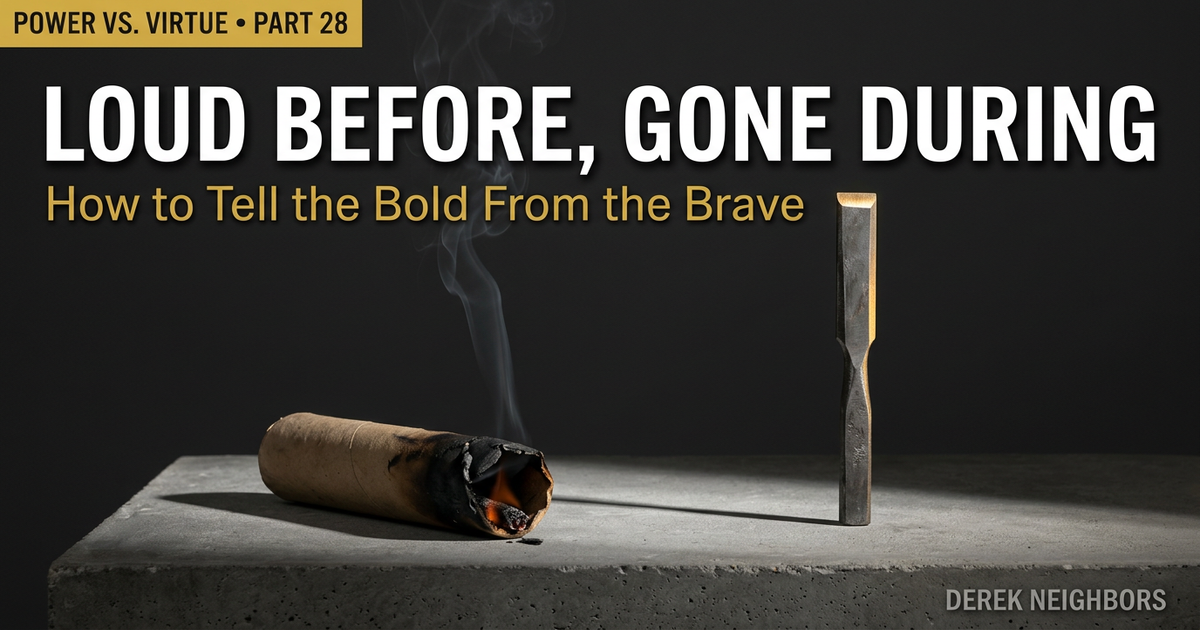
Aristotle complicates the picture by acknowledging that the reckless often appear courageous before the moment of actual danger, but ‘in the actual dangers they stand aloof’ (1115b30). This observation hints at a psychological complexity: thrasytes may involve overcompensation for hidden anxiety. The person who dismisses all warnings may be defending against fears they cannot acknowledge. Their boldness is brittle precisely because it lacks the foundation of genuine self-knowledge.
The practical implications extend beyond individual psychology. Thucydides portrays the disastrous Sicilian expedition as collective thrasytes, where Athenian confidence outran Athenian judgment. The assembly, swept up in enthusiasm, failed to adequately reckon with distances, resources, and the strength of Syracuse. What felt like civic boldness became civic catastrophe. This historical example reveals thrasytes as a social phenomenon, capable of corrupting group deliberation when unchallenged by cautionary voices.
For the person seeking excellence, the lesson is uncomfortable: what feels like courage may be its opposite. The internal experience of bold certainty provides no reliable evidence that one possesses genuine virtue rather than its counterfeit. Only the test of outcomes, combined with honest retrospection, can distinguish the brave from the reckless. This uncertainty demands humility, the very quality that thrasytes, in its confident dismissal of danger, most conspicuously lacks.
Modern Application
When you confuse reckless action with courage, you risk destroying what you're trying to build. True leadership requires distinguishing between bold moves grounded in sound judgment and impulsive gambles driven by ego or impatience. You must learn to recognize when your 'courage' is actually thrasytes, a failure to properly assess risk that endangers your team and mission.
Historical Examples
Alcibiades stands as perhaps the most vivid embodiment of thrasytes in ancient history. His advocacy for the Sicilian expedition, as Thucydides records in Book 6, combined genuine strategic insight with catastrophic overconfidence. When cautious Nicias argued for the massive scale of resources required, hoping to dissuade the assembly, Alcibiades seized on this to demand even more ambitious commitment. His boldness was infectious, but it lacked the sober assessment of genuine Athenian capability that the situation demanded. The eventual disaster, which cost Athens its fleet and thousands of lives, resulted not from cowardice but from collective recklessness that Alcibiades both embodied and encouraged.
Marcus Licinius Crassus provides a Roman example. According to Plutarch’s Life of Crassus, his fatal expedition against Parthia in 53 BCE was driven by desire for military glory equal to Pompey’s and Caesar’s. He dismissed warnings about Parthian cavalry tactics, ignored advice from Armenian allies who knew the terrain, and led his legions into the desert against a mobile enemy. At Carrhae, his recklessness destroyed seven legions. Plutarch explicitly contrasts Crassus’s presumption with the prudent boldness of experienced commanders who understood when to fight and when to wait.
Xerxes’ decision to bridge the Hellespont and invade Greece, as Herodotus portrays it, demonstrates thrasytes at imperial scale. When a storm destroyed his first bridge, Xerxes ordered the sea whipped and branded as punishment. This act, which Herodotus presents as emblematic of Persian hubris, reveals the psychology of recklessness: the inability to accept limits, even those imposed by nature itself. His advisors who counseled caution were overruled by courtiers who fed his boldness. The eventual defeat at Salamis vindicated the warnings Xerxes had dismissed.
How to Practice Thrasytes
Start each morning by reviewing your planned bold actions. Ask yourself: What am I afraid of that I should be? Write down three genuine risks you may be minimizing or ignoring.
Track your decision patterns. Create a log of risky decisions you’ve made in the past month. For each one, note: Was I responding to actual opportunity or to my own restlessness? Did I consult others who might see dangers I missed? What was the outcome?
Seek out the dissenting voice. Before any significant risk, identify the person most likely to challenge your plan. Listen without defending. Their caution may reveal blind spots in your courage.
Review your failures quarterly. Examine decisions that went badly. How many involved ignoring reasonable warnings? How many stemmed from impatience or desire to appear decisive? Pattern recognition protects against future recklessness.
Practice the pause. When you feel the surge of bold action, wait 24 hours before committing to major risks. Use this time to distinguish genuine courage from thrasytes. Ask: If this fails, will I have been brave or merely reckless?
Engage in scenario planning. For your next bold initiative, write two futures: one where it succeeds, one where it fails catastrophically. If you cannot vividly imagine failure, you’re not being courageous. You’re being reckless.
Application Examples
A startup founder dismisses market research showing limited demand for their product, insisting that vision will create its own market. They burn through funding on aggressive expansion, ignoring advisors who urge caution. The company collapses within eighteen months.
Thrasytes often wears the mask of entrepreneurial boldness. Genuine business courage requires integrating uncomfortable data, not dismissing it.
After a painful divorce, you immediately pursue a new relationship with intense commitment, ignoring friends who suggest you need time to process and heal. You dismiss their concerns as overcaution and repeat destructive patterns.
Recklessness in emotional life often stems from unwillingness to sit with discomfort. True courage would mean facing the pain rather than fleeing into premature action.
A new executive implements sweeping organizational changes in their first month, overriding objections from experienced team members who understand institutional history. The changes create chaos and erode trust.
Thrasytes in leadership manifests as the need to act decisively before understanding context. Patience and listening require more courage than bold moves.
A field commander, eager to prove aggressive leadership, orders an advance without adequate reconnaissance. The unit walks into an ambush that proper caution would have revealed.
Military history is littered with thrasytes mistaken for martial virtue. The best commanders know when boldness serves the mission and when it sacrifices soldiers to ego.
An investor puts their entire portfolio into a single high-risk opportunity, dismissing diversification as ‘timid.’ When the investment fails, they lose everything and blame bad luck rather than poor judgment.
Thrasytes in financial matters rationalizes recklessness as confidence. Genuine investment courage involves calculated risks with clear downside protection.
Common Misconceptions
Many assume thrasytes describes people who feel no fear at all. Aristotle actually suggests the opposite: the reckless often experience intense anxiety that they manage through denial and aggressive action. Their apparent fearlessness compensates for fears they cannot face directly. This makes thrasytes a psychological defense mechanism rather than a character trait.
Another error involves equating thrasytes with having a high risk tolerance. Some situations genuinely warrant bold action despite significant danger. The reckless person is not simply someone who takes big risks but someone who fails to accurately assess which risks are worth taking. A calculated gamble with understood odds differs fundamentally from blind overconfidence.
People also wrongly believe that outcomes determine whether an action was courageous or reckless. Success does not retroactively transform thrasytes into andreia. A reckless bet that happens to pay off remains reckless. Virtue concerns the quality of judgment and character that led to the action, not the luck of how events unfold.
I spent years confusing thrasytes with courage, and it cost me dearly.
In my early days as a leadership coach and Agile practitioner, I prided myself on boldness. I would challenge executives directly, push teams past their comfort zones, and advocate for radical transformations. I told myself this was courage. Sometimes it was. Often it was recklessness wearing courage’s clothing.
The turning point came during an organizational transformation where I pushed a client to move faster than their culture could absorb. I dismissed the concerns of a veteran HR director as resistance to change. I was certain my vision was correct and that hesitation was the enemy. The transformation imploded. Not because the direction was wrong, but because my pace ignored real constraints I should have respected. The HR director had seen what I refused to see.
That failure forced me to examine the difference between challenging people and ignoring wisdom. I had been so attached to my identity as someone who ‘pushes boundaries’ that I couldn’t distinguish between productive boundary-pushing and destructive recklessness.
Now I practice what I call ‘calibrated boldness.’ Before any significant intervention, I actively seek out the person most likely to see the risks I’m minimizing. I’ve learned that my eagerness to act often signals anxiety rather than courage. When I feel most certain that bold action is required immediately, that’s precisely when I need to pause.
The hardest lesson: sometimes the most courageous thing is admitting you don’t know enough to act yet. Thrasytes is seductive because it feels decisive. Genuine courage often feels uncertain, slow, and unglamorous. But it builds what recklessness destroys.
Frequently Asked Questions
What is thrasytes in Greek philosophy?
Thrasytes is the Aristotelian term for reckless boldness or foolhardiness. It represents the vice of excess regarding fear, where a person fails to feel appropriate fear in genuinely dangerous situations. Unlike true courage (andreia), thrasytes lacks the rational judgment that distinguishes brave action from mere daring.
What is the difference between thrasytes and andreia?
Andreia (courage) is the virtuous mean between thrasytes (reckless boldness) and deilia (cowardice). The courageous person fears what should be feared and acts boldly when reason warrants it. The reckless person fails to recognize genuine threats and rushes into danger without proper assessment. Courage requires phronesis (practical wisdom); thrasytes lacks it.
How do I know if I'm being courageous or reckless?
Ask whether your boldness is informed by accurate risk assessment or driven by ego, impatience, or ignorance. Genuine courage involves acknowledging real dangers and acting despite them for worthy ends. Recklessness dismisses legitimate concerns and charges forward regardless of consequences. If you cannot articulate what could go wrong, you may be exhibiting thrasytes rather than andreia.