Pleonexia vs Hubris: Key Differences in Greek Philosophy
Both pleonexia and hubris destroy the people who harbor them, but they work through different mechanisms and leave different wreckage behind. Pleonexia is insatiable grasping, the compulsion to take more than your share. It is not simply greed for money, though it includes that. It is the deeper disposition to treat every situation as an opportunity to extract, accumulate, and hoard, whether the currency is wealth, power, attention, or credit. Aristotle placed pleonexia at the center of his analysis of injustice in the Nicomachean Ethics, identifying it as the specific vice that destroys fair dealing between people. Hubris is the transgression of limits, the refusal to recognize boundaries that apply to you. In Greek tragic tradition, hubris is the quality that drives a person to act as though they are exempt from the constraints that govern everyone else. It is not confidence. It is not ambition. It is the specific delusion that the rules, whether natural, social, or divine, do not apply to you. These vices target different things. Pleonexia corrodes relationships and communities from within. The pleonexic person hollows out every exchange by taking more than they contribute. Trust erodes gradually as people realize the relationship is extractive. Hubris provokes catastrophic failure. The hubristic person overreaches until reality delivers the correction they refused to accept voluntarily. The correction is usually disproportionate and public. The two often co-occur in positions of power, and when they do, the combination is devastating. A leader with pleonexia takes more than their share of credit, resources, and authority. A leader with hubris believes they are entitled to take it. Together, they produce the pattern of escalating extraction followed by dramatic collapse that recurs throughout history and across organizations. The person who cannot stop taking eventually takes something they cannot hold. Aristotle and the tragedians diagnosed these vices from different angles, but their analyses converge on a shared insight. Both pleonexia and hubris represent failures of sophrosyne, the self-knowledge and self-restraint that keeps a person in right relationship with their limits. The pleonexic person fails to recognize the boundary between fair share and excess. The hubristic person fails to recognize the boundary between legitimate authority and overreach. In both cases, the corrective is the same: an honest reckoning with what you are actually owed and what you are actually capable of. Without that reckoning, accumulation accelerates until the structure collapses. For honor pursued well versus appetite run wild, see philotimia and eleutheria.
Definitions
Pleonexia
(πλεονεξία)
pleh-oh-NEX-ee-ah
The insatiable desire to have more than one’s fair share—a grasping acquisitiveness that Aristotle identified as the opposite of justice. This vice drives one to claim excessive honors, wealth, or power at the expense of others and one’s own character.
Hubris
(ὕβρις)
HOO-bris
Excessive pride or arrogance that leads one to transgress natural or divine limits, often resulting in downfall. In Greek thought, hubris represented the dangerous overstepping of human boundaries—the fatal assumption that one is beyond the constraints that govern mortal life.
Key Differences
| Aspect | Pleonexia | Hubris |
|---|---|---|
| Target | Pleonexia targets material and social goods. It is the drive to accumulate more than your fair share of wealth, power, recognition, and resources. | Hubris targets boundaries themselves. It is the drive to act beyond the limits that constrain others, treating yourself as an exception to natural or social laws. |
| Mechanism | Pleonexia operates through accumulation. It takes incrementally, expanding its holdings through each transaction. The process can be slow and almost invisible. | Hubris operates through overreach. It makes a dramatic move, seizes what is not available, or acts in a way that exceeds the person's legitimate scope. The action tends to be visible and bold. |
| Social Impact | Pleonexia destroys trust and fairness in relationships and communities. When people sense they are being extracted from, cooperation collapses. The damage is relational and cumulative. | Hubris provokes retaliation and correction, *nemesis*, the retaliatory correction from community or cosmos, often proportional to the overreach. |
| Self-Awareness | Pleonexia can be hidden, even from the person who has it. The grasping person may genuinely believe they are simply being strategic, ambitious, or competitive. Others notice before they do. | Hubris is often accompanied by a kind of intoxication that makes self-awareness impossible. The hubristic person feels invincible, which is precisely what makes the eventual correction so devastating. |
| Philosophical Treatment | Aristotle analyzes pleonexia primarily in ethical and political contexts, as a vice that undermines justice and community. It is a disposition that can be identified and corrected through moral education. | Hubris receives its deepest treatment in Greek tragedy, where it functions as the catalyst for catastrophic reversal. The tragedians were less interested in correction than in showing the inevitable consequences of transgression. |
Target
Pleonexia targets material and social goods. It is the drive to accumulate more than your fair share of wealth, power, recognition, and resources.
Hubris targets boundaries themselves. It is the drive to act beyond the limits that constrain others, treating yourself as an exception to natural or social laws.
Mechanism
Pleonexia operates through accumulation. It takes incrementally, expanding its holdings through each transaction. The process can be slow and almost invisible.
Hubris operates through overreach. It makes a dramatic move, seizes what is not available, or acts in a way that exceeds the person's legitimate scope. The action tends to be visible and bold.
Social Impact
Pleonexia destroys trust and fairness in relationships and communities. When people sense they are being extracted from, cooperation collapses. The damage is relational and cumulative.
Hubris provokes retaliation and correction, *nemesis*, the retaliatory correction from community or cosmos, often proportional to the overreach.
Self-Awareness
Pleonexia can be hidden, even from the person who has it. The grasping person may genuinely believe they are simply being strategic, ambitious, or competitive. Others notice before they do.
Hubris is often accompanied by a kind of intoxication that makes self-awareness impossible. The hubristic person feels invincible, which is precisely what makes the eventual correction so devastating.
Philosophical Treatment
Aristotle analyzes pleonexia primarily in ethical and political contexts, as a vice that undermines justice and community. It is a disposition that can be identified and corrected through moral education.
Hubris receives its deepest treatment in Greek tragedy, where it functions as the catalyst for catastrophic reversal. The tragedians were less interested in correction than in showing the inevitable consequences of transgression.
When to Apply Each Concept
When to Choose Pleonexia
Watch for pleonexia in yourself and others when you notice patterns of extraction in relationships, negotiations, or resource allocation. The diagnostic question is: ‘Am I consistently taking more than I contribute?’ If others are pulling away, if partnerships feel one-sided, or if your success comes at a visible cost to those around you, pleonexia may be the operating principle.
When to Choose Hubris
Watch for hubris when you notice boundary violations, whether in yourself or in leaders around you. The diagnostic question is: ‘Am I acting as though normal constraints do not apply to me?’ Warning signs include dismissing warnings from experienced advisors, believing that past success guarantees future immunity, and taking actions that no reasonable person in your position would attempt.
Frequently Asked Questions
What is the difference between pleonexia and hubris?
Pleonexia is the compulsion to take more than your fair share, operating through gradual accumulation of wealth, power, or resources. Hubris is the transgression of limits, acting as though the rules that govern others do not apply to you. Pleonexia is about quantity (always more). Hubris is about status (above the rules). Both are destructive, but pleonexia erodes trust slowly while hubris provokes sudden catastrophic correction.
Are pleonexia and hubris related?
They frequently co-occur and reinforce each other. The person who accumulates excessively (pleonexia) may begin to believe they have earned exemption from ordinary limits (hubris). Conversely, the person who believes they are above the rules (hubris) will naturally take more than their share (pleonexia). In Greek thought, both represent failures of self-knowledge and self-restraint, but they attack different dimensions of character.
Pleonexia vs hubris examples?
A corporate executive who quietly inflates their compensation package while cutting employee benefits demonstrates pleonexia. An executive who overrides the board, ignores regulatory boundaries, and believes the company cannot function without them demonstrates hubris. In practice, the same person often displays both: the accumulation feeds the sense of exemption, and the sense of exemption enables further accumulation.
How do pleonexia and hubris manifest in leadership?
Pleonexia in leadership appears as credit-hoarding, resource-grabbing, and consistently tilting negotiations in one's own favor. Hubris in leadership appears as bypassing established processes, dismissing expert counsel, and making unilateral decisions that exceed one's authority. Both destroy organizational health. Pleonexia alienates allies and subordinates. Hubris creates the conditions for catastrophic failure when the leader's unchecked decisions finally collide with reality.
Articles Exploring Pleonexia or Hubris (20)
Make Someone Untouchable and the Failure Is Already Yours
A founding architect nobody was allowed to question. A senior engineer who questioned him once and got moved. Two years of pull requests with zero comments that everyone called quality. Then the migration that took the platform down, with a root cause that had been raised in the one review that got silenced. Athens ran the same story with Alcibiades in 415 BC and lost a fleet. The moment an organization decides someone is beyond reproach, the failure that follows belongs to everyone who agreed, and there is an old Greek word for the thing they got backwards.
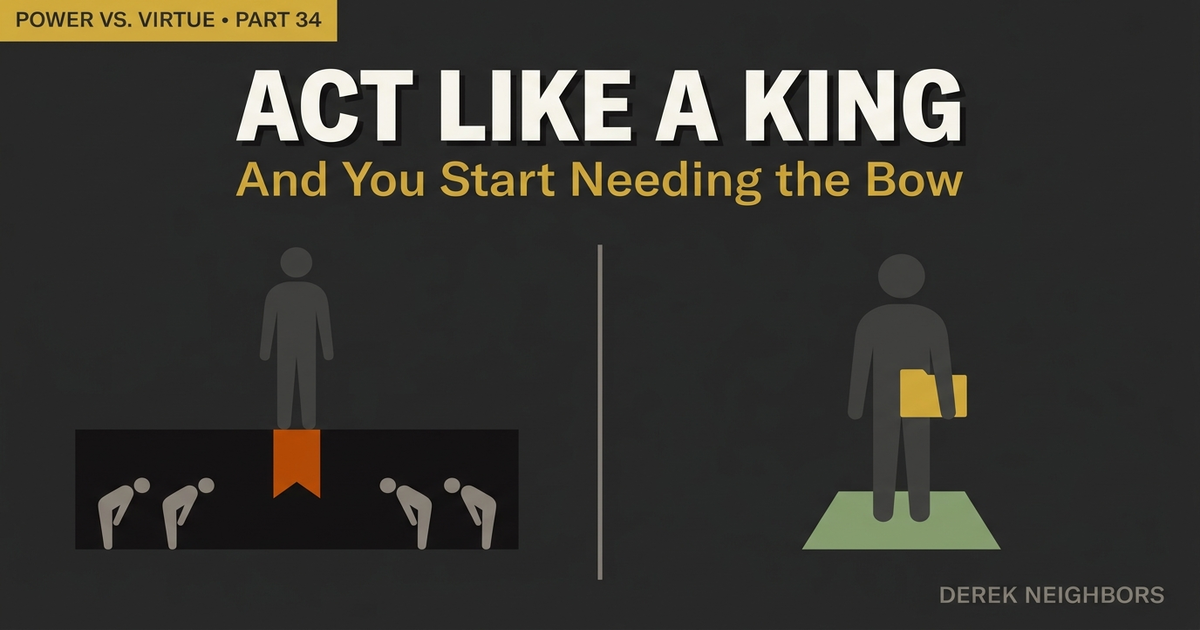
Act Like a King and You Start Needing the Bow
Law 34 of the 48 Laws of Power tells you to act like a king so the room treats you like one. The tactical truth is real. Rooms copy how you price yourself, and cheap familiarity can collapse the work. The character cost arrives when bearing becomes a standing request for deference. You start needing the bow. The ARETE alternative still holds a standard for how you are treated, then roots that standard in inner sufficiency instead of a court.
The Big Guy Breaks When You Refuse to Stay Down
Position feels like invincibility until someone smaller keeps standing after every punch. The damage is not only physical. It lands in the story the big guy told about being untouchable. If you are on top, keep training the grit that got you there. If you are behind, make refusal your strategy.

If You Can Only Rank It, You Can't See What It's Worth
Value blindness starts when comparison becomes the only way you look. Worth stops being seen as itself and turns into a rank or a price. Scheler's ressentiment named the pattern. Greek phthonos and axia sharpen it. Excellence needs eyes that can still see a good without putting it on a ladder.

You Can't Buy Better Judgment With a Bigger Raise.
When every task gets read through the paycheck, excellence has already left. Fair pay removes the money crisis. Using raises as a lever for complex work buys worse judgment.

Hard Times Build Character. Easy Times Expose It.
Training virtue for hard times is the easy half. The real exam starts when constraints fall away and the only person who can stop you is you. Hard times build the muscle. Easy times tell you what the muscle was for.

You Fixed What Was Missing. The Ache Just Moved.
You spent years wanting the thing. You got it. A season later, something else is the thing. Single people ache for partnership and partnered people ache for solitude. The overworked ache for rest and the rested ache for purpose. Most people read the moving ache as proof they chose wrong or that gratitude is broken in them. Plato had a different answer: desire has lack in its lineage and cannot be separated from it. Scarcity never resolves. It relocates. Meaning follows the gap, and the mature move is an honest inventory of the current gap, not another round of chasing.
Your Successor Can't Lead While You're Still in the Room
Most leaders treat succession as a problem of finding the right person. The harder problem comes after. Your continued presence, offered as help, keeps the team loyal to you and the successor leading in your shadow. The Greeks had a discipline for the deliberate withdrawal that finishes the job: anachoresis. The handoff that looks like loss is the only move that completes the work, and it is the one most leaders refuse to make.

Concentrate Your Forces. Just Don't Make Them Someone Else's.
Greene's Law 23 welds two opposite ideas together. Concentrate your forces at their strongest point is some of the most virtue-aligned advice in the book. Find the one patron, the fat cow to milk, is the trap. Both feel like focus. One builds a foundation you own. The other lends your forces to a hand that can drop you.
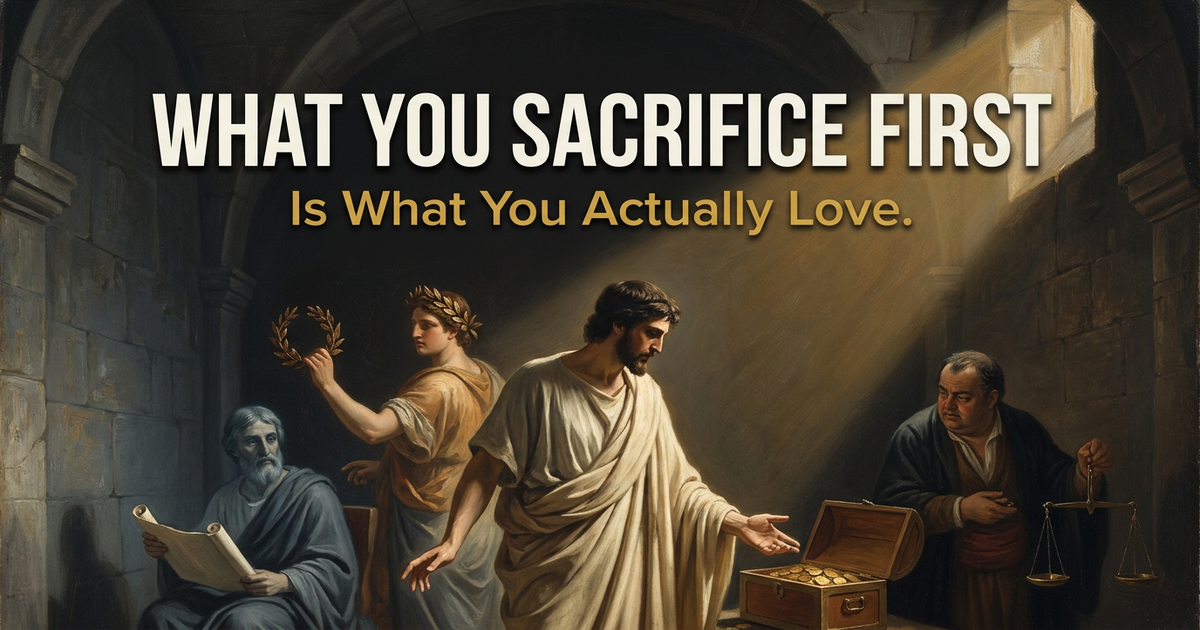
What You Sacrifice First Is What You Actually Love
Most people believe they hold their values in balance: family, work, health, growth, all weighted more or less equally. Plato argued that nobody actually lives this way. Every soul is ordered by a single ruling love, and everything else gets ranked beneath it. The proof is not in what you claim to value. The proof is in what you sacrifice first when two of your loves collide, because the thing you protect last is the thing you actually love.
You Don't Need More. You Need to Strip Your Life Down on Purpose.
We have engineered constraint out of ordinary days and cannot understand why ordinary days no longer move us. The ancient world knew the answer. They built deliberate practices around removing inputs, not adding them. The Sabbath was an amputation. Askēsis was training. Autarkeia was the freedom of needing less. This is the protocol for a thirty-day voluntary sabbath that gets the meaning back into the small things you have stopped noticing.

The Future You're Killing Yourself For Doesn't Include You
The next milestone always arrives on schedule, but the person it was supposed to arrive for has already moved on to the next pursuit. The engine producing your wins is the engine evicting you from the life they were meant to build. The paradox is structural, not personal, and most ambitious people have been paying for it for decades without noticing the bill.

The Loudest Person in the Room Keeps Getting Promoted. That's the Problem.
The person who speaks first, speaks loudest, and projects the most certainty keeps getting the corner office. Meanwhile, the person the team actually trusts gets passed over. The ancient Greeks had a name for both patterns.

If You Need to Destroy Your Enemies, You Were Never Really Winning
Greene says leave nothing to chance and annihilate your opponent completely. But total destruction requires total obsession with another person's existence. The Greeks called this failure of character, not strength. Megalopsychia, greatness of soul, means your purpose is too large for any single enemy to define.

Your Team Doesn't Tease You. That Should Terrify You.
The capacity to receive what you give is the mark of integrated character. Leaders who dish out sharp feedback but bristle when it comes back their way reveal something they would rather not face: their strength was a performance all along.

Taking Credit for Your Team's Work Will Destroy Everything You've Built
Greene says get others to do the work and take the credit. The Greeks say earn your honor through what you actually contribute. One builds empires that depend on resentful people staying. The other builds teams that grow stronger because people choose to stay.

If Money Is Why They Stay, Money Is Why They'll Leave.
Pay them well and they'll stay. Pay them more and they'll work harder. It sounds logical until you watch your highest-paid people leave for less money. The myth of compensation-driven loyalty is destroying teams.

Your Life Right Now Is Just Your Last 90 Days Playing Out
Your fitness, your bank account, your relationships, your opportunities right now aren't revealing your identity. They're showing you what you've been doing for the past 30-90 days. That's not philosophy. That's physics.

AI-First Leadership: Guiding Organizational Transformation
Most leaders want AI transformation results without undergoing the leadership metamorphosis it requires. Here's what AI-first leadership actually demands.

Sophia vs. Phronesis: When Wisdom Meets the Real World
Why brilliant strategies fail and how ancient Greek wisdom provides the solution through integrating theoretical and practical wisdom.