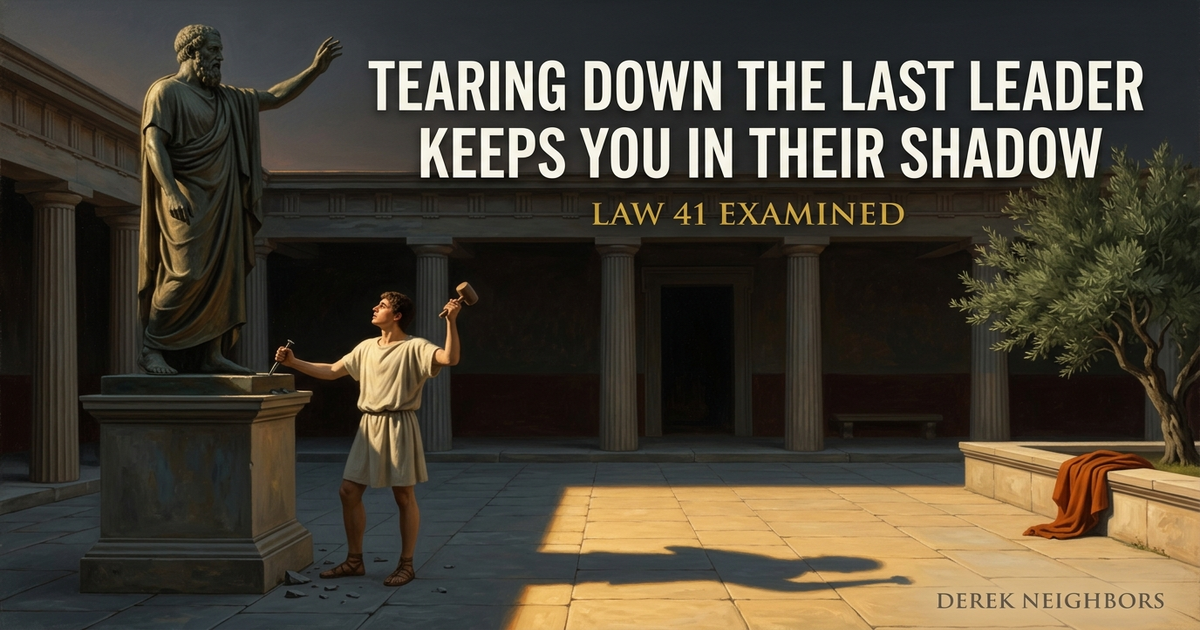
Tearing Down the Last Leader Keeps You in Their Shadow
By Derek Neighbors on October 12, 2026
Power vs. Virtue: The 48 Laws Examined
A year-long examination of Robert Greene's 48 Laws of Power through the lens of ancient virtue ethics. Some laws we affirm, some we reframe, some we reject entirely.
Law 40 was about gifts and who ends up owing whom. Law 41 of the 48 Laws of Power, Avoid Stepping into a Great Man’s Shoes, is about the biggest thing most of us ever inherit at work: a job somebody admired was doing before we got there.
I have watched a lot of people take over from a legend. A new VP of engineering follows the one who built the team. A second CTO arrives after the technical founder. An engineer inherits the service a well-loved staff engineer wrote before leaving. Greene’s advice to all of them is the same, and the first half of it is the most honest description of their problem I have read. The second half is how many of them make it worse.
The Law: Avoid Stepping into a Great Man’s Shoes
Law 41: “Avoid Stepping into a Great Man’s Shoes.”
Greene’s judgment runs like this. Whatever happens first always looks better and more original than whatever comes after. If you succeed a great leader or have a famous parent, you will have to do twice as much to outshine them. Do not get lost in their shadow or stuck in a past you did not make. Establish your own name by changing course. “Slay the overbearing father,” run down his legacy, and win power by shining in your own way.
Keep your eye on two moves at the end. One is to change course so that you look like yourself. The other is to run down the person you replaced.
The Tactical Truth
The comparison is real, and it is unfair in a specific way.
Your predecessor’s record has already been edited. The outages they caused are forgotten. The hires that did not work out left two years ago. What remains is the story people tell at offsites: the launch, the save, the time they stood up to the board. Your record is live. Every bug ships under your name this week, and nobody has had time to forget any of it. You are being compared to a highlight reel with your raw footage.
Imitation has a second problem. If you copy the founder’s style, people read you as a lesser version of them. Plato’s word for copying was mimesis, and his worry about it was exactly this: the copy sits one step further from the real thing. A successor who quotes the founder’s sayings in all-hands, keeps the founder’s meeting rhythm, and makes the founder’s kind of jokes is asking to be graded as the copy.
And some successors really do get stuck. I have seen engineering orgs run the founding CTO’s playbook for years after the company outgrew it, because nobody wanted to be the one who changed what the legend set up. The architecture fit a team of twelve, and the team was a hundred and forty.
Homer knew the odds. Early in the Odyssey, Athena, in the shape of an old friend of the family, tells Telemachus that few sons turn out equal to their fathers. Most are worse, she says, and only a few are better. That is a hard thing to say to the son of Odysseus, and it is the tactical truth of Law 41 in one line.
The law also has an old patron. Plutarch says that when news came that Philip of Macedon had taken another city, the boy Alexander did not celebrate. He complained to his friends that his father would leave him nothing great to do. Every successor who has felt that the best work was already taken knows the feeling.
Notice which parts of this you control. What people remember about your predecessor, and how they grade you against it, belongs to them. Your reasons for each change, what you say about the person you replaced, and the quality of your own work belong to you. Greene spends all his effort trying to manage the first list, and I think the effort belongs on the second. The trouble starts with his cure.
The Character Cost
Start with the act itself, before any of the costs. Running down someone’s work so you look bigger by comparison is a false account of what they did. If the predecessor built something good and you say it was a mess, you are lying about a person who usually is not in the room to answer. If you never took the trouble to learn why they built it that way, your account is false too, and the failure there is that you did not ask. And if the work really was bad, you still owe the truth about it: say what was wrong with the work, specifically, and leave the person’s character out of it. The contempt Greene recommends would be wrong on a day it cost you nothing, and the costs below come on top of it.
The first cost falls on the work. When the reason for a change is “so it looks like mine,” the change is aimed at the comparison instead of the problem. This is the ninety-day rewrite. A new leader arrives, decides the old system is the predecessor’s system, and starts over. Sometimes the rewrite was needed. Often the old system worked, the new one takes eighteen months to reach the same place, and the customers spend that time waiting. The reorg that undoes the last reorg comes from the same place. Users and teams pay for the new leader’s need to look different. The push often comes from above, from a CEO who hired you to show change. That pressure is real, and the reason for each change is still yours to give.
Second, you insult the people who are still there. The predecessor left, but the team who built the thing with them is still here. When you say the last five years were a mistake, the engineers who wrote that code hear “you were a mistake,” and they are right to hear it that way. The people who know why the system is shaped the way it is stop volunteering what they know. Some of them leave, and they take the reasons with them.
Third, contempt shuts down the best teacher you had. Your predecessor knew things you do not. They knew why the retry logic is so odd, which customer the strange config flag exists for, and which vendor promise turned out to be false. Every one of those lessons cost them something. Once you have decided the person was wrong about everything, you stop asking, and you get to pay for each lesson a second time.
Fourth, and this is the one Greene misses entirely, changing course in order to be different keeps the predecessor at the center of every decision you make. If the old leader liked big quarterly plans and you switch to weekly ones because they liked quarterly, you are still being steered by them, with the wheel turned the other way. A leader who asks “what would they have done?” and then does the opposite is consulting them on every call. Greene’s cure for living in the shadow is a way of staying there for good.
Fifth, you teach the next person to do it to you. Someday you will be the predecessor. If the way to make a name in your organization is to run down whoever came before, that is exactly what your successor will do to your work, and the people who watched you do it will cheer them on. Law 15 made the same point about crushing enemies: the method gets learned by everyone who watched it work.
Under all five sits an old pair of motives. Greene’s successor wants honor, which the Greeks called philotimia, and wanting honor is not a vice by itself. The problem is aiming it at the name instead of the work. Running down the predecessor adds the second motive, phthonos, which is envy: the pain of seeing someone else have a good thing, and the wish to take it away from them. Law 41 is envy aimed at the one person who is no longer around to defend what they built. Envy also changes the person who practices it. Train yourself to see someone else’s good work as a threat and you lose the ability to admire good work, and admiring good work is how anyone learns from anyone.
The ARETE Alternative
Aristotle saw the difference Greene missed. In the Rhetoric, Book II, he puts envy right next to a feeling he calls zelos, emulation. Both start the same way, with pain at seeing good things in someone like you. Emulation hurts because you do not have those things yet and sends you to work to earn them, while envy hurts because the other person has them and sends you to work to take them away. Aristotle calls emulation a good feeling that belongs to good people, and envy a base one.
He adds a line that could have been written for successors. We feel emulation most, he says, for the goods that our own ancestors, relatives, and people close to us have had, because those feel like they belong to us too. The son of a great man, or the leader who inherits a great team, is the person Aristotle expects to feel emulation most strongly. Law 41 takes that feeling and pushes it toward envy. The virtuous version competes with the predecessor’s standard and leaves their reputation alone.
By the standard I mean the quality of the work and the good the predecessor was reaching for, rather than their habits, style, or reputation. Both of you were aiming at the same thing: a system that works and a team that does good work for the people it serves. Emulation looks past the predecessor to that target, which is why it corrects both failures from the tactical truth. You keep what still serves the target, and you change the founder’s playbook once it stops serving it. The successor still running a playbook built for a team of twelve fails the same standard as the one who tears everything down, and neither of them is looking at the work.
Plato shows what emulation looks like. He was the student of the most famous philosopher in Athens, and he made his own name by putting his teacher at the center of almost everything he wrote. Socrates is the main speaker in dialogue after dialogue. On Greene’s advice, Plato was sinking himself in another man’s shadow. Twenty-four centuries later, nobody reads Plato as the lesser copy of Socrates. Much of what we know about Socrates we know because Plato carried him, and Plato is the bigger name. He would have been right to carry his teacher even if nobody remembered either of them, because it was true to what he owed Socrates and to the work. The fame only shows that continuity did not cost him his own name.
Then look at how Plato’s own student handled breaking with him. Aristotle studied with Plato for about twenty years and came to disagree with him about the center of his philosophy. In the Nicomachean Ethics, Book I, before he argues against Plato’s theory of Forms, he stops to say how uncomfortable it is, because the people who introduced the theory are his friends. Then he says that both are dear, but piety requires us to honor the truth first. That is the model for changing what you inherit. Aristotle changed course because he thought the truth required it. He said so in the open, with respect, and he never pretended Plato had been a fool.
Telemachus becomes himself the same way. In the first four books of the Odyssey he is a young man living in his absent father’s house, pushed around by the suitors and unsure of his own name. He grows up by acting: he calls an assembly and speaks in it, then sails to Pylos and Sparta to find out what happened to his father and talks with the old kings as a man. When Odysseus comes home, the son fights beside the father. He never had to run Odysseus down to become someone.
Even Alexander, the boy who complained that his father would leave him nothing, did not follow Greene’s advice. He kept Philip’s army, Philip’s infantry formation, and Philip’s best generals. He changed the destination and kept the machine his father built. He went further than Philip because he started from everything Philip had made.
Before the practices, here is the end they serve. The work and the people outlast both you and the person you replaced. Your job is to leave the thing better than you found it, tell the truth about who built what, and be the kind of predecessor you would want to follow. A name earned that way holds up on its own.
Learn why before you change what. Before you change anything big, write down why the predecessor built it that way. Ask them if you can reach them. Ask the people who were there. This is where I start with the model. Claude reads the git history, the old design docs, and the incident reports in an afternoon and writes up why each odd decision was made. Half the strange choices turn out to be scars from an outage nobody wrote a postmortem for. The model has no stake in who built it, so it reports what happened. Then you decide.
Say out loud what you are keeping. In your first month, tell the team which of the predecessor’s decisions you think were right and are not going to touch. It costs you nothing, it tells the people who built them that you were paying attention, and it makes every later change easier to trust.
Give a reason that does not mention them. For each change, write the reason in one sentence. If the sentence only makes sense as a contrast with the person before you, the change is about you. “The deploy takes forty minutes and we ship twice a day” passes that test, and “we are not going to run things the old way” fails it.
Credit them by name. When something the predecessor built saves you, say so in public and say what it was. “The rate limiter she wrote two years ago is the only reason last night was not an outage.” People notice who gives credit to someone who can no longer do anything for them.
Take on a problem they never got to. This is the sound part of Greene’s advice: you need ground of your own, and the honest way to get it is to add. Every predecessor leaves a list of things they never had time for. Pick the one that most needs doing, which is usually the hardest, and finish it because it needs doing. Whatever name you earn will come from that, and nobody can compare it to anything, because nobody did it before you.
None of this depends on rank. The new grad who inherits a module from a staff engineer who left, and rewrites it in the first week to prove something, is following Law 41. So is the second engineering manager on a team that loved the first one, who changes the 1:1 format in week one so nobody mistakes her for her predecessor. So is the founder’s son who sells off his father’s best product line because it was his father’s. The intern who keeps a working script and adds the tests it never had is doing what Aristotle called emulation.
Ancient Wisdom: emulation, and the truth above friends
Aristotle’s Rhetoric, Book II, chapters 10 and 11, is the clearest short account I know of the difference between envy and emulation. Read them together. Chapter 10 describes envy, phthonos, as pain at the good fortune of people like us. Chapter 11 describes zelos, which starts from the same pain and turns it into work. Side by side, for someone taking over from a respected predecessor:
| Envy (phthonos) | Emulation (zelos) | |
|---|---|---|
| What hurts | They had the good thing | You do not have it yet |
| What it sends you to do | Take it away from them | Earn it yourself |
| What happens to their work | Torn down or run down | Kept where it serves, changed where it does not |
| What you say about them | Their mistakes | What they got right, and why you are changing the rest |
| Who steers your decisions | Still them, in reverse | The work |
The Nicomachean Ethics, Book I, chapter 6, is where Aristotle disagrees with his teacher and says why. He names the friendship before he names the disagreement, and he puts the truth above both. That short passage is a good model for anyone who has to change something a respected person built.
The first four books of the Odyssey are the oldest story we have about growing up in a famous father’s absence. Athena’s line about sons who are worse than their fathers is in Book II, and Telemachus spends the next two books proving he can be one of the few who are not.
Plutarch’s life of Alexander gives the boy’s complaint about his father, which is the feeling Law 41 is built on. Read on, and you find a son who used everything his father left him.
Plato’s dialogues are the standing counterexample to Greene. A student wrote his teacher into the center of his work and became one of the most read philosophers in the West.
The Test
Think of the last thing you changed after you took over from someone. Can you state the reason without mentioning them?
What did your predecessor get right that you have never said out loud?
Who on your team built something with the person you replaced, and when did you last ask them why it works the way it does?
What problem did your predecessor never get to, and why is it not on your list yet?
And the one that decides: if your predecessor walked in tomorrow and read everything you have said about their work since you arrived, would they recognize it as true? If not, start with the next thing you say about them.
Final Thoughts
Greene is right that the person who follows a legend is measured against an edited memory, that copying their style reads as a lesser version, and that some successors stay stuck in a past they did not make. His cure makes the problem worse. Running down the predecessor is a false account of their work. It also costs you the people who built it, closes off what they knew, and keeps them steering every decision you make in reverse.
Aristotle’s emulation competes with the standard and leaves the reputation alone. Plato carried his teacher and became the larger name. Aristotle broke with his own teacher only where the truth required it, and said so with respect. Learn why the old thing was built, keep what was right, change what needs changing for reasons that stand on their own, and earn your name on a problem nobody solved before you.
If you are the one leaving, the other half of this is why a predecessor has to step away so the next person can lead.
Law 42 is next, and it is about striking the shepherd so the sheep scatter.
Building on what came before you, without bowing to it or burning it down, is part of the craft. That is what MasteryLab is for.