Your Pleasures Are Too Small, So You Keep Scrolling
By Derek Neighbors on November 28, 2026
Diogenes the Cynic was washing vegetables for his dinner (most retellings make them lentils) when Aristippus walked past. Aristippus spent years at the court of Dionysius, the tyrant of Syracuse, and Diogenes didn’t let the moment go by. If you had learned to live on lentils, he said, you wouldn’t have to flatter a king.
Aristippus had an answer ready. If you knew how to deal with people, he said, you wouldn’t be washing lentils.
Diogenes Laertius records the exchange in his Lives of the Eminent Philosophers, and it has lasted more than two thousand years because both men landed a punch. Diogenes thought Aristippus had sold his freedom for a seat at a rich man’s table. Aristippus thought Diogenes had walked so far from pleasure that he could only be happy in one small room.
Most people today pick a side by reflex. Diogenes gets the credit for discipline, and Aristippus, who was the first of Socrates’ students to charge money for teaching, gets cast as the one who sold out. I think that verdict gets the important part wrong. Aristippus understood something about pleasure that most of us have forgotten, and it explains why so many people end the day on the couch with a phone in their hand and feel worse than when they picked it up.
The trouble with that phone is that the pleasure it gives is too small.
The Pleasure You Can’t Put Down
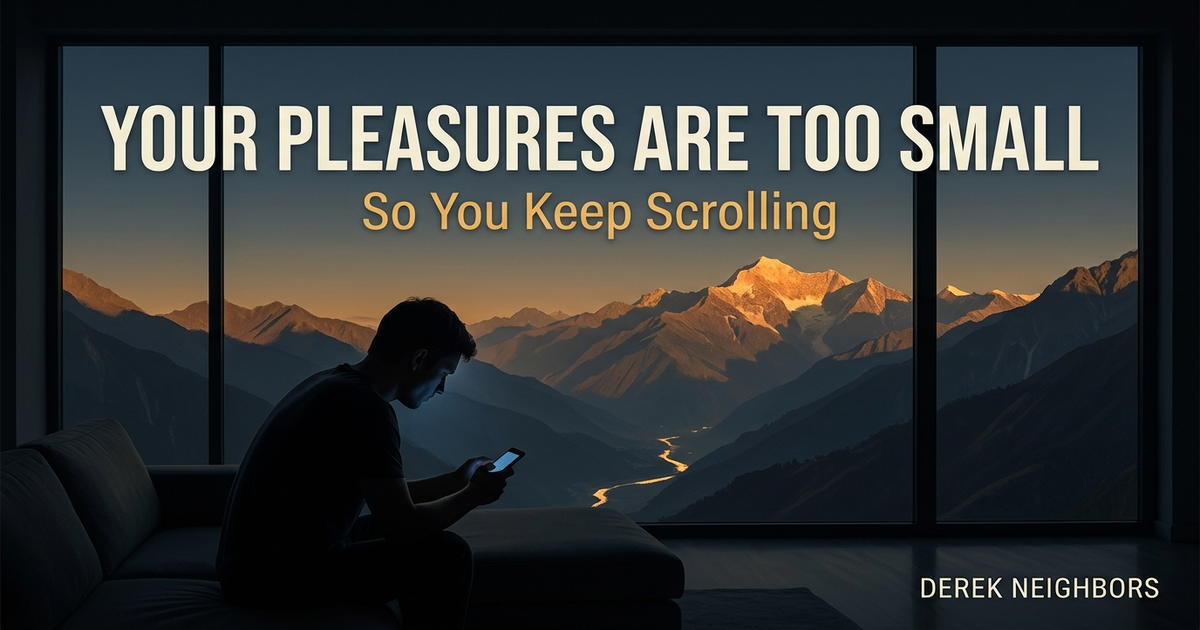
Picture the end of a normal weekday. Dinner is done. You sit down and open the phone for a minute, and fifty minutes later you are still there. You didn’t enjoy most of it and couldn’t say what you saw. You meant to read, or call someone, or go to bed, and you did none of those things.
We usually describe this as a problem of wanting too much: too much stimulation, too much comfort, too much pleasure. So we reach for restriction: delete the app, set a timer, be more like Diogenes.
Aristippus would have described it the other way around. The person on the couch wants too little. They have settled for a pleasure that costs nothing up front, delivers a few seconds at a time, and leaves nothing behind. A man who argued philosophy with Socrates, traveled between the courts of tyrants, and was at home in a palace or a shipwreck would have looked at that evening and called it poverty.
The Cyrenaic school that grew out of his teaching held that hedone, pleasure, is the goal of life. That sounds like permission to do whatever feels good, until you hear the condition Aristippus attached to it.
Aristippus Makes His Case
Aristippus kept company with Lais, the most famous courtesan in Greece. His friends teased him that she was using him. His answer, as Diogenes Laertius records it, was this: “I possess Lais, but I am not possessed by her.”
He made the same point as a general rule. The best thing, he said, is to master pleasure without ever being beaten by it, and abstaining from pleasure doesn’t do that.
That gives you a test you can run tonight. A pleasure is yours if you can put it down. If it picks you up and puts you down on its own schedule, it owns you, however small it is.
By that test, the evening on the couch fails twice. The scrolling doesn’t give much pleasure, and you can’t stop it when you want to. You get the worst of both: a pleasure too thin to enjoy and too sticky to quit.
The answer Aristippus offers is to get better at pleasure, which is different from giving it up. Choose ones big enough to be worth the evening, and keep the ability to walk away from any of them. Aristippus treated that as a skill you build over years, the way you build any other.
Diogenes Makes His Case
Diogenes deserves a fair hearing, because on most of what we call treats, he is right.
His charge was simple. A man who needs the king’s dinner belongs to the king. Every pleasure you can’t do without becomes a leash, and whoever controls the supply controls you. Diogenes slept in a jar, drank from his hands, and owned almost nothing, so nobody had a leash on him.
Look at the pleasures most of us chase and you’ll see his point: the bigger house that needs a bigger salary to keep, the title we want mostly so other people will see it, the feed built by people paid to keep us on it. Diogenes would ask who holds the other end of each one. For a lot of them, the honest answer is a landlord, a boss, or an ad company.
Diogenes could aim the same charge at Aristippus himself. Aristippus put up with insults at the court of Dionysius, and the stories say he took them calmly. Was that a man who could walk away whenever he liked, or a man who needed the table? The sources don’t settle it, and I won’t pretend they do. His own test applies to him the same way it applies to you.
So the Cynic is right about the leash. Where I think he goes wrong is the cure. He treated every pleasure as a leash and walked away from all of them, which made him free in exactly one way. He could live on lentils. He couldn’t sit at the king’s table without contempt, enjoy a good meal without guilt, or be at ease anywhere except the edge of the marketplace.
Where the Two Men Agree
Read the lentils exchange again and you’ll find the two men agree on more than they admit.
Both of them built the ability to want less. Diogenes built it by refusing everything, while Aristippus built it so he could take anything and still leave. Horace, writing three centuries later, said of him that every color, condition, and circumstance suited Aristippus. He could wear fine robes or rags. He could eat lentils with Diogenes, and he could also dine with a king and walk out unchanged.
Side by side, the two men look like this:
| Diogenes | Aristippus | |
|---|---|---|
| How he handled pleasure | Refused nearly all of it | Took it and kept the ability to leave |
| What kept him free | Needing almost nothing | Needing little and fearing no room |
| Where he was at ease | The edge of the marketplace | A palace, a beach after a shipwreck, a bowl of lentils |
| His charge against the other | You belong to the king | You can only be happy in one room |
The bigger pleasures sit on the far side of needing very little, and most people never get there because they’ve never trained the needing-little part. None of this takes money. Diogenes had almost nothing and trained that part harder than anyone in Athens.
So what makes a pleasure big? I use three checks. A big pleasure stays yours when you set it down. It grows as you get better at the thing that gives it. It also leaves something behind after it ends, like a skill, a friend, or a decision you are proud of. Scrolling fails all three.
Here are the four big pleasures I see in the stories about Aristippus, put in plain terms. You can’t get any of them from a screen.
Start with independence. Vitruvius tells a story about Aristippus being shipwrecked on Rhodes. On the beach he saw geometry diagrams drawn in the sand and told his companions to take heart, because educated people lived here. He walked into the city, started teaching, and was soon well provided for. Afterward he gave advice for travelers: carry the kind of wealth that can swim out of a shipwreck with you. The Greeks called this self-sufficiency autarkeia, needing little from outside yourself. Few feelings beat knowing you would be fine if everything around you went under.
The second is ease in any company. Asked what philosophy had given him, Aristippus said the ability to feel at ease with anyone. That ease came from a trained mind, which nobody could take from him or sell him. Picture walking into a room of people richer, smarter, or more powerful than you and not shrinking at all. Most people never get to feel that, because they spend every room managing how they look.
The third is the pleasure of hard things done well. Aristippus argued with Socrates. He talked his way through the courts of tyrants and taught for a living in a city where he had just washed up on the beach. Those pleasures come from skill, and skill only comes from years of being bad at something first.
The last is simplicity: a plain meal when you are truly hungry, a quiet morning with nothing scheduled, a short list of things you own and like. Diogenes had this one too. Aristippus enjoyed it as one pleasure among many, where for Diogenes it was the only one allowed.
My Own Refill Years
I learned this the slow way.
In my thirties I ran a company through a bad economy. We pared everything back. I bought a twenty-year-old Toyota 4Runner on purpose and drove it for years. The house stayed simple. It was a hard stretch, and I remember it as one of the best of my life, because what we had was enough and what we did mattered.
Then the economy turned and the kids graduated, and I refilled. I bought more cars, did rounds of remodels, and took on more commitments than I had room for. I told myself I had earned it, and in some ways I had. Every one of those things gave me a little pleasure the day it showed up. None of them gave me what the lean years did, and together they took up attention I used to spend on things I cared about.
What brought me back, in my late forties, was mostly my wife. She is a hardcore minimalist, much more disciplined about it than I am, and she held the line until I could see it again. I still go through cycles. Something catches my eye and I want to bring it home. I let most of it pass now, because I know what it would push out.
The desert runs I do most mornings are part of the same lesson. Cell signal dies about a mile in. For an hour or three I have nothing to scroll and nobody to answer. People assume I am giving something up out there. It is the biggest pleasure in my week, and the phone has never once come close.
Why Enjoying Life Takes Courage
If bigger pleasures are better, why does almost everyone settle for small ones?
Because the small ones ask for nothing up front and bill you later. Scrolling costs nothing at 9 p.m. The bill shows up at 6 a.m. as a tired brain, and over a year as the book you didn’t write and the friendship you let go quiet.
The big ones charge first. Independence means saving when others spend, saying no to the job that pays more and owns more of you, and living for a while with less than people expect you to have. Ease in any company means walking into rooms where you’re the least impressive person there, again and again, until it stops scaring you. Hard things done well means being a beginner in public. Simplicity means getting rid of things other people admire, and putting up with their questions about it.
Every one of those costs some fear before it pays. The fear is your own guess about what might go wrong, so it is yours to walk through, and walking through it is the courage that enjoying life well requires. If you dodge every discomfort, you end up enjoying almost nothing, whatever the people around you are doing. I made a related argument in Stop Chasing Happiness. It’s Making You Miserable., which is about happiness arriving as a byproduct of how you live. Happiness is the shape of a whole life and can’t be aimed at directly, while pleasure comes from single activities you get to choose. So go ahead and chase pleasure, as long as it is big enough to deserve the chase.
Diogenes had enough courage to go without. Aristippus went without when he had to, then went after the big things too, a king’s court included, and stayed himself in the middle of them. I think that takes more nerve than refusing everything.
Five Moves This Week
- Run the put-down test. Pick the pleasure you reach for most often without thinking. For three days, stop it once on purpose, mid-use, and notice how hard that is. If you can’t stop, it owns you.
- Name your four. Write down one place in your life where you feel independent, one room where you feel at ease, one hard thing you do well, and one simple thing you enjoy. If a line is blank, that is the pleasure you are missing.
- Trade one small evening for one big one. Take one night this week you would normally spend scrolling and spend it on something that costs effort up front: a hard conversation, a first lesson in something, a long walk with no phone.
- Walk into one room that scares you a little. A meeting above your level, a group of people who know more than you. Go to practice being at ease, and skip the impressing.
- Get rid of one thing you bought for other people’s eyes. Notice how long you miss it. Usually it is less than a week.
Final Thoughts
The phone at midnight is a sign that we want too little, and the usual fix of more restriction misses that. Aristippus showed that you can enjoy pleasure fully and still own it, as long as you can put any of it down and walk away. The pleasures worth that skill are big ones: independence, ease with anyone, hard things done well, and a simple life you actually like. They cost courage up front, which is exactly why most people never get them. Stop settling for the small ones.
If you want a room of people who will ask what you did with your evenings this week and whether it was worth it, MasteryLab is that room.
Frequently Asked Questions
Who was Aristippus?
Aristippus of Cyrene was a student of Socrates who lived in the 4th century BC. He was the first of Socrates’ followers to charge for teaching, and the Cyrenaic school grew from his ideas. He argued that pleasure is good and worth pursuing, but that a person must master pleasure rather than be ruled by it. Diogenes Laertius records his famous line about a lover: I possess her, she does not possess me.
What did Aristippus and Diogenes argue about?
Diogenes the Cynic was washing his dinner, lentils in most retellings, when Aristippus walked past. Diogenes said that if Aristippus had learned to live on lentils, he would not have to flatter a king. Aristippus answered that if Diogenes knew how to deal with people, he would not have to wash lentils. Each man thought the other had given up his freedom.
Why is doomscrolling a sign of small pleasures?
A pleasure you cannot put down is a small one, because it controls you instead of the other way around. Scrolling gives a quick hit at no up-front cost, then bills you later in lost sleep and attention. Bigger pleasures, like independence, ease with any person, and doing hard things well, ask for effort and some fear first. People who never pay that up-front cost end up living on the small ones.
What makes a pleasure big or small?
A big pleasure passes three checks. It stays yours when you set it down, so you can stop whenever you choose. It grows as you get better at the thing that gives it. And it leaves something behind after it ends, like a skill, a friendship, or a decision you are proud of. Scrolling a phone fails all three, which makes it a small pleasure no matter how long it holds you.