The Couples Who Fight Are the Couples Who Last
By Derek Neighbors on December 4, 2025
At a dinner party years ago, a couple mentioned they’d never had a fight in twelve years of marriage.
Everyone at the table nodded approvingly. Someone said they were “goals.” The couple smiled. They looked peaceful. Harmonious. Like they’d figured something out the rest of us hadn’t.
Eight months later, he moved out. She told friends she never saw it coming. He said he’d been unhappy for years.
I’ve watched this pattern play out more times than I can count. The couples who brag about never fighting. The marriages that look smooth on the surface. The relationships where peace is the highest value. They tend to end suddenly, devastatingly, with at least one person blindsided.
Meanwhile, the couples I know who are still together after decades? They fight. Not constantly. Not destructively. But they enter the arena. They say the uncomfortable thing. They repair what ruptures. And somehow, they’re still choosing each other.
The correlation became impossible to ignore. The couples who fight are the couples who last.
Not all fighting. Fighting well. There’s a difference that changes everything.
The Myth
We’ve been sold a lie about what healthy relationships look like.
Happy couples don’t fight. Conflict is a symptom that something’s broken. The goal is harmony, smooth sailing, no waves. When we disagree, we should compromise. When we’re frustrated, we should take space. When we’re angry, we should wait until we’ve calmed down. Peace equals love. Absence of conflict equals success.
Watch any romantic comedy from the last fifty years. The fighting couple is either headed for breakup or needs to learn to “communicate better.” The aspirational endpoint is two people who understand each other so completely that friction becomes unnecessary. Soul mates don’t struggle. True love is frictionless.
This logic seems sound. Fighting feels bad. We’ve all witnessed destructive conflict in relationships that were genuinely toxic. Peace feels like love, so conflict must feel like its absence. And besides, every couple we admire seems so… calm.
So we optimize for calm, chasing the good vibes only that keep us weak. We swallow the small irritation to keep the peace. We let the thing slide because it’s not worth a fight. We avoid the hard conversation because things are good right now and why rock the boat? We become excellent conflict avoiders.
And slowly, almost imperceptibly, we become strangers who share an address.
The Reality Check
John Gottman has spent decades studying what actually predicts whether marriages succeed or fail. His research lab has observed thousands of couples. His findings upend everything we assume about conflict.
Conflict frequency doesn’t predict divorce. Conflict style does.
The couples who end up divorced aren’t necessarily the ones who fight the most. Often they’re the ones who fight poorly: criticism, contempt, defensiveness, stonewalling. Or they’re the ones who don’t fight at all. They avoid. They swallow. They keep score silently.
High-conflict couples who repair well outlast low-conflict couples who never address issues. The repair attempt matters more than the rupture. Coming back together after coming apart. Acknowledging impact even when intent was different. Staying connected through the discomfort rather than retreating to separate corners.
What looks like peaceful harmony is often two people who’ve stopped trying to be known by each other. They’ve traded intimacy for comfort. They’ve optimized for the absence of tension rather than the presence of connection. They’re polite roommates. Excellent co-managers of a household. Strangers in the same bed.
The “sudden” divorces that shock everyone? They’re rarely sudden. They’re the detonation of decades of unexploded ordinance. Small things that never got said became medium things that couldn’t be said became the big thing that ended everything.
The Greeks understood that some things grow stronger through opposition. They called productive struggle agon. The gymnasium wasn’t peaceful. The Socratic dialogue wasn’t comfortable. Excellence emerged through the fire of genuine contest, not the comfort of agreement.
Marriage is meant to be an agon. Not war, but the generative struggle that creates something neither person could forge alone.
The Hidden Cost
Watch what happens when conflict avoidance becomes the strategy:
The small things become load-bearing walls. Every irritation you swallow doesn’t disappear. It gets filed. The mental ledger grows silently. His habit of leaving dishes in the sink. Her way of answering questions with questions. The thing that annoyed you slightly on year one becomes the thing that enrages you on year ten. Not because it got worse. Because it accumulated.
Truth becomes the enemy of peace. When keeping the peace is the highest value, saying what’s true becomes a threat. You fail the brutal honesty test with yourself and your partner. You learn to edit yourself. You learn which feelings are acceptable to express and which ones will “start something.” Slowly, your partner stops knowing who you actually are. They know the curated version that keeps things calm. And you stop knowing yourself. You forget what you actually want because you’ve spent so long suppressing it.
Intimacy erodes to politeness. Real connection requires friction. You can’t know someone who never shows you their edges. Smoothing over differences creates polished surfaces that never actually touch. You become excellent at coexistence. Terrible at communion.
Someone eventually snaps. The container can only hold so much pressure. One day, something trivial triggers an explosion that seems wildly disproportionate. Or one day, someone simply says “I’m done” and the other person never saw it coming. The pressure was invisible. The release is catastrophic.
What you avoid doesn’t disappear. It ferments.
The Truth
Nassim Taleb coined a term that applies perfectly here: antifragile. Some things break under stress. Some things survive it. And some things actually get stronger through stress. Bones that bear weight become denser. Muscles that tear rebuild stronger. Systems that absorb shocks become more resilient.
The best relationships aren’t fragile, shattering at the first conflict. They’re not just robust, surviving despite difficulty. They’re antifragile. They grow stronger because of navigated difficulty.
The couples who last have learned to fight well. Fighting isn’t the virtue. Truth-telling is. Fighting is just what happens when two people refuse to suppress what’s true.
They attack the problem, not each other. The issue is the enemy, not the partner. “This pattern isn’t working for me” lands differently than “you always do this.” The goal is resolution, not victory. Two people against a problem rather than two people against each other.
They stay on the issue at hand. No historical grenades. No “while we’re at it, let me mention this other thing from three years ago.” The current conflict gets addressed. The archive of grievances stays closed. Each fight is about one thing, resolved before moving on.
They repair with grace. The rupture matters less than the repair. Coming back after walking away. The words “I was wrong” spoken without defense. Forgiveness isn’t weakness here; it’s the mechanism that lets repair actually work. Acknowledging impact even when intent was innocent. The bridge built back being stronger than the one that fell.
The Greeks called deep friendship philia. It wasn’t the absence of conflict. It was the presence of commitment that made conflict survivable. Two souls pursuing virtue together, sharpening each other through truth-telling that would be intolerable from a stranger. Philia grows through shared struggle. Intimacy is forged in the fire, not preserved in the comfort.
Excellence in relationship, arete, is the capacity to be fully known while fully knowing another. Not performing a curated self. Not managing impressions. Showing the edges and trusting they won’t be weaponized. This is why fighting well matters for eudaimonia, human flourishing. Aristotle understood we cannot flourish alone. The depth of our connections determines the depth of our lives. Shallow peace produces shallow people. This is why character is the foundation of every relationship that endures.
What couples who fight well access is something eternal: genuine communion between souls. Without truth, you have only the shadow of intimacy. The pleasant illusion of connection while remaining strangers. Real connection requires the discomfort of being fully known. That’s the Form. Everything else is performance.
So what’s the actual metric? Not “How often do we fight?” but “How well do we repair?” Not “Do we disagree?” but “Can we stay connected through disagreement?” The absence of conflict isn’t the goal. The presence of resolution is.
And the goal isn’t longevity for its own sake. It’s refusing to trade truth for false peace. The Greeks called this courage andreia: the willingness to face what’s difficult rather than retreat to what’s comfortable.
Sometimes that courage builds something that lasts decades. Sometimes it reveals what shouldn’t continue. And sometimes your partner refuses to enter the arena at all. That’s information too. Truth-telling in the face of perpetual stonewalling might mean acknowledging a harder truth: this person cannot or will not meet you there.
Either way, you lived honestly. The virtue is in the practice, not the outcome.
The Shift
If you’ve built a pattern of avoidance, changing it feels dangerous. The first time you say the thing you’ve been swallowing, it will feel like you’re threatening the peace. You are. The false peace. The fragile peace that was never peace at all.
Name the small things while they’re small. The moment you swallow an irritation, you’re adding to the ledger. Small conflicts addressed immediately stay small. “This bothered me” is infinitely easier than “you’ve been doing this for years and I’ve resented you the entire time.”
Reframe conflict as maintenance, not damage. Fighting well is like changing the oil. Avoiding conflict is like ignoring the engine light. The engine seems fine until it isn’t. Then you’re stranded. Small, regular friction prevents catastrophic failure.
Build repair rituals. You need to build habits for your worst day, not your best. How do you reconnect after rupture? What does coming back look like in your relationship? Some couples need words. Some need touch. Some need time. Know what bridges the gap for your partner. Practice it until it’s instinct.
Embrace the discomfort. Conflict feels bad. That’s okay. The discomfort of a hard conversation is nothing compared to the devastation of accumulated silence. Short-term discomfort, long-term intimacy. Short-term comfort, long-term estrangement.
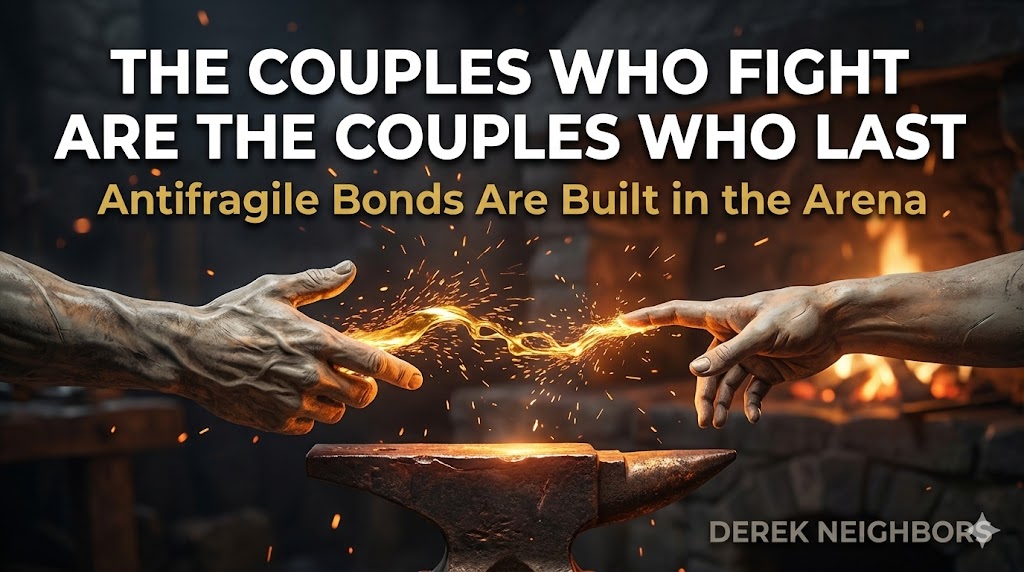
The couples who last aren’t the ones who never fight. They’re the ones who learned to fight well. They bring things up before they fester. They stay in the arena when it gets uncomfortable. They repair with grace. They understand that the forge of difficulty creates bonds that comfort never could.
The Diagnostic
What have you been avoiding saying?
Not the big thing. Start with something small. The small irritation you’ve been swallowing. The preference you’ve been suppressing. The truth you’ve edited to keep the peace.
That’s not peace you’re keeping. That’s distance you’re creating.
The couples who fight are the couples who last. Not because fighting is good in itself. But because the willingness to enter the arena together, to face what’s uncomfortable, to repair what ruptures… that’s what builds something that can actually endure.
The forge creates what comfort never could.
Final Thoughts
Here’s the test: think of the strongest relationship you’ve witnessed. Not the most peaceful. The strongest. The one that weathered storms. The one that’s still standing after decades.
I’d bet they fight. Not constantly. Not destructively. But they don’t avoid the arena. They don’t swallow truth to keep peace. They say the hard thing. They repair. They come back. Again and again.
That’s the model. Not two people who never disagree. Two people who’ve learned to disagree without destroying. Who’ve discovered that the bond becomes antifragile through navigated conflict. Who’ve built repair rituals that work. Who trust each other enough to fight.
What are you avoiding saying to protect a peace that isn’t really peace at all?
Say it. While it’s still small. While repair is still possible.
The forge is uncomfortable. What it produces is unbreakable.
Ready to develop the courage for the conversations you’ve been avoiding? MasteryLab provides frameworks and community for people who are done avoiding the real work.