Megalopsychia vs Philotimia: Key Differences in Greek Philosophy
Megalopsychia and philotimia both drive people toward exceptional performance, but they draw from different wells of motivation. Understanding which one powers your ambition determines whether your achievements will sustain you or consume you. Megalopsychia is greatness of soul, the disposition of a person who has developed genuine excellence and claims the recognition that excellence deserves. Its source of validation is internal. The megalopsychos knows what they are worth because they have assessed themselves honestly against demanding standards. They accept honor when it comes, but their self-understanding does not depend on receiving it. External recognition confirms what they already know. Philotimia is love of honor, the drive to earn recognition and esteem from others. In Athenian culture, philotimia was not a vice. It was the engine of civic life. Citizens competed to fund festivals, build public works, and lead military campaigns because they craved the honor that came with generous contribution. Philotimia built the Parthenon. It funded the dramatic festivals. It motivated the wealthy to bankroll public goods because public recognition was the prize. But philotimia is other-directed. Its fuel is the response of the audience, the praise of peers, the acknowledgment of the community. When the audience disappears or turns hostile, the philotimos faces a crisis that the megalopsychos does not. Aristotle treated the relationship between these concepts with nuance. He placed philotimia among the virtues of the ambitious person in the Nicomachean Ethics, but he subordinated it to megalopsychia because external honor is less stable than internal worth. A person can lose the esteem of others through no fault of their own, through political shifts, changing tastes, or simple jealousy. If your entire motivation rests on what others think of you, that vulnerability will shape your choices in ways that compromise your integrity. The mature position is to value honor without depending on it, to seek recognition as a natural consequence of excellence rather than as its purpose. This tension between internal and external sources of motivation has direct implications for how you structure incentive systems, evaluate performance, and develop leaders. A culture that rewards only visible contribution (philotimia’s domain) will produce performers who optimize for recognition at the expense of substance. A culture that demands invisible virtue with no recognition at all will burn out its best people. The Greek insight is that both drives have legitimate functions, but one must be subordinate to the other.
Definitions
Megalopsychia
(μεγαλοψυχία)
meg-ah-loh-psoo-KHEE-ah
Greatness of soul—the virtue of one who considers themselves worthy of great things and is actually worthy of them. For Aristotle, it is the crown of all virtues, belonging to those who rightly claim honor for genuine excellence while remaining untroubled by fortune or misfortune.
Philotimia
(φιλοτιμία)
fee-loh-tee-MEE-ah
The love of honor and distinction—an ambitious drive to earn recognition through noble deeds and virtuous conduct. In ancient Greek culture, philotimia was the competitive desire to benefit one’s community while achieving personal glory, distinguishing worthy ambition from mere vanity.
Key Differences
| Aspect | Megalopsychia | Philotimia |
|---|---|---|
| Source of Validation | Megalopsychia is internally validated. The person of great soul assesses their own worth against their own standards. External honor is welcome but not necessary for self-knowledge. | Philotimia is externally validated. The honor-loving person's sense of worth depends on recognition from community, peers, or authority figures. Without that recognition, the motivation falters. |
| Motivation | Megalopsychia is motivated by the desire to live in accordance with one's actual excellence. The drive is toward alignment between character and action. | Philotimia is motivated by the desire to earn distinction and honor. The drive is toward achieving recognition through contribution, competition, or visible achievement. |
| Vulnerability | Megalopsychia is relatively invulnerable to flattery and social pressure. Because the foundation is internal, external manipulation has limited leverage. | Philotimia is vulnerable to flattery, peer pressure, and the shifting opinions of crowds. The person who needs honor can be steered by whoever controls the supply of recognition. |
| Relationship to Community | Megalopsychia can exist somewhat independently of community. The person of great soul participates in civic life but does not require it for self-understanding. | Philotimia is deeply communal. It requires a community that can grant honor and a culture that values public contribution. Without a functioning audience, philotimia has no outlet. |
| Philosophical Evaluation | Aristotle considered megalopsychia the crown of the virtues, a capstone that requires all other excellences as its foundation. It represents the highest form of self-possession. | Aristotle treated philotimia as genuinely virtuous when directed toward worthy ends and proportionate to actual achievement. It becomes problematic when the love of honor exceeds or replaces the love of excellence itself. |
Source of Validation
Megalopsychia is internally validated. The person of great soul assesses their own worth against their own standards. External honor is welcome but not necessary for self-knowledge.
Philotimia is externally validated. The honor-loving person's sense of worth depends on recognition from community, peers, or authority figures. Without that recognition, the motivation falters.
Motivation
Megalopsychia is motivated by the desire to live in accordance with one's actual excellence. The drive is toward alignment between character and action.
Philotimia is motivated by the desire to earn distinction and honor. The drive is toward achieving recognition through contribution, competition, or visible achievement.
Vulnerability
Megalopsychia is relatively invulnerable to flattery and social pressure. Because the foundation is internal, external manipulation has limited leverage.
Philotimia is vulnerable to flattery, peer pressure, and the shifting opinions of crowds. The person who needs honor can be steered by whoever controls the supply of recognition.
Relationship to Community
Megalopsychia can exist somewhat independently of community. The person of great soul participates in civic life but does not require it for self-understanding.
Philotimia is deeply communal. It requires a community that can grant honor and a culture that values public contribution. Without a functioning audience, philotimia has no outlet.
Philosophical Evaluation
Aristotle considered megalopsychia the crown of the virtues, a capstone that requires all other excellences as its foundation. It represents the highest form of self-possession.
Aristotle treated philotimia as genuinely virtuous when directed toward worthy ends and proportionate to actual achievement. It becomes problematic when the love of honor exceeds or replaces the love of excellence itself.
When to Apply Each Concept
When to Choose Megalopsychia
Cultivate megalopsychia as the foundation of sustainable ambition. When you need to make difficult decisions that will be unpopular, when your best work goes unrecognized, or when you face criticism that does not match your self-assessment, megalopsychia provides the stability to persist. The question it asks is: ‘Do I know my own worth independently of what others tell me?’
When to Choose Philotimia
Channel philotimia as a catalyst for contribution. When your community needs someone to step forward and lead, build, or sacrifice for the common good, philotimia provides the energy. The Athenian model shows that the love of honor, directed well, can produce extraordinary public benefit. The question is: ‘Am I seeking honor through genuine contribution, or am I substituting recognition for the harder work of developing real excellence?’
Frequently Asked Questions
What is the difference between megalopsychia and philotimia?
Megalopsychia is greatness of soul, an internally grounded self-assessment where a person of genuine excellence claims the recognition they deserve. Philotimia is love of honor, an externally directed drive to earn distinction and esteem from others. The megalopsychos knows their worth regardless of whether others acknowledge it. The philotimos depends on that acknowledgment as a primary source of motivation.
Is philotimia a virtue or vice?
In Greek thought, philotimia occupies a complex position. Aristotle considered it virtuous when properly directed, comparing it to a healthy ambition that motivates civic contribution. In Athenian culture, philotimia was the social engine that funded public works and encouraged generosity. It becomes a vice when the love of honor overrides the love of genuine excellence, when a person will sacrifice integrity for applause, or when recognition-seeking replaces actual achievement.
Megalopsychia vs philotimia in leadership?
A leader driven by megalopsychia makes decisions based on their honest assessment of what is right and what they are capable of, accepting praise and criticism with equal steadiness. A leader driven by philotimia makes decisions influenced by what will earn recognition and esteem. Both can produce excellent results, but the philotimos is more susceptible to populism, short-term thinking, and the temptation to prioritize visible wins over substantive ones.
How do internal and external honor differ in Greek philosophy?
Internal honor (the domain of megalopsychia) is self-knowledge of one's genuine worth, grounded in character and achievement. External honor (the domain of philotimia) is the recognition granted by others for contribution, status, or visible excellence. Aristotle argued that external honor is the greatest of external goods but that it depends on the judgment of others, making it inherently less reliable than the self-knowledge of the person of great soul.
Articles Exploring Megalopsychia or Philotimia (24)
Tearing Down the Last Leader Keeps You in Their Shadow
Law 41 of the 48 Laws of Power tells you to avoid following a great predecessor, and if you must, to break with them and run down what they built. The comparison is real. The cure keeps you steering by the person you are trying to escape.
The Person Who Wanted Your Job Is Waiting for You to Miss
You got the job. Someone else wanted it, and they hold the history and the relationships you need. They will not quit loudly. They will pull back a little at a time and wait for you to miss. Giving it time feels kind and reads as indifference. Lincoln showed the better move with William Seward: settle who decides in private, early, and then hand the rival real work everyone can see.

Some Lunches Are Worth Owing For
Law 40 of the 48 Laws of Power tells you to distrust anything free, pay full price, and give lavishly because generosity draws power. Half of that is sound. The other half teaches you to turn down help, keep a ledger on your friends, and give only when it buys something.
Sour Grapes Cost More Than the Grapes
Law 36 of the 48 Laws of Power tells you to disdain what you cannot have and to ignore your enemies, because ignoring them is the best revenge. Half of that is true. Attention makes things bigger, and you cannot hang your good on things outside your reach. Then Greene tells you to do it the way Aesop's fox did, by deciding the grapes were sour. The fox lied to himself, and the lie is the expensive part. The Stoics had a cheaper way to lose.

The Room Orbits Whoever Holds Steady
Watch any room when something breaks. Eyes go to one person, and it is not always the boss. Authority people actually follow is accumulated character, built through held standards and absorbed hits.

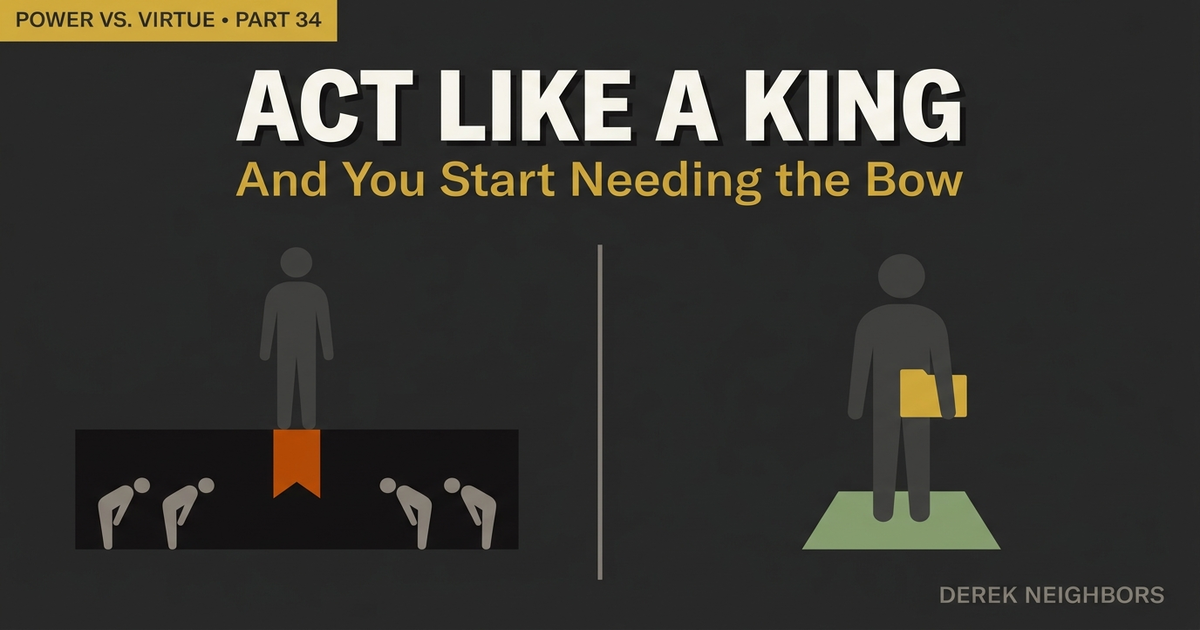
Act Like a King and You Start Needing the Bow
Law 34 of the 48 Laws of Power tells you to act like a king so the room treats you like one. The tactical truth is real. Rooms copy how you price yourself, and cheap familiarity can collapse the work. The character cost arrives when bearing becomes a standing request for deference. You start needing the bow. The ARETE alternative still holds a standard for how you are treated, then roots that standard in inner sufficiency instead of a court.
How You Leave Tells the Truth About Who You Are
We grade people on how they begin. The evidence of character is how they dissolve a living bond. Honorable closure tells the truth without turning the last hour into a trial, owns what you own without requiring a matching apology, and moves forward without needing the last word.

If You Can Only Rank It, You Can't See What It's Worth
Value blindness starts when comparison becomes the only way you look. Worth stops being seen as itself and turns into a rank or a price. Scheler's ressentiment named the pattern. Greek phthonos and axia sharpen it. Excellence needs eyes that can still see a good without putting it on a ladder.
Write Your Own Review First. Then Decide What Theirs Means.
Owning your career means owning the judgment. Write your own honest review before the meeting, then use theirs as information that updates your ledger.

The Styrofoam Cup: The Title Was Never Yours to Lose
The ceramic cup, the car service, the upgraded seat, the jokes that got funnier with every promotion. All of it arrived as you rose, so it reads like a measurement of you. It never was. The deference is addressed to the chair, and the chair is on loan. The Stoics kept a running audit of exactly this, and the Greeks had a job title for the right way to hold borrowed power. Confuse the trappings for yourself and the confusion bills you twice: once while you hold the title, and once, brutally, on the day you hand it back.
Your Response to Unfairness Reveals More About You Than the Unfairness Does
Three leaders take the same public hit. One escalates, one absorbs and redirects, one performs martyrdom for an audience. The unfairness was identical. The response was not. Between the stimulus and your reply lies the only territory where character actually lives, and most people never inspect what runs there.

Your Successor Can't Lead While You're Still in the Room
Most leaders treat succession as a problem of finding the right person. The harder problem comes after. Your continued presence, offered as help, keeps the team loyal to you and the successor leading in your shadow. The Greeks had a discipline for the deliberate withdrawal that finishes the job: anachoresis. The handoff that looks like loss is the only move that completes the work, and it is the one most leaders refuse to make.

What You Sacrifice First Is What You Actually Love
Most people believe they hold their values in balance: family, work, health, growth, all weighted more or less equally. Plato argued that nobody actually lives this way. Every soul is ordered by a single ruling love, and everything else gets ranked beneath it. The proof is not in what you claim to value. The proof is in what you sacrifice first when two of your loves collide, because the thing you protect last is the thing you actually love.
The People You're Afraid to Offend Already Run Your Life
Greene says study people before you act, and never offend the wrong one. Run that as your operating system for a few years and watch what it does to your honesty. The Greeks had a sharper answer.
Your Self-Doubt Is a Tax on Everyone Around You
We treat self-deprecation as humility. Aristotle saw it as the same failure of self-knowledge as arrogance, just from the opposite side. The cost lands on the people around you.

If You Need to Destroy Your Enemies, You Were Never Really Winning
Greene says leave nothing to chance and annihilate your opponent completely. But total destruction requires total obsession with another person's existence. The Greeks called this failure of character, not strength. Megalopsychia, greatness of soul, means your purpose is too large for any single enemy to define.
You Think You're Good. Then You Meet Someone Who Actually Is.
The distance between very good and extraordinary isn't incremental. It's a cliff. And the moment you encounter someone who has already climbed it, your response reveals more about your character than your skills ever will.

Taking Credit for Your Team's Work Will Destroy Everything You've Built
Greene says get others to do the work and take the credit. The Greeks say earn your honor through what you actually contribute. One builds empires that depend on resentful people staying. The other builds teams that grow stronger because people choose to stay.

Your Modesty Is Costing Everyone Around You
Greene says court attention at all costs. The Greeks say build something worth seeing, then refuse to hide it. One manufactures spectacle. The other practices megalopsychia, the discipline of being exactly as capable as you are, in public, where it counts.
Your Wins Aren't About You. That's Why They Matter.
Achievement for its own sake is accumulation, not excellence. The Greeks understood that individual flourishing and communal contribution aren't separate goals. Your wins matter precisely because they're not about you.

The Fastest Path to Opportunity Is Through the Work Nobody Wants
Everyone's competing for the spotlight. Meanwhile, opportunity waits in the tasks everyone avoids. The dirty work doorway isn't just a path to success. It's the only path that isn't crowded.

Why Leaders Who Don't Need Applause Get All the Respect
The leaders who command the most respect don't need your applause to do the work. And that's exactly why you can't stop watching them.

Why Leaders Who Don't Endorse Others Stay Relationally Poor
Your willingness to risk your reputation for someone else's growth reveals everything about your actual confidence in your leadership.
When Craft Becomes Cowardice: The Ancient Test for True Excellence
Jason Fried's knife-maker defense sounds reasonable, stay in your lane, perfect your craft, ignore the pressure to build battleships. But what if your 'disciplined focus' is just fear dressed as virtue? Aristotle had a test for this.