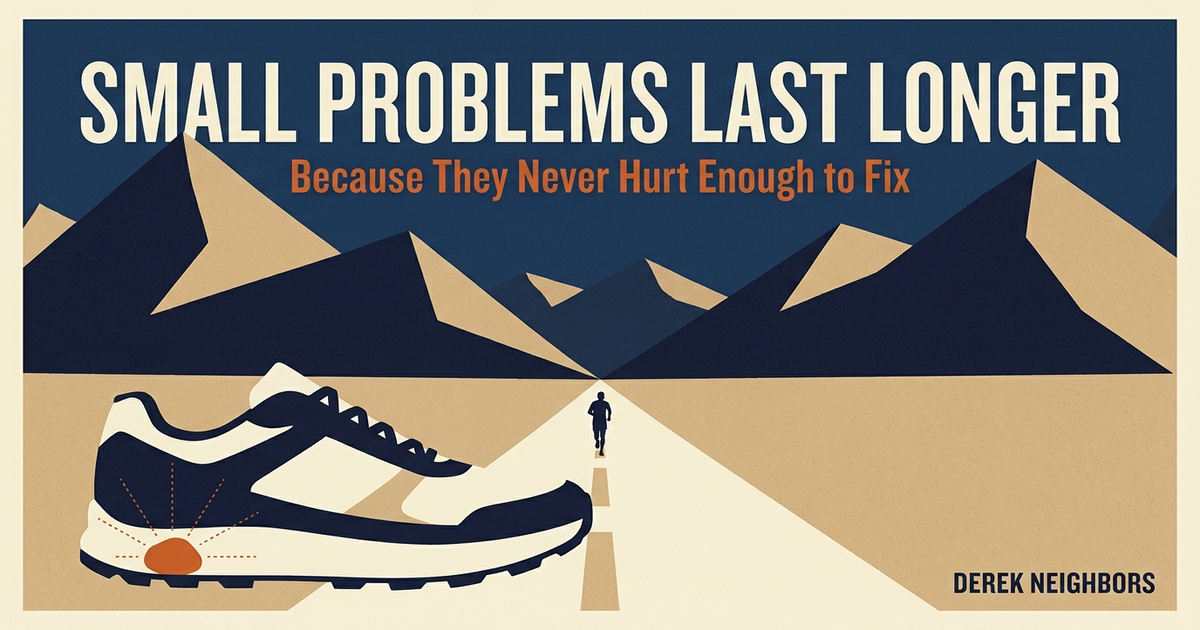
Small Problems Last Longer Because They Never Hurt Enough to Fix
By Derek Neighbors on November 26, 2026
On a long desert run, sand gets into my shoe. At mile two it’s a small problem, a grain I can barely feel, and stopping means unlacing, dumping it out, and losing a minute I don’t want to lose. So I keep going. By the back half of the run that grain has rubbed a hot spot into a blister, and the blister sets my pace for the rest of the day.
If I rolled an ankle at mile two, I’d stop on the spot. Nobody has to tell you to deal with a rolled ankle.
Engineering teams make the same trade. When production goes down, the whole company is looking at it within minutes. Agents dig through the logs, someone owns the call, the fix ships that day, and the write-up lands by Friday. Meanwhile there’s a check in the pipeline that fails about one run in ten for reasons nobody has figured out. The software factory retries it and moves on, and it has been doing that for two years.
The outage got fixed in a day because it hurt, and the flaky check survived two years because it never hurt enough to make anyone stop. Small problems outlast big ones for exactly that reason, and on most teams I’ve seen, the small ones often cost more in total.
The Pattern: Pain Sets the Bar for Action
Psychologists have studied this. In 2004, Daniel Gilbert, Matthew Lieberman, Carey Morewedge, and Timothy Wilson published a paper in Psychological Science called “The Peculiar Longevity of Things Not So Bad.” They named the effect the region-beta paradox. Intense distress can fade faster than mild distress, because only the intense kind pushes people to do something about it.
They explained it with an example about getting around. Say you walk anywhere close and drive anywhere past a certain distance. A trip just past that line gets the car and takes five minutes. A trip just short of it gets your feet and takes twenty. The shorter trip takes longer because it fell under the line that would have triggered the faster option.
In their lab experiments, a harsher hit sometimes left people feeling better sooner than a milder one. The bigger hit got their coping going, while the milder one never got a response and lingered.
Older research points the same way. In 1981, Allen Kanner, Richard Lazarus, and their colleagues compared two ways of measuring stress: tallying the major life events people had been through, and tallying their daily hassles. The hassles predicted psychological symptoms better than the big events did. A layoff gets a response, and the commute and the drawer that sticks every morning get lived with.
There’s an old line about this that usually gets pinned on Muhammad Ali: it isn’t the mountains ahead that wear you out, it’s the pebble in your shoe. Quote Investigator found older versions, with a grain of sand instead of a pebble, from long before anyone credited Ali. Whoever said it first, I’ve found it to be true on the trail and at work.
By a small problem I mean one that keeps coming back, costs a little each time, and never hurts enough on any single day to get an owner. Every small problem on your team sits under a bar for action, and nobody set that bar on purpose. Pain set it. Once you know pain is choosing what gets fixed, leaving it in charge is a choice you’re making. Anything that doesn’t hurt enough right now to make you stop goes to the back of the line, and whatever waits there long enough becomes part of how the team works.
Four Ways Small Problems Survive on a Team
“It’s Not Worth the Time”
This is the excuse I hear most, and for most of my career it was honest math. Fixing that flaky check meant pulling a person off real work for a day or two of digging into timing problems, all to save ten minutes a week. A lot of leaders, me included, looked at that trade and said no.
Agents changed the math. Pointing an agent at the check with a clear description now takes a few minutes of a person’s time, and the agent does the digging. The fix often costs less than one week of living with the problem. “Not worth the time” was a fair call when a person had to do the fixing. Today it usually means nobody went back and checked the price.
The Workaround Becomes the Process
Every team has tricks everyone learns. Rerun the build if it fails once. When a customer request comes in, ask sales the same three questions, because the request form doesn’t ask them. Nobody calls these problems anymore. They’re how things work here.
New people pick up the tricks in their first week, so the problem gets taught instead of fixed. Each trick is small, and stacked together they’re a big part of why a new person takes a month to feel useful.
I made a similar argument about people in What You Tolerate, You Insist On: whatever you put up with long enough becomes the standard. A workaround does the same thing to a process. Once the trick is in the onboarding notes, the problem has a permanent home.
Waiting for It to Break for Real
Some small problems get a quiet promise: if it gets worse, we’ll fix it. The check that fails one run in ten will get attention when it fails one in three. The slow page will get attention when a customer complains about it.
That threshold is never written down, and it moves. By the time the problem crosses it, the team has spent months adjusting, and the adjusting made “worse” harder to see. The run that fails one time in three feels about as normal as one in ten did, because everyone already reruns it without thinking.
Big problems at least get argued about. In The Problem Your Team Won’t Name Is Eating Every Other Meeting, the trouble was a problem too big and uncomfortable to say out loud. Small problems have the opposite trouble. They’re easy to say out loud, and they still never make it onto anyone’s list.
Correcting the Agent by Hand
This one is newer, and I’ve done it plenty. An agent makes the same small mistake in every draft, a phrase you can’t stand or a step it skips, and you fix it in the chat each time. Each correction takes thirty seconds, so it never registers as a problem. A few hundred corrections later, it’s a real slice of your week.
The fix is one line in the file the agent reads before it starts. For me that’s the rules file in the repo. Once the rule is there, the agent stops making the mistake and I stop spending my mornings catching it.
What Works Instead
How much a small problem hurts is out of your hands, but writing it down the second time it happens is fully in them, so the fix has to come from a habit that doesn’t wait for pain.
The habit I’d put in place is a daily pebble pass, and agents are what make it cheap.
- Keep a pebble list for one week. Any time something annoys you or someone on your team twice, write it down in one line. Don’t judge the size. “The preview environment hangs on Monday mornings” counts.
- Pick one pebble a day and write a three-line spec. Write what happens now, what should happen, and how you’ll know it’s fixed. Three lines is enough for an agent to start.
- Hand it to an agent and judge what comes back. The agent digs, finds the cause, and proposes the fix. Your job is deciding whether it’s right and whether to ship it.
- Lower the bar in writing. Put the rule where the team can see it: if two people hit the same friction twice, it goes on the list. That rule replaces the bar that pain was setting for you.
Some small problems are worth keeping. If the fix is riskier than the annoyance, say so on the list and cross it off. That still counts as a decision, which is more than the problem ever got before.
Keep it to one a day. Starting a fix costs almost nothing now, and it’s easy to flood a team with small changes that each need someone to judge them. One a day for a quarter clears about sixty things that were wearing on your team, and nobody gives up a day of real work for any of them.
Diagnostic Questions and a Challenge
Ask yourself these this week:
- What does your team rerun, re-ask, or reset by hand at least once a week?
- What did your newest person learn as a trick in their first month that should have been fixed instead?
- What correction have you typed to an agent more than five times?
- What have you promised to fix “if it gets worse,” and what would worse look like in numbers?
Then take the challenge. For the next five working days, clear one of these a day with an agent, and write down how many minutes each one took you. I’d bet the five add up to less than an hour, which is less than most of those problems cost your team in a single week.
Final Thoughts
A rolled ankle gets an instant stop, and a grain of sand gets ignored until it’s a blister. Teams treat outages and flaky checks the same way, for the same reason: pain decides what gets fixed, and small problems never hurt enough to make the cut. The minutes add up, and years of working around small problems also train you and your team to stop seeing them at all.
For years the honest excuse was that fixing small things cost more than living with them. Agents took most of that cost away. What’s left for you is noticing, writing three lines, and judging what comes back. Do one a day, and the small problems stop outlasting everything else on your team.
If you want a room of people who will ask what’s been rubbing in your shoe for two years, MasteryLab is that room.
Frequently Asked Questions
What is the region-beta paradox?
The region-beta paradox is a finding from Daniel Gilbert and colleagues, published in Psychological Science in 2004 under the title ‘The Peculiar Longevity of Things Not So Bad.’ Intense distress pushes people to cope or act, while mild distress often stays below the level that triggers any response. As a result, mild problems can last longer than severe ones.
Why do small problems last longer than big problems?
Big problems hurt enough to force action, so they get attention, an owner, and a fix. Small problems sit below that level. People work around them, teach the workaround to new people, and promise to fix them if they get worse. Research on daily hassles going back to 1981 found that small, repeated annoyances predicted stress symptoms better than major life events did.
How can AI agents help fix small recurring problems at work?
The usual reason small problems survive is that fixing one used to cost a person a day or two of work for a problem that costs ten minutes a week. An agent can do the digging and propose a fix from a short description, so the human cost drops to a few minutes of writing the problem down and judging the result. A simple habit is to pick one small problem a day, write a three-line description, hand it to an agent, and decide whether to ship what comes back.