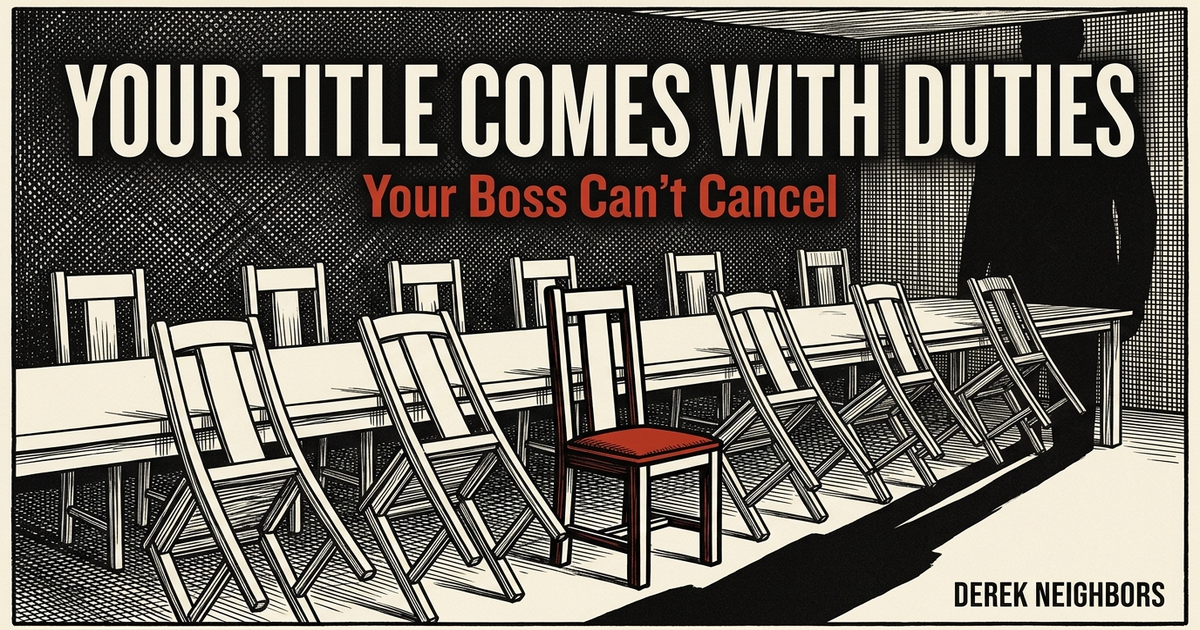
Your Title Comes With Duties Your Boss Can't Cancel
By Derek Neighbors on November 24, 2026
The VP of engineering knows the launch date in the board deck will not hold. The plan assumes the agents ship three months of work that nobody has judged yet, and the integration with the biggest customer has not started. She has said a softer version of this twice. Both times the CEO cut her off, and the second time he said, in front of the staff, that he needed people who believed in the plan.
So this week she says nothing. She tells herself the date is the CEO’s call and it is not her job to raise it again.
That last sentence is wrong. The date is the CEO’s call, and telling him what is true about the date is her job. It was her job before he made it clear he did not want to hear it, because her title came with that duty. Nobody above her can cancel it, though they can make it expensive.
The Surface Problem: Bad News Stops Climbing
Most companies have some version of this. The people closest to the work know the date will slip or the biggest customer is about to leave. The people at the top find out last, usually from the result.
Leaders call this a culture problem and reach for the usual fixes. They run an anonymous survey, or they announce an open door and add skip-level meetings. A few of those help a little. Most of them fail, because they treat speaking up as a favor of courage the employee might grant if the conditions are right. When the conditions turn bad again, the favor stops.
The VP above has plenty of courage, and she has already done something more dangerous than staying quiet once: she has decided the duty is gone. I wrote about the personal cost of swallowed truths in Why Staying Silent Is the Most Expensive Thing You’ll Ever Do. Dropping the duty comes before that, and it makes the silence feel like no choice at all.
The System: Duties Held as a Deal With the Boss
Most people hold their duties as a deal with whoever they report to. The boss wants the date defended, so defending the date becomes the job. The boss signals he does not want the integration risk raised again, so raising it drops off the job. Nobody writes this down. The duty list shrinks to match the boss’s mood.
The loop that follows runs like this. The boss hears less bad news and gets curated information. He makes worse calls on that information, the calls go sideways, and he gets more anxious. An anxious boss signals harder that he wants believers, the duty list shrinks again, and the whole cycle starts over. Each person in it is behaving reasonably for the deal they think they have, and the company still walks off a cliff with its eyes open.
Epictetus taught that duties work differently. In Discourses 2.10 he tells his students to consider who they are: a human being first, then a citizen, a son, a brother, a member of the city council. Each of those names, he says, points to the acts that fit it. The Stoic word for those fitting acts is kathekon, the duty that comes with a role. A role exists because a larger whole, the city or the council or the family, needs something from it, so its duties come from that need and the person who handed you the role did not create them.
The sharpest version is in chapter 30 of his Handbook. Duties, he says, are measured by relationships. Your father is owed care. Then he takes the obvious objection: “But he is a bad father.” His answer is that you were not given a good father, only a father. The duty comes from the relationship, not from whether the other person holds up their side.
Swap the father for a CEO and the point carries. You were hired into a seat, and the seat came with duties whatever kind of boss you got.
Epictetus knew the price of this firsthand. He was born a slave and later exiled from Rome by the emperor Domitian, and the stories he taught it with came from men who had paid even more.
Stoic Role Ethics: The Senator Who Kept Showing Up
Helvidius Priscus was a Roman senator under the emperor Vespasian. His father-in-law, Thrasea Paetus, had already been forced to kill himself under Nero for refusing to go along with the Senate’s flattery. Helvidius knew exactly what the job could cost.
Epictetus tells the story in Discourses 1.2. Vespasian sent word that Helvidius should stay away from the Senate. Helvidius answered that the emperor had the power to remove him from the Senate, but as long as he was a senator, he had to attend. Fine, said Vespasian, attend and keep quiet. Helvidius said he would keep quiet if nobody asked his opinion. But a senator gets asked, said Vespasian. Then I have to say what seems right, said Helvidius. And if you do, I will have you killed.
Helvidius said, “When did I ever tell you I was immortal? You will do your part, and I will do mine.” It was the emperor’s part to kill, he said, and his part to die without trembling.
Vespasian later had him exiled and then executed.
Look at what Helvidius did with the duty list. The emperor tried to edit it twice: first don’t come, then come and stay silent. Helvidius kept both items because they belonged to the seat, and Vespasian had never owned them. The emperor could take the seat away, but while Helvidius held it, the duties came with it.
The Leverage Points
A system like this has a few places where a small change does most of the work. Three of them sit in this story.
Decide the duties before the pressure arrives. Epictetus pairs Helvidius with another senator, Agrippinus. A man named Florus asked Agrippinus whether he should perform at one of Nero’s festivals, which would have meant joining the emperor’s show. Agrippinus told him to go. When Florus asked why Agrippinus wasn’t going himself, he said, “I don’t even consider the question.” Epictetus’s point is that once you start weighing whether to keep a duty, with your career on one side of the scale, you are already halfway to dropping it. The VP lost her duty in the second meeting, when she started weighing it against the CEO’s mood. The fix is to settle the list on a calm day, so the hard day is only about how to do it.
Split your part from theirs. “You will do your part, and I will do mine” is the most practical sentence in this whole story. The CEO’s part is the decision and whatever he does to the person who brought the bad news. Your part is the true report, delivered clearly, in the room where the call gets made. The Stoics called the part that is fully yours prohairesis, your power of choice. It covers what you say and how you say it, and it stops short of whether he listens. People drop the duty because they confuse the two and decide that since they cannot control the outcome, the report is pointless.
Fix the boss’s half of the seat. The VP’s CEO raised the price of her report in front of his staff. His seat has duties too, and one of them is keeping the truth cheap for the people who report to him. Amy Edmondson’s research on psychological safety is about this half of the problem. A leader who punishes the report has broken his own duty list. He has also trained the room to hand him a fake one.
The Honest Part: What It Costs and What It Isn’t
Helvidius died for this, and I am not going to pretend the modern version is free. Doing your seat’s duties can cost you a promotion, a project, the boss’s trust for a year, or the job. Stoic role ethics promises only that you will still be the person who did the work, whether or not you keep the office.
There is a second caveat, and the ancient sources give it to us. Suetonius says Helvidius also needled Vespasian in public. He greeted the new emperor by his plain private name, and as a magistrate he left the emperor’s titles out of his official notices. Part of that was principle, and part of it looks like a man picking fights.
The seat’s duties are specific. Here is a quick test: a seat duty is something the company would want from anyone in that chair, no matter who held it. The VP owes the CEO an accurate picture of the date, in writing, where the decision is made. She does not owe him a speech in the all-hands, a leak to the board, or a running war over every forecast. If you turn the duty into permission to pick every fight, you are serving yourself at the role’s expense. I made a related case in Calm Is Not the Goal, about people who treat Stoicism as a mood to reach: the job is the duty, and calm and defiance are both side effects.
The Intervention
-
Write the seat card. On one page, list three things your role owes the company no matter who sits above you. Make them concrete. “Tell my boss in writing when a committed date is at risk, within a week of knowing” passes. “Be honest” tells you nothing. If you manage people, add one duty you owe down: “Tell my team the real reason when their work gets cut.”
-
Say the card out loud in calm weather. Show it to your boss on a normal day, well away from any fight. “Here is what I think this seat owes you, even when you won’t like it.” Most bosses agree in a calm room. That agreement becomes something you can point back to later.
-
Under pressure, ask whose part it is. When the signal comes that a duty is unwelcome, ask one question: is this my part or theirs? The report is yours, while the decision and the reaction belong to them. Do yours and let them do theirs.
-
Do the duty in the form the seat requires. Bring it to the place where the decision gets made, say it once, plainly, and put it in writing. Then stop. Saying it again in every meeting adds nothing to the duty.
-
If you lead, name the duties you will never ask people to drop. Tell your directs which items on their seat card you want even on your worst day. Then thank the first person who uses one on you, in front of the same people who watched you push back the last time.
The Results
When the duties come from the seat, the loop runs the other way. The boss gets the real date, so he makes better calls with fewer surprises. People stop recalculating their job every time the mood upstairs changes, which is exhausting and teaches everyone to watch the boss instead of the work. Bad news gets cheaper because it is expected, and the person delivering it is doing the job they were hired for.
None of that is guaranteed. The CEO may ignore the report and the date may still blow up in front of the board. The duty holds anyway, because your part ended when you made the report. What he did with it was his part.
The last result is personal. If you let pressure strip the duties out of your role, you end up holding a title with nothing in it. When you keep your seat’s duties, you keep something nobody upstairs can take, even on the day you lose the seat.
Final Thoughts
Your title came with duties, and you did not get to pick which boss you would report to while you hold them. A boss can make those duties expensive, but you are the only one who can drop them. Write down what your seat owes, settle it before the pressure comes, do your part where the decision gets made, and leave the decision to the person whose part it is.
If you want a room of people who will ask what your seat owes and whether you paid it this week, MasteryLab is that room.
Frequently Asked Questions
What is Stoic role ethics?
Stoic role ethics is the idea that your duties come from the roles and relationships you hold, such as citizen, parent, sibling, or member of a council. Epictetus taught that if you consider each name you carry, it tells you what actions fit it. The Stoic word for those fitting actions is kathekon. The duties belong to the role, so they do not disappear when the person on the other side of the relationship behaves badly or stops wanting them done.
What did Helvidius Priscus say to Vespasian?
According to Epictetus in Discourses 1.2, the emperor Vespasian told Helvidius Priscus not to attend the Senate. Helvidius answered that it was in Vespasian’s power to remove him from the Senate, but as long as he was a senator he had to attend. When Vespasian threatened to kill him if he spoke, Helvidius replied that he had never claimed to be immortal: ‘You will do your part, and I will do mine.’ It was the emperor’s part to kill and his part to die without trembling.
What does Epictetus mean by appropriate actions in the Enchiridion?
In chapter 30 of the Enchiridion, Epictetus says appropriate actions are measured by relationships. If someone is your father, you owe him care. If you object that he is a bad father, Epictetus answers that you were not given a good father, only a father. The duty comes from the relationship itself, not from whether the other person is living up to their side.