Kanon (κανών): Meaning, Definition & Modern Application
kah-NOHN
A measuring rod or standard used to determine straightness, proportion, and correctness. In philosophy, it signifies the authoritative criterion by which truth, beauty, or moral action is judged.
Etymology
Derived from the Greek kanna, meaning ‘reed’ or ‘cane’, which was used as a straightedge in construction and measurement. The term evolved from its literal meaning as a carpenter’s rule to denote any standard of measurement or judgment. By the classical period, kanon had acquired philosophical significance as the criterion by which one assesses truth, artistic proportion, or ethical conduct. The word passed into Latin as ‘canon’ and subsequently into English, retaining its sense of an authoritative standard or rule.
Deep Analysis
The concept of kanon sits at the intersection of epistemology, ethics, and aesthetics in Greek thought, serving as the linchpin for any system that claims to distinguish better from worse, true from false, beautiful from ugly. Without a kanon, judgment becomes arbitrary, subject to the shifting winds of opinion and circumstance. With one, the philosopher, artist, or leader gains a fixed point from which to assess and act.
Epicurus made kanon central to his philosophy, titling his work on how we know anything ‘The Canon’. For Epicurus, the criteria of truth were sensations, preconceptions (prolepsis), and feelings. These served as the measuring instruments by which all claims about reality must be assessed. Diogenes Laertius reports that Epicurus considered these criteria self-evident standards requiring no external validation. The kanon does not itself need to be measured; it is the measure.
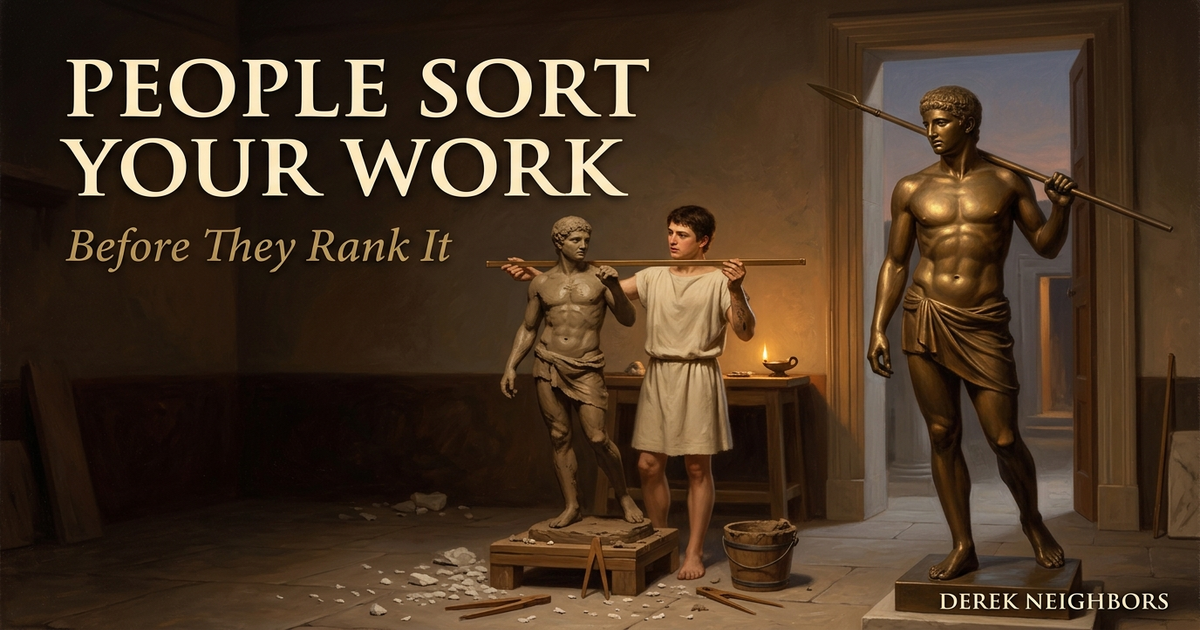
This epistemological application reveals a crucial characteristic of kanon: it must possess a stability and reliability that the things measured against it lack. A ruler that bends is worthless. A criterion that shifts with circumstances provides no guidance. This is why the ancient sculptors, particularly Polyclitus, sought mathematical proportions as the kanon of human beauty. His statue known as ‘The Canon’ embodied the ideal proportions of the human form, ratios that could be applied universally. The standard transcended individual variation.
Yet here lies a productive tension in the concept. The kanon must be fixed enough to serve as a genuine standard, yet applicable to the infinite variety of particular cases. Aristotle addresses this in the Nicomachean Ethics when discussing equity (epieikeia). He notes that the standard rule of law, like a rigid measuring rod, cannot adapt to every circumstance. The Lesbian builders, he observes, used a lead rule that could bend to fit irregular stones. Is this flexibility a strength or a corruption of the kanon?
The answer depends on distinguishing between the underlying principle and its application. The principle of justice remains fixed; its application requires phronesis, practical wisdom. The kanon of ethical action is not a checklist but a criterion that guides judgment in particular circumstances. This is why developing a personal kanon requires both clarity about principles and the wisdom to apply them well.
The Stoics contributed their own analysis of kanon through their concept of the kataleptic impression, the criterion by which true representations could be distinguished from false ones. For them, certain impressions carry a self-evident quality that commands assent. These serve as the kanon of cognitive judgment. Skeptics attacked this notion, arguing that no impression is self-certifying. The debate illuminates the vulnerability in any kanon: who or what validates the validator?
This regress problem does not invalidate the concept but reveals its nature. A kanon functions not because it possesses absolute metaphysical certainty but because it provides a stable reference point within a practice or domain. The carpenter’s rule need not be metaphysically perfect; it needs only to be consistent enough for the building to stand. Similarly, a leader’s kanon need not resolve every philosophical puzzle; it must be reliable enough to guide decisions that produce better outcomes over time.
The relationship between kanon and telos deserves attention. A standard implies a purpose. The carpenter’s rule measures straightness because straight boards serve the building’s function. The kanon of beauty serves the artist’s aim of creating pleasing form. To establish a kanon without clarity about the telos it serves is to measure without knowing what you are measuring for. This is why articulating your purpose must precede establishing your criteria.
Finally, kanon relates to horoi, the boundaries or definitions that establish what something is. Boundaries distinguish one thing from another; the kanon judges whether something meets the standard of its kind. Together, they enable the rational ordering of experience and action that Greek philosophy sought. Without clear definitions, we cannot know what we are measuring. Without a reliable standard, we cannot measure well.
Modern Application
You need a personal *kanon* to make decisions under pressure. Without an internalized standard, you become reactive, swayed by circumstances or the opinions of others. Define your criteria for excellence before the moment demands a choice. Then, when ambiguity strikes, you measure your options against a fixed point rather than grasping at whatever seems convenient.
Historical Examples
Polyclitus of Argos, the fifth-century BCE sculptor, created what ancient sources call ‘The Canon,’ a statue demonstrating the ideal proportions of the human body. According to Galen, Polyclitus also wrote a treatise explaining the mathematical ratios underlying his work. Pliny the Elder reports that artists called the statue the Canon and drew the lines of their art from it as if from a law. The kanon was not merely theoretical; it was embodied in bronze, a physical standard that artists could study and apply. Polyclitus demonstrated that establishing a criterion requires not only articulating principles but instantiating them in concrete form.
Epicurus elevated kanon to the foundation of his entire philosophical system. In ‘The Canon,’ he established sensations, preconceptions, and feelings as the criteria for judging truth. Diogenes Laertius records that Epicurus considered these standards self-validating, requiring no external proof. This was a radical philosophical move: rather than seeking certainty in abstract reasoning, Epicurus grounded his kanon in immediate experience. His approach influenced later empiricists and demonstrated that the choice of criterion determines the entire structure of thought that follows.
The Athenian statesman Aristeides, known as ‘the Just,’ exemplified kanon in civic life. Plutarch reports that Aristeides was so consistent in applying his criterion of justice that even his enemies trusted his judgments. When the Greek allies needed someone to assess each city-state’s contribution to the common treasury, they chose Aristeides because his standard was known to be fixed. His personal kanon became a public institution. This historical example reveals that a reliably applied standard generates trust even from those who might otherwise be adversaries.
How to Practice Kanon
Start each week by articulating your primary standard for decision-making. Write one sentence that captures your criterion: ‘This week, I measure success by how consistently I speak difficult truths’ or ‘I judge my actions by whether they build team capability.’ Post this where you will see it daily.
Track your decisions against your stated kanon. At the end of each day, review three significant choices. Ask: Did I apply my standard, or did I deviate? Note deviations without judgment, simply observe the gap.
Seek feedback from a trusted colleague. Share your kanon with them and ask them to observe whether your actions align with your stated criterion. External perspective reveals blind spots invisible to self-assessment.
Review and refine monthly. A kanon is not immutable. If your standard consistently produces outcomes misaligned with your deeper values, revise it. However, do not change it merely because adherence proved difficult.
Practice applying your kanon to hypothetical scenarios. Before bed, imagine a challenging situation and mentally rehearse measuring your response against your criterion. This builds the habit of pausing to assess rather than reacting impulsively.
Create a physical representation. Ancient craftsmen kept their measuring rods at hand. Keep a card in your wallet, a note on your desk, or a reminder on your phone that states your current kanon. The tangible reminder strengthens the mental habit.
Application Examples
A company faces pressure to hit quarterly numbers. The CEO must decide whether to ship a product that meets minimum specifications but falls short of the quality standard the company claims to uphold. The decision will be made quickly, under pressure from investors.
Kanon reveals that the real question is not ‘can we ship?’ but ‘does this meet our standard?’ Having the criterion established in advance removes the temptation to rationalize deviation.
You are offered a lucrative opportunity that requires compromising a principle you have previously articulated as non-negotiable. The opportunity is time-sensitive. Friends advise you to ‘be practical’ and ‘not be rigid.’
A kanon exists precisely for moments when deviation seems reasonable. If the standard bends under pressure, it was never a standard at all.
A manager must evaluate team members for promotion. Without clear criteria established in advance, the evaluation becomes susceptible to recency bias, personal affinity, and the persuasiveness of different candidates’ self-advocacy.
Kanon demands that the criteria be articulated before evaluation begins, not constructed afterward to justify a preferred outcome.
An architect designing a public building must balance aesthetic vision, budget constraints, accessibility requirements, and community input. Each stakeholder advocates for their priority. Without a unifying standard, the design becomes a compromise satisfying no one.
Establishing the primary kanon, whether it is civic dignity, functionality, or environmental harmony, allows all other considerations to be measured against a single reference point.
A software team debates whether code meets the ‘definition of done.’ Without explicit criteria, the conversation becomes a battle of opinions. Senior voices dominate not because they are right but because they are senior.
Kanon democratizes judgment. When the standard is explicit, even a junior team member can point to the measurement and say, ‘This does not meet our criterion.’
Common Misconceptions
Many assume that having a kanon means being inflexible or dogmatic. In fact, the standard itself can include conditions for appropriate adaptation, as Aristotle’s discussion of the Lesbian builders’ lead rule demonstrates. The kanon need not be rigid in application, but the criterion for when flexibility is appropriate must itself be defined.
Another error is confusing a kanon with a goal or aspiration. Goals describe what you want to achieve; a kanon provides the criterion by which you judge whether something meets your standard. You can achieve a goal through means that violate your kanon, which is precisely why both are needed. The standard governs the path, not the destination.
People frequently believe that establishing a kanon is a one-time intellectual exercise. In practice, the standard must be applied repeatedly to become internalized. A criterion that exists only on paper, never tested against real decisions, provides no guidance when pressure arrives. The kanon becomes real through use, not through declaration.
Most teams can list their values and still argue about every hard call, because a value is not a measure. ‘We value quality’ settles nothing. ‘Code that has not been reviewed does not ship’ settles a lot. The second sentence is a kanon: a rod you can hold against the work and get the same answer no matter who is holding it.
The same test applies when you are new to a field. Before you tell people your work is different, find the measures the best work in that field is already judged by and hold yours up against them. If it falls short, you know what to fix. If it holds up, your difference finally means something.
Your kanon is whatever you actually measure against when the decision is hard. If it bends every time the price is right, the price is the real standard.
Frequently Asked Questions
What is kanon in Greek philosophy?
In Greek philosophy, *kanon* refers to a measuring standard or criterion used to judge truth, beauty, or correct action. Epicurus titled his work on epistemology 'The Canon', outlining the criteria for distinguishing true knowledge from false belief. It provides the fixed reference point against which all assessments are made.
How is kanon different from nomos (law)?
*Nomos* refers to custom, convention, or enacted law, which can vary between societies and eras. *Kanon* implies an objective, often universal standard of measurement. A law might be judged against a *kanon* of justice, meaning the standard precedes and evaluates the particular rule.
How do I develop a personal kanon for leadership?
Begin by identifying non-negotiable principles that define excellent leadership for you. Articulate these as specific, measurable criteria. Test them against past decisions: would applying this standard have improved outcomes? Refine until you have a concise standard you can apply consistently under pressure.