Charis vs Eunoia: Key Differences in Greek Philosophy
Two of the most underappreciated concepts in Greek ethics concern how people orient themselves toward each other before any obligation or contract comes into play. Charis is grace, gratitude, and the reciprocal exchange of favor freely given. It names the entire cycle of generosity: the act of giving, the experience of gratitude, and the returned favor that completes the circuit. The three Graces (Charites) of Greek mythology embodied this cycle, representing giving, receiving, and returning. Charis creates bonds between people through concrete acts of generosity that establish mutual obligation and deepen relationship. Eunoia is goodwill, the benevolent disposition of wishing well toward another person. It is quieter than charis, more internal, less visible. Eunoia is the attitude of a person who genuinely wants good things for you, regardless of whether they act on that wish in any particular moment. Aristotle identified eunoia as a component of ethos in his Rhetoric: a speaker must demonstrate not only wisdom (phronesis) and virtue (arete) but also goodwill (eunoia) toward the audience for their character to be persuasive. The distinction between charis and eunoia maps onto the difference between generosity as action and goodwill as disposition. Charis moves. It requires you to do something, to extend a gift, a favor, a sacrifice that the other person receives. The act of charis creates a social bond that did not exist before, because the recipient now exists in a relationship of gratitude with the giver. Eunoia sits still. It is an orientation of the heart that may never manifest in any specific act. You can hold eunoia toward someone for years without ever expressing it through a particular favor. Eunoia is the warm regard that precedes and makes possible the active generosity of charis. Both are necessary for healthy relationships and communities, but they fail in different ways when they exist without each other. Eunoia without charis is warm sentiment that never translates into tangible support. You wish someone well but never actually help them. The disposition is genuine, but from the outside, it is indistinguishable from indifference. Charis without eunoia is transactional exchange without genuine care. You give, but the giving is strategic rather than generous. The cycle of favor and obligation continues, but it lacks the warmth that transforms social exchange into genuine human connection. In organizational life, this distinction shows up constantly. The leader with eunoia but no charis is liked but not trusted to deliver. The leader with charis but no eunoia is useful but not loved. The leader who combines both, who genuinely wishes well for their people and acts on that wish through concrete support, builds loyalty that no incentive structure can replicate.
Definitions
Charis
(χάρις)
KAH-ris
Grace, gratitude, and reciprocal generosity. A cycle of giving, receiving, and returning that is voluntary, joyful, and excessive. The three Graces in Greek mythology danced in a circle representing this continuous flow of generosity that sustains community without ledger-keeping.
Eunoia
(εὔνοια)
yoo-NOY-ah
Goodwill, benevolence, and well-mindedness toward others. A genuine disposition of favorable regard that forms the foundation of trust and effective community. Aristotle considered eunoia a prerequisite for genuine friendship.
Key Differences
| Aspect | Charis | Eunoia |
|---|---|---|
| Nature | Charis is active exchange: the giving of gifts, favors, and grace. It requires concrete action and creates tangible bonds between giver and receiver. | Eunoia is passive disposition: the internal attitude of wishing well toward another. It exists as an orientation of character before any specific action occurs. |
| Reciprocity | Charis creates mutual obligation. The cycle of giving, receiving, and returning generates a web of reciprocal bonds that strengthen relationships and communities. | Eunoia expects nothing in return. Goodwill is offered as a disposition, not as an exchange. You wish someone well without any expectation of reciprocation. |
| Visibility | Charis is manifest in concrete actions: gifts given, favors extended, sacrifices made. Its presence is visible to both the giver and the receiver. | Eunoia is an internal orientation that may or may not be visible. Goodwill can exist silently, known only to the person who holds it, until circumstances call for its expression. |
| Relationship to the Recipient | Charis requires a specific action directed toward a specific person. You extend grace to someone in a particular moment through a particular act. | Eunoia can be a general benevolence toward many people simultaneously. You can hold goodwill toward an entire community without directing it through specific acts toward specific individuals. |
| Social Function | Charis builds networks of obligation and reciprocity. In ancient Greek culture, the exchange of charis was the primary mechanism for creating alliances, solidifying relationships, and establishing social trust. | Eunoia builds trust and credibility. Aristotle emphasized that an audience must perceive the speaker's eunoia to be persuaded, because people trust those they believe wish them well. |
Nature
Charis is active exchange: the giving of gifts, favors, and grace. It requires concrete action and creates tangible bonds between giver and receiver.
Eunoia is passive disposition: the internal attitude of wishing well toward another. It exists as an orientation of character before any specific action occurs.
Reciprocity
Charis creates mutual obligation. The cycle of giving, receiving, and returning generates a web of reciprocal bonds that strengthen relationships and communities.
Eunoia expects nothing in return. Goodwill is offered as a disposition, not as an exchange. You wish someone well without any expectation of reciprocation.
Visibility
Charis is manifest in concrete actions: gifts given, favors extended, sacrifices made. Its presence is visible to both the giver and the receiver.
Eunoia is an internal orientation that may or may not be visible. Goodwill can exist silently, known only to the person who holds it, until circumstances call for its expression.
Relationship to the Recipient
Charis requires a specific action directed toward a specific person. You extend grace to someone in a particular moment through a particular act.
Eunoia can be a general benevolence toward many people simultaneously. You can hold goodwill toward an entire community without directing it through specific acts toward specific individuals.
Social Function
Charis builds networks of obligation and reciprocity. In ancient Greek culture, the exchange of charis was the primary mechanism for creating alliances, solidifying relationships, and establishing social trust.
Eunoia builds trust and credibility. Aristotle emphasized that an audience must perceive the speaker's eunoia to be persuaded, because people trust those they believe wish them well.
When to Apply Each Concept
When to Choose Charis
Practice charis when relationships need strengthening through action. When you recognize an opportunity to help, support, or give generously, charis moves you from good intentions to tangible contribution. The cycle of charis requires you to give without calculating the return, and to receive with genuine gratitude rather than a sense of entitlement.
When to Choose Eunoia
Cultivate eunoia as the foundation of your orientation toward others. Before you can give well, you must wish well. Eunoia shapes how you perceive others’ needs and determines whether your acts of charis carry genuine warmth or merely strategic calculation. When you notice yourself becoming cynical about others’ motives, eunoia is the corrective.
Frequently Asked Questions
What is the difference between charis and eunoia?
Charis is grace and the reciprocal exchange of favor, involving concrete acts of giving, receiving, and returning that create bonds between people. Eunoia is goodwill, the benevolent disposition of wishing well toward another regardless of whether that wish is expressed through specific actions. Charis acts. Eunoia orients. Both are necessary for healthy relationships.
Charis vs eunoia in Greek philosophy?
In Greek philosophy, charis operated as the social mechanism of reciprocal generosity. The three Charites (Graces) embodied the cycle of giving, receiving, and returning. Eunoia functioned as a character disposition essential to persuasion and trust. Aristotle identified eunoia as a component of ethos in rhetoric: the audience must believe the speaker wishes them well. Together, charis and eunoia describe the active and dispositional dimensions of positive human relations.
What does charis mean in Greek?
Charis encompasses grace, gratitude, favor, and the reciprocal exchange of generosity. It derives from the same root as charisma and charity. In Greek culture, charis described the entire cycle of generous exchange: the act of giving freely, the gratitude experienced by the recipient, and the returned favor that completes the relationship. The three Charites (Graces) of mythology personified this cycle.
How do grace and goodwill differ in Greek thought?
Grace (charis) is active and relational, requiring concrete acts of generosity that create bonds of mutual obligation. Goodwill (eunoia) is dispositional and internal, requiring only the genuine wish for another's well-being. Grace creates connections through what you do. Goodwill establishes the foundation for those connections through who you are. Greek thinkers recognized that sustainable relationships require both: the disposition to wish well and the willingness to act on that wish.
Articles Exploring Charis or Eunoia (14)
The More You Prove It, the Harder They Deny It
You brought the dashboard to the one-on-one. Then the incident list. Then the queue graph and a two-page doc. Each week the engineer explained it away a little harder. Your evidence was right, and every chart made agreeing more expensive for them. Leading someone out of denial takes something other than a better case.

Some Lunches Are Worth Owing For
Law 40 of the 48 Laws of Power tells you to distrust anything free, pay full price, and give lavishly because generosity draws power. Half of that is sound. The other half teaches you to turn down help, keep a ledger on your friends, and give only when it buys something.

Loyalty Only Counts When They Are Free to Leave
A parakeet named Delilah, by every account devoted to her owner, flew through the first open door. Beauvoir explains why that was the only proof her devotion was real. An AI companion can never leave, and neither can the people locked in by your vesting schedule, which means their staying tells you nothing. Here is how to find out who would stay if they could go.

You Gave a Vision Speech to a Team That Needed a Shield
Tuesday the layoff rumor got around. Thursday you gave the best all-hands of the year, and the room went cold. Nothing you said was wrong. A team checks a leader against six needs, and you brought the one you are best at instead of the one they were waiting for.

Unspoken Expectations Are Premeditated Resentments
The ticket was green. I still sat in the review angry about a customer note, a rollback, and a demo that were never on the page. She asked when I had put those in writing. I had not. I was collecting a bill for a test I never handed out.

If They Can't Find You, You Don't Have a Network
I rotated five breakfast spots so nobody could pin me to a chair. Then I picked one table and kept the same morning window. The owner learned the mug. Merchants stopped texting and walked over. The network grew because I became easy to find.

Find Their Soft Spot and You Become Unsafe to Know
Law 33 of the 48 Laws of Power tells you to find each person's thumbscrew: the insecurity, the need, the secret pleasure, then turn it. The tactical truth is real. People have soft spots, and pressure on a known fear produces motion. The character cost arrives when that knowledge becomes inventory. They stop telling you the truth. You keep the title and lose the information that would have let you lead. The ARETE alternative still reads people, then aims the knowledge at their good instead of your next yes.

Your Team Isn't Fighting the Decision. They're Fighting How You Made It.
Leaders keep blaming the decision when the fracture started earlier. People can carry hard outcomes they disagreed with when they were heard first. Being treated as audience to a sealed call is what they refuse.

Nice Leaders Ruin People
The most beloved manager I ever watched ruined more careers than any tyrant in the building. Niceness spares the leader discomfort now and bills the team later, with interest. Real kindness demands someone's best and says so out loud.

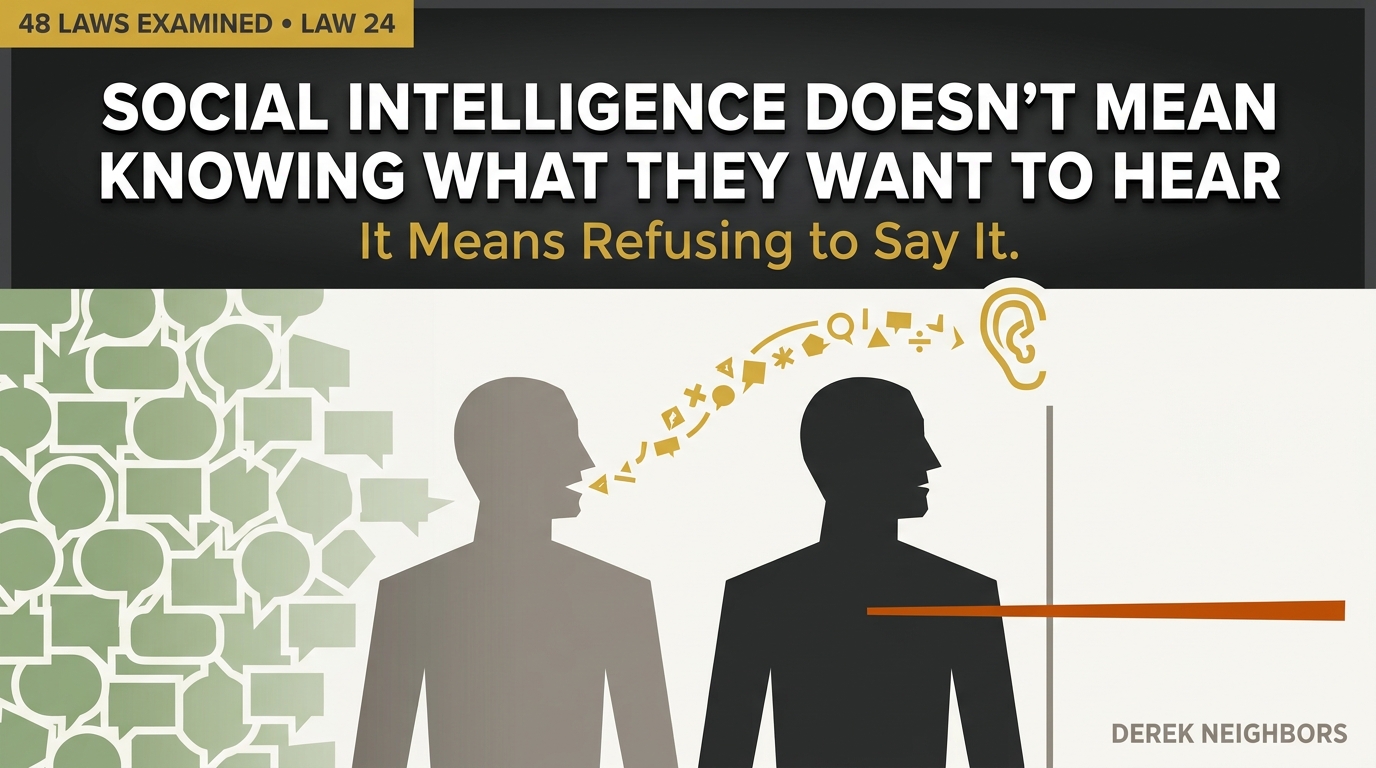
Social Intelligence Doesn't Mean Knowing What They Want to Hear. It Means Refusing to Say It.
Law 24 tells you to become the perfect courtier: master indirection, flatter without obvious flattery, never deliver uncomfortable truths directly. The Greeks had a word for that kind of social facility. They called it kolakeia. They condemned it. Not because flattery fails tactically, but because it corrupts both the giver and the receiver. The alternative is charis: social grace rooted in genuine goodwill, deployed with the courage to say what needs to be said.
Your Work Family Has an Expiration Date. Most People Discover It Too Late.
The retirement party promise was honest in the moment. The silence three months later is structural. Most workplace bonds rest on four scaffolds that disappear the day the project does, and the bitterness most leaders carry into their late careers comes from expecting utility friendships to behave like virtue friendships. Aristotle mapped three kinds of philia 2,400 years ago. The leadership move is to know which kind you have, identify the one or two candidates for the third kind, and invest on purpose outside the project's calendar.

Fear Makes People Obey. It Never Makes Them Follow.
Law 17 says keep others in suspended terror through unpredictability. The Greeks had a name for leaders who ruled through fear: tyrants. And they had a clear record of how every tyranny ends.

Your 'Strategic Friendships' Are Why Nobody Trusts You
Greene says use friendship as cover for intelligence gathering. The Greeks called performing emotions you don't feel hypokrisis, the word that gave us hypocrisy. One produces temporary advantage. The other produces permanent inability to connect with anyone who matters.

Nobody Owes You Anything. Stop Asking Like They Do.
Greene says appeal to self-interest because gratitude and mercy are unreliable. The Greeks say build the kind of character that makes people want to help because your cause is worth joining. One treats people as machines with levers. The other treats them as allies capable of something extraordinary.