Mimesis vs Poiesis: Key Differences in Greek Philosophy
Mimesis and poiesis represent two poles of creative activity. Mimesis learns by imitating what exists. Poiesis brings into existence what did not exist before. All creative development moves between these poles, and understanding where you are on the spectrum clarifies what your craft demands from you at each stage of growth.
Definitions
Mimesis
(μίμησις)
mih-MAY-sis
The act of imitation or representation, central to Aristotle’s theory of art and learning. Beyond mere copying, mimesis describes how humans learn virtue by observing and emulating exemplary models, internalizing excellence through deliberate imitation until it becomes authentic character.
Poiesis
(ποίησις)
poy-AY-sis
The act of bringing something into being that did not exist before—creative production that transforms raw material into meaningful form. For Aristotle, poiesis represents making or crafting, distinguished from mere action (praxis) by its focus on producing an external work or artifact.
Key Differences
| Aspect | Mimesis | Poiesis |
|---|---|---|
| Creative Direction | Mimesis moves from the existing to the reproduced. It takes what is already present in nature, art, or human behavior and represents it. | Poiesis moves from non-existence to existence. It brings forth something genuinely new through the creative act. |
| Relationship to Originals | Mimesis requires a model or original to imitate. The quality of mimesis depends on the accuracy, insight, or depth of the representation. | Poiesis does not require a pre-existing model. The maker draws on skill, vision, and understanding to produce something that has no direct predecessor. |
| Learning Stage | Mimesis is foundational to learning. You develop skill by imitating masters, following established patterns, and reproducing known forms. | Poiesis represents mature creativity. After mastering through imitation, you develop the capacity to create original works. |
| Philosophical Status | Plato criticized mimesis as twice removed from truth (copies of copies). Aristotle defended it as natural to humans and essential for learning. | Poiesis was broadly respected as a genuine bringing-forth. The poet (poietes, maker) was honored for the ability to create rather than copy. |
Creative Direction
Mimesis moves from the existing to the reproduced. It takes what is already present in nature, art, or human behavior and represents it.
Poiesis moves from non-existence to existence. It brings forth something genuinely new through the creative act.
Relationship to Originals
Mimesis requires a model or original to imitate. The quality of mimesis depends on the accuracy, insight, or depth of the representation.
Poiesis does not require a pre-existing model. The maker draws on skill, vision, and understanding to produce something that has no direct predecessor.
Learning Stage
Mimesis is foundational to learning. You develop skill by imitating masters, following established patterns, and reproducing known forms.
Poiesis represents mature creativity. After mastering through imitation, you develop the capacity to create original works.
Philosophical Status
Plato criticized mimesis as twice removed from truth (copies of copies). Aristotle defended it as natural to humans and essential for learning.
Poiesis was broadly respected as a genuine bringing-forth. The poet (poietes, maker) was honored for the ability to create rather than copy.
When to Apply Each Concept
When to Choose Mimesis
Lean on mimesis during the learning phase of any skill. Study the masters, copy their techniques, analyze their choices. Imitation is not plagiarism when it serves development. Writers who copy passages by hand, painters who reproduce masterworks, and programmers who study and replicate excellent code are all using mimesis as a learning tool.
When to Choose Poiesis
Lean on poiesis when you have absorbed enough through mimesis that you can generate original work. When you feel the pull to create something that does not yet exist, to synthesize your influences into a voice or vision that is distinctly yours, you are moving into poiesis. The shift happens gradually, and the best creators continue cycling between mimesis (learning) and poiesis (making).
Frequently Asked Questions
What is the difference between mimesis and poiesis?
Mimesis is imitation or representation, the act of reproducing or depicting what already exists. Poiesis is creative production, the act of bringing something new into existence. In artistic development, mimesis typically precedes poiesis: you learn by imitating, then you create originally. Both are essential, and most mature creative work involves elements of each.
Did Plato and Aristotle agree about mimesis?
No. Plato was deeply suspicious of mimesis, arguing in the Republic that artistic imitation is twice removed from truth and can corrupt the soul by appealing to emotions rather than reason. Aristotle defended mimesis in the Poetics, arguing that imitation is natural to humans, that we learn through it from childhood, and that artistic mimesis can reveal universal truths about human nature.
How do mimesis and poiesis work together in creative development?
Creative mastery follows a natural progression from mimesis to poiesis. Early development relies heavily on imitation: copying techniques, studying exemplary work, and internalizing established patterns. As skill develops, the practitioner begins synthesizing influences and generating original work (poiesis). Mature creators continue alternating between the two, using mimesis to expand their range and poiesis to express their unique vision.
Articles Exploring Mimesis or Poiesis (2)
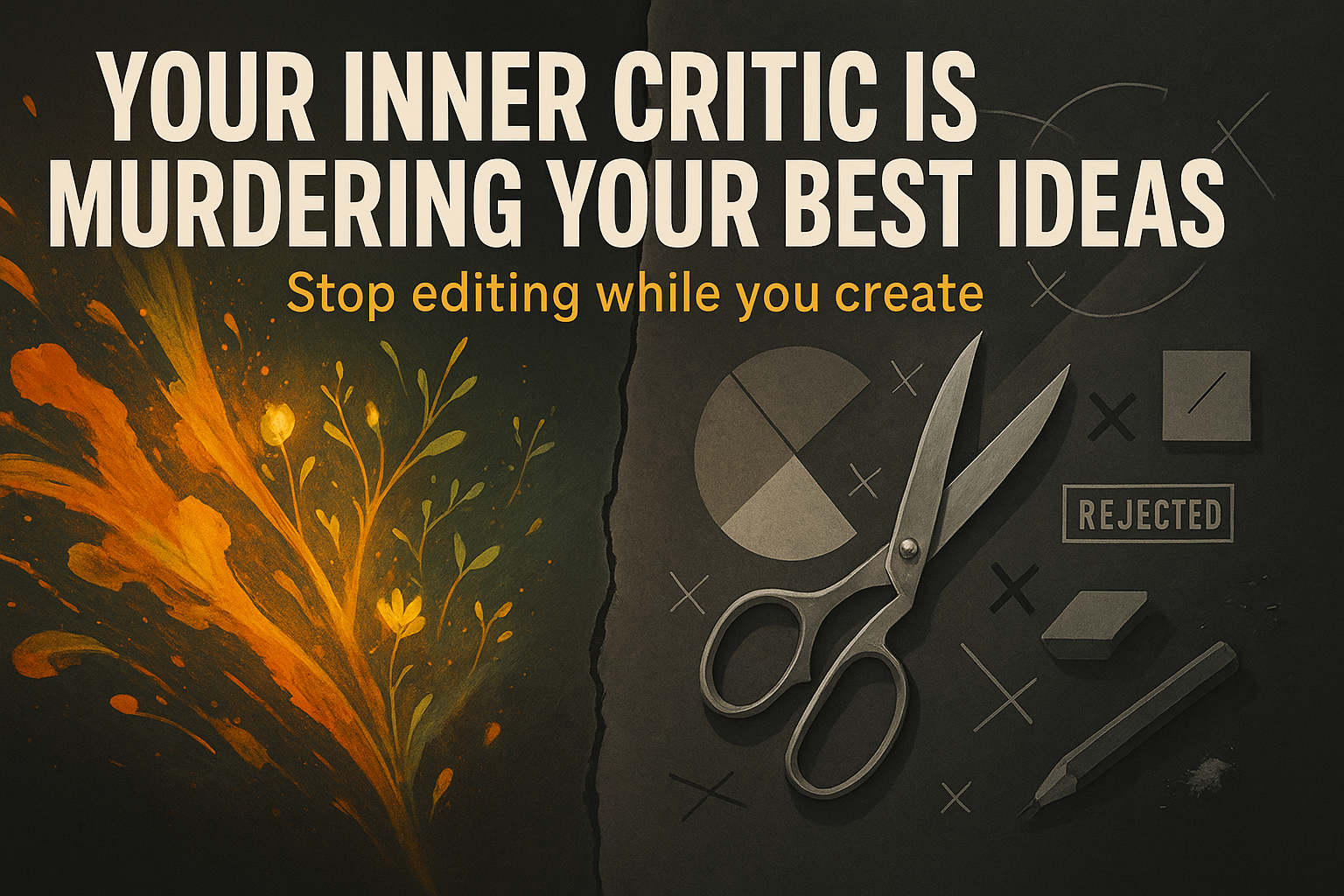
Your Inner Critic Is Murdering Your Best Ideas in the Crib
Your inner critic isn't the enemy. But letting it judge while you create guarantees mediocrity. Excellence requires opposite mindsets—and knowing when to deploy each.
Stop Apologizing for Your Ambition. Character Is Caught, Not Taught.
Your kids don't learn character from perfect attendance. They learn it from watching you demonstrate what's worth pursuing. Stop apologizing for your ambition. Start showing them what commitment looks like.
