Autarkeia vs Autonomy: Key Differences in Greek Philosophy
Autarkeia and autonomy both begin with ‘auto’ (self), but they address different dimensions of independence. Autarkeia is about needing less from outside yourself. Autonomy is about governing yourself according to your own principles. You can be self-sufficient without being self-governing, and you can govern yourself while still depending on others. Clarity about which form of independence you are pursuing changes how you build your life.
Definitions
Autarkeia
(αὐτάρκεια)
ow-TAR-kay-ah
Self-sufficiency. The capacity to stand on your own capability, meeting challenges through developed competence rather than chronic dependency on external support.
Autonomy
(αὐτονομία)
ow-toh-noh-MEE-ah
Self-legislation and the capacity to govern oneself according to one’s own rational principles rather than external compulsion. In ancient Greek thought, it referred both to political self-governance of city-states and the individual’s mastery over their own will and actions.
Key Differences
| Aspect | Autarkeia | Autonomy |
|---|---|---|
| Core Meaning | Autarkeia means self-sufficiency, the condition of having enough within yourself that external circumstances do not control your well-being. | Autonomy means self-governance, the condition of directing your own life according to principles you have chosen through reason. |
| What It Provides | Autarkeia provides resilience. When you need less, you are less vulnerable to loss, disruption, and the unpredictability of fortune. | Autonomy provides agency. When you govern yourself, your choices reflect your values rather than external pressures or others' expectations. |
| Relationship to Others | Autarkeia can involve withdrawal from dependence on others. At its extreme, it seeks complete self-containment. | Autonomy is compatible with deep interdependence. You can govern yourself while participating fully in community and relationships. |
| Philosophical Tradition | Autarkeia was central to Stoic and Cynic philosophy. Diogenes lived in a barrel to demonstrate that human needs could be reduced to almost nothing. | Autonomy was developed more fully by Kant and modern philosophers, though its roots trace to Greek self-legislation and the concept of the free citizen. |
Core Meaning
Autarkeia means self-sufficiency, the condition of having enough within yourself that external circumstances do not control your well-being.
Autonomy means self-governance, the condition of directing your own life according to principles you have chosen through reason.
What It Provides
Autarkeia provides resilience. When you need less, you are less vulnerable to loss, disruption, and the unpredictability of fortune.
Autonomy provides agency. When you govern yourself, your choices reflect your values rather than external pressures or others' expectations.
Relationship to Others
Autarkeia can involve withdrawal from dependence on others. At its extreme, it seeks complete self-containment.
Autonomy is compatible with deep interdependence. You can govern yourself while participating fully in community and relationships.
Philosophical Tradition
Autarkeia was central to Stoic and Cynic philosophy. Diogenes lived in a barrel to demonstrate that human needs could be reduced to almost nothing.
Autonomy was developed more fully by Kant and modern philosophers, though its roots trace to Greek self-legislation and the concept of the free citizen.
When to Apply Each Concept
When to Choose Autarkeia
Cultivate autarkeia when you notice that your well-being depends too heavily on external circumstances. If a market shift, a relationship change, or the loss of a possession would devastate you, your dependence has become a vulnerability. Autarkeia is the practice of building inner resources that remain stable regardless of what happens around you.
When to Choose Autonomy
Cultivate autonomy when you notice that your decisions are being driven by external expectations, social pressure, or inherited assumptions you have never examined. Autonomy demands that you identify your own principles and align your choices with them, even when that puts you at odds with convention.
Frequently Asked Questions
What is the difference between autarkeia and autonomy?
Autarkeia is self-sufficiency, the state of needing minimal external goods for well-being. Autonomy is self-governance, the capacity to direct your life according to your own reasoned principles. Autarkeia reduces dependence. Autonomy asserts agency. A monk who has renounced possessions practices autarkeia. A leader who makes principled decisions against popular opinion practices autonomy.
Can you have autonomy without autarkeia?
Yes. A person can govern themselves according to their own principles while still depending on others for material support, emotional connection, and community. Autonomy does not require isolation or self-containment. It requires that your choices flow from your own deliberation rather than from external compulsion or unexamined convention.
Is autarkeia about isolation?
Not necessarily. While Cynic philosophers pushed autarkeia toward extreme self-containment, Aristotle integrated it with community life. He argued that the truly self-sufficient person participates in the polis because political life is part of human flourishing. Autarkeia in Aristotle's sense means having enough inner stability that you can contribute to community from strength rather than clutching at others from need.
Articles Exploring Autarkeia or Autonomy (15)
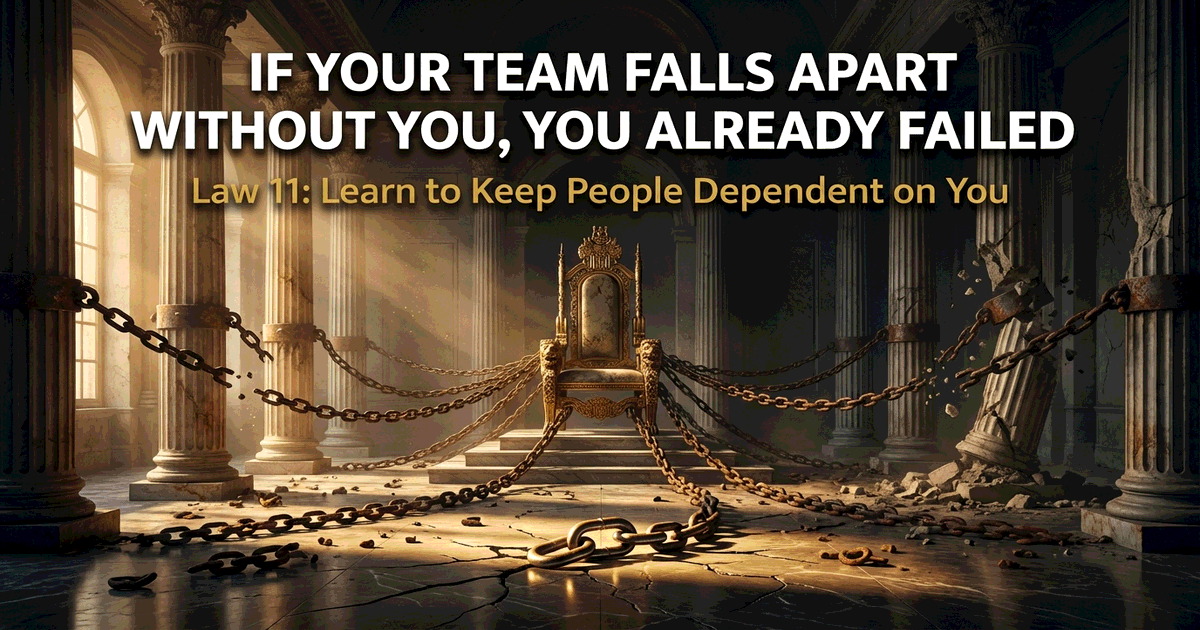
If Your Team Falls Apart Without You, You Already Failed
Greene says make people dependent on you to secure your position. The Greeks say build people who stand on their own. One creates leverage that requires constant maintenance. The other creates organizations that grow stronger whether you're in the room or not.
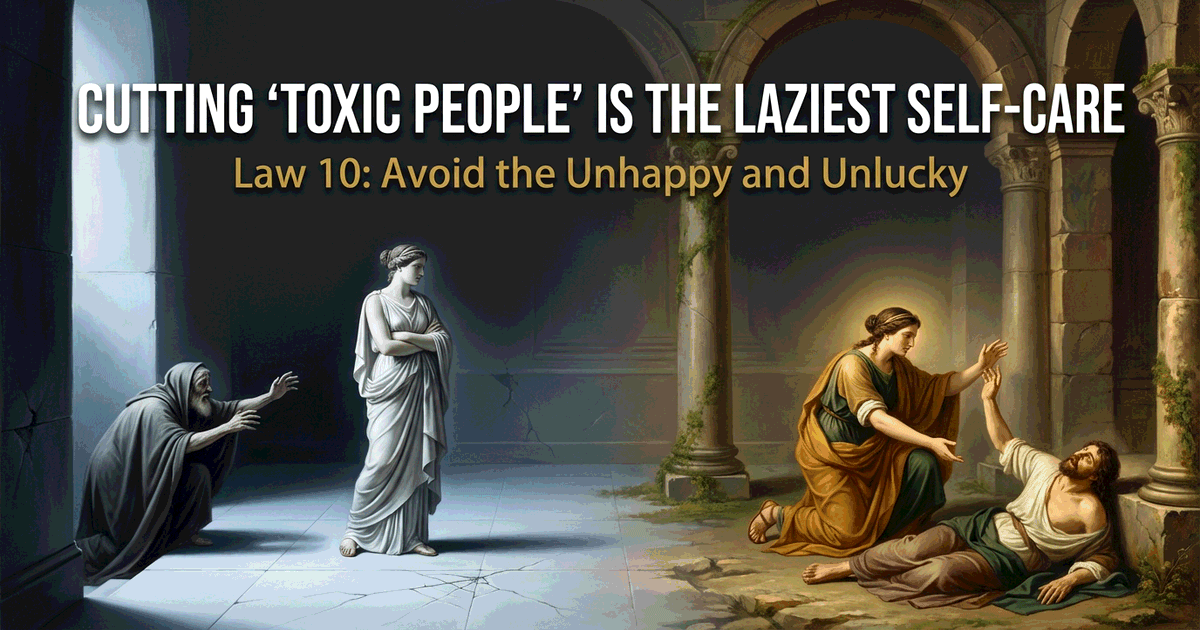
Cutting 'Toxic People' Out of Your Life Is the Laziest Form of Self-Care
Greene says avoid the unhappy and unlucky. The ancients say build yourself strong enough to sit with someone else's pain without losing your center. One protects your comfort. The other builds your character.
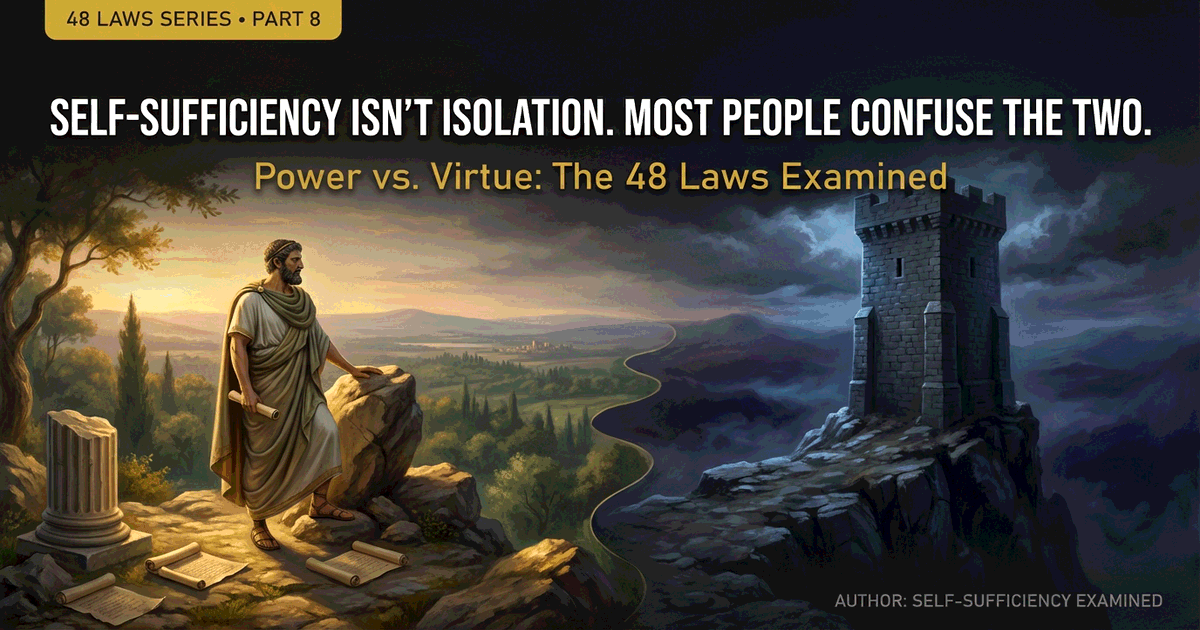
Self-Sufficiency Isn't Isolation. Most People Confuse the Two.
Greene says make others come to you. The Stoics say build a foundation so solid that who moves first becomes irrelevant. One is a tactic. The other is character.
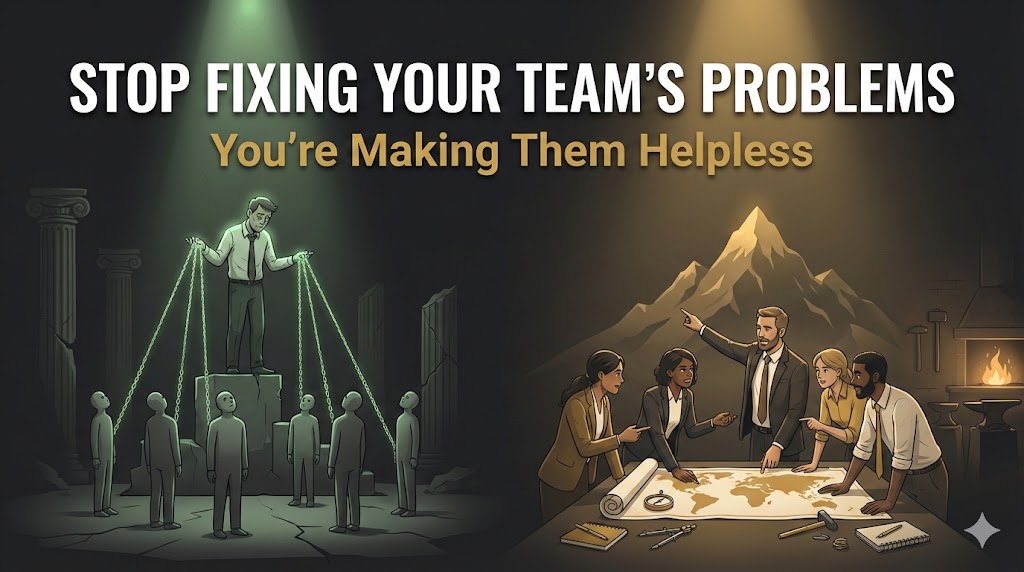
Stop Fixing Your Team's Problems. You're Making Them Helpless.
The best thing you can do for your team is stop rescuing them. Every problem you solve for them is capability they never develop. Coaching builds warriors. Rescuing creates dependents.
If Money Is Why They Stay, Money Is Why They'll Leave.
Pay them well and they'll stay. Pay them more and they'll work harder. It sounds logical until you watch your highest-paid people leave for less money. The myth of compensation-driven loyalty is destroying teams.
Stop Chasing Job Security. Build Skills They Can't Take Away.
Job security is dead. The people who recover fastest from layoffs aren't the ones with the best titles, they're the ones who built skills that travel. Here's what autarkeia teaches us about real security.
You're Not Less Talented. You're Less Focused.
What looks like exceptional talent is usually exceptional attention. The people crushing it aren't more gifted, they've just built the character discipline to ignore everything except what matters most.

The Discipline Gateway: Why Real Freedom Costs More, Not Less
The brutal truth about freedom: it's not the absence of constraints, it's the wisdom to choose the right ones.
The Character Foundation: Why Most Leadership Development Gets It Backwards
The $366 billion leadership development industry teaches techniques before character, skills before being. Here's why 70% of programs fail and how character-based leadership endures.
The Independence Paradox: Why Freedom Requires More Structure, Not Less
True independence isn't the absence of structure—it's the mastery of structure. Here's why the most free people are often the most disciplined, and how to build systems that create authentic freedom.
The Stretch Paradox: Why Safety Enables Greater Challenge
The greatest challenges require the greatest safety. Great leaders understand this paradox: the more psychological safety you create, the more difficult challenges your team will tackle. Here's the framework that makes it work.
The One-on-One Revolution: Leadership Through Structured Dialogue
Most one-on-ones are glorified status updates disguised as leadership development. The DIALOGUE method transforms individual conversations into systematic leadership multiplication, creating leaders who create more leaders through structured excellence.
Building AI-First Teams: The Leadership Transformation
The future belongs to leaders who can build teams that don't just use AI tools, but think AI-first. This requires a fundamental transformation in how we hire, develop, and structure technical teams.
Creating Environments for Excellence: The SPACE Model
Excellence isn't just about individual character, it's about creating environments where excellence becomes natural, inevitable, and sustainable for everyone. Here's how leaders architect the conditions for human flourishing.
Autonomy vs Performance
Learn how to strike the right balance between giving teams autonomy while maintaining high performance standards.