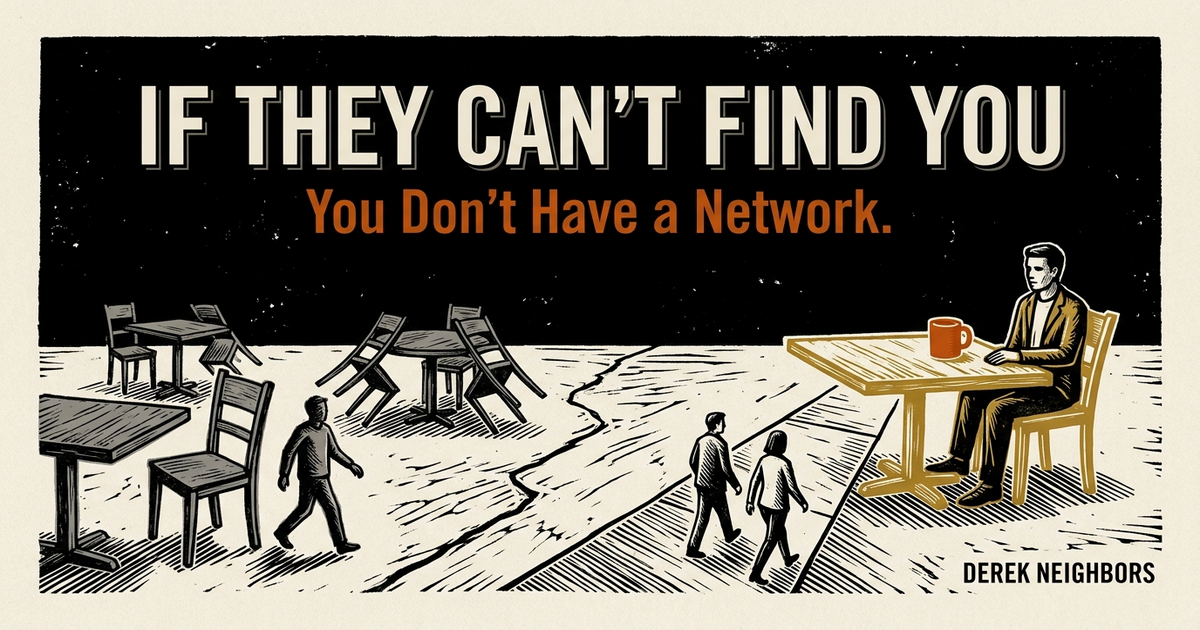
If They Can't Find You, You Don't Have a Network
By Derek Neighbors on August 21, 2026
I used to treat breakfast like a meeting I could move.
Downtown Chandler had five places that would take a laptop. I rotated them so I would not get bored, and so nobody could pin me to a chair. My calendar looked social. I told myself I had a network. My life was a set of temporary rooms.
Then I was DCCP president, a merchant, and a landlord at the same time. People needed a human, not another calendar link. I picked one table at one diner and kept the same morning window. Within a few months the owner had a mug waiting. A merchant who wanted a variance knew where to walk. A friend who wanted ten minutes stopped texting “are you free” and came to the booth.
The cards I collected sat in a drawer. The booth is what grew the network.
You Keep Changing Rooms
Most people I coach have a full calendar and a thin community.
They stack coffees in new rooms. They change the Zoom link every week so it feels fresh. They say “let’s grab time” and never name a place. They add people on LinkedIn after a conference and call the pile a network.
The pile stores names. See whether anyone can reach you without a scavenger hunt.
I have sat in those rotating rooms. I told myself the rotation was curiosity. It was also cover. If nobody knew where I sat, nobody could interrupt the story I was telling myself about being in demand. When I needed a merchant intro or a ten-minute judgment call, I had to start a thread and wait. The booth would have finished it before lunch.
The Greeks treated shared life as koinonia (κοινωνία), partnership aimed at a common good, not a stack of names. Aristotle starts the Politics with households and cities as forms of koinonia. A city has streets. A polis has places you can walk to. A private moving chair leaves you running errands.
This is the beginning state. You look busy and nobody can walk to you.
Being reachable is owed even if you have no diner, no tab, and no civic title. A library table, a park bench, a church basement, or one standing phone hour still counts. Missing money limits the room. It does not cancel the address. The diner, the mug, and the tab in this story are instances. The thing they stand for is a life other people can reach.
The First Season at One Table
The first weeks at a fixed table feel small.
You sit, you work, and you pay. The owner learns your order. You learn the owner’s name. Nothing viral happens. That is the point. hexis (ἕξις) is a disposition built by repetition. Showing up on Tuesdays from seven to nine is how the disposition gets into your body. Mood will not do that work. The calendar will. You do not control who arrives. You control whether the hour and the address stay put, and whether a person who does arrive can interrupt you. Six empty Tuesdays are the first reps, not a verdict on the practice.
I did not pick the diner because it was branded. I picked it because I could reach it on a weekday without a special trip, and because I could stay long enough for someone to find me. The DCCP work and the landlord work needed a public, boring room. A merchant could walk in without booking a conference. I was less tempted to spend the morning being watched.
After a month, the closest people stopped asking where I was. They asked what time I would be there. That is the first real upgrade: the place is known, so the only question left is the hour.
philia (φιλία), friendship that can turn into character friendship, needs those reps. Aristotle is blunt about this. You do not become friends by exchanging one intense coffee. You become friends by sharing ordinary hours. A moving chair starves the ordinary hours. You keep meeting as if you are new.
The first season is also where you decide whether the table is a hiding place or a host. If you put on headphones the entire window and glare at anyone who approaches, you locked a private office in public. Stay interruptible for part of the window, not all of it. Work still happens. The chair still has a job besides your inbox.
When People Start Aiming at the Chair
The advanced state is quiet.
The owner runs a tab because you showed up long enough to be trusted, not because you needed a status prop. A merchant brings another merchant. Someone you helped last quarter walks in with a problem you did not schedule. You make an intro that would have taken three emails and a week of “circling back.”
The Greeks named the host-and-guest obligation xenia (ξενία). xenia is the host-and-guest bond. The host offers a place and a measure of protection. The guest honors the house and returns the favor later. A running tab is a small modern version. You are known. You are hosted. You host the people who walk in. If you only extract, the house will feel it. If you only give when someone is watching, the house will feel that too.
charis (χάρις) is favor given first. Buy the extra coffee. Make the intro before you need one. Stay for the person who is late. Do that for a season before you ask the room to carry you. I learned this the slow way. Early on I treated the booth as a place to get work done in public. The compounding started when I treated it as a place other people could use.
This is not the same argument as building a fortress. That piece is about walls. This one assumes you already left the walls. The remaining failure is motion: community has no address.
It is also not the work family that expires with the project. That bond lives on a shared Slack. A table that is not owned by one company can outlast the project.
And it is not staying uncommitted until nobody comes looking. Law 20 refuses the tie. This failure accepts the tie and hides the meeting place.
arete (ἀρετή) here is the disposition of being available to a shared good. Rational animals live in koinonia. A moving chair starves that function. The mean sits between hiding in rotation and sitting as a display. The table is an instrument. Excellence is the habit of being useful where someone can actually find you.
How to Give Your Network a Place This Week
You do not need a brand. You need a chair and a clock.
Pick one weekday place you can reach without a special trip. If the place is a thirty-minute event, you will cancel it. Pick a diner, a lobby cafe, a library table, or a coworking booth you can walk to from the work you already do.
Pick one recurring window. Same day. Same two hours. Put it on the calendar as if it were a customer. If you keep moving the window, you are back in the rotating-room game.
Tell three people the address and the hours, not a blast list. A colleague, a merchant, a friend who already texts you “we should catch up.” Give them something they can aim at.
Learn the owner’s name. Give first. You are joining a house, not buying a throne.
Stay interruptible for part of the window. Headphones can go on for a stretch. They should come off long enough that a person who walked over does not feel like they broke into your bunker.
Run it for a season before you judge it. The first six visits will feel like you sat alone and wasted a morning. That is how hexis always looks from the inside. The seventh visit is often when someone aims at the chair.
If you work remote, work nights, or drive for a living, keep the same rule without a Chandler booth. Keep the same Zoom, the same nurse-station hour, or the same truck-stop stool. Never change the URL or the mile marker. Put the place in the footer and in the channel where people already hunt you. A moving meeting place is the vice. The diner is one instance.
Travel can skip a week without restarting the rotation. The calendar reveals a hide that was already there.
The guardrail is this: people can find you, and you are not on display. Give your life an address so koinonia has a body. If the table becomes a way to be watched, you rebuilt the conference in a smaller room. Close the laptop lid for ten minutes and talk to the person who came.
I still travel. The diner does not need me every day. It needs a pattern people can trust more weeks than not. That is enough for a network to grow around a chair instead of a thread.
Final Thoughts
A contact list feels like a network because it has names. Names without an address are a museum.
Pick a table, keep the hours, give first, and let people walk to you.
The work gets easier when the closest people stop asking where you are.
If you want a community with a standing place to practice, MasteryLab is where people show up on a schedule and do the work in public.
FAQ
How do you build a professional network without networking events?
Pick one weekday place you can actually reach and one recurring two-hour window. Tell three people the address and the hours. Learn the owner’s name and give first: buy the extra coffee, make the intro, stay for the person who is late. Run it for a season. A network is people who can walk to you without a thread. Events can add names, and a table is what turns those names into a habit.
What is a third place?
Ray Oldenburg’s third place is a hangout that is not home and not the office: a diner, a barber, a cafe with regulars. The useful part for leadership is the address. People need a chair they can aim at. If you keep changing rooms, you are running errands.
What does koinonia mean in Greek philosophy?
koinonia is shared life, a partnership aimed at a common good, not a stack of contacts. Aristotle treats the household, the village, and the city as forms of koinonia. A CRM can store names and still fail to host the shared life. You practice it by showing up in the same room on a schedule and contributing more than you extract. See koinonia.
What is xenia in Greek?
xenia is guest-friendship: obligations on the host and the guest. The host offers a place and protection. The guest honors the house and returns the favor later. A running tab at a regular table is a small modern version. You are known. You are hosted. You host the people who walk in. See xenia.