Allos-autos (ἄλλος αὐτός): Meaning, Definition & Modern Application
AHL-los ow-TOS
Another self. Aristotle's phrase for a true friend: someone you wish well for their own sake, the way you wish yourself well, who helps you see yourself clearly while remaining a separate person with judgment of their own.
Etymology
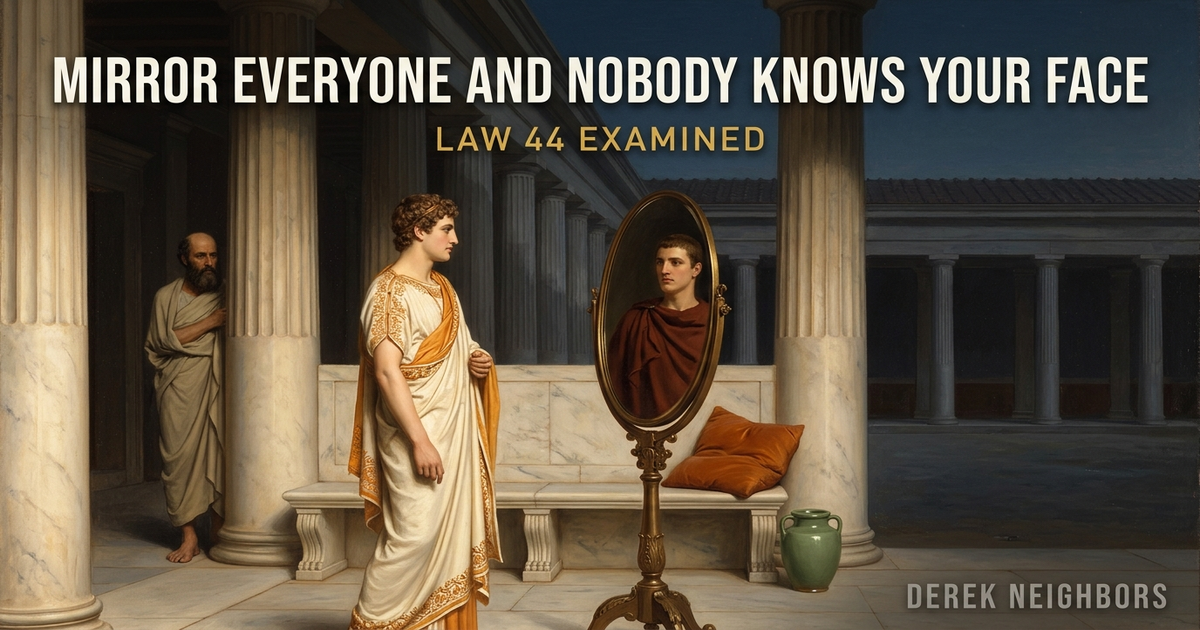
From allos (ἄλλος), ‘other’ or ‘another,’ and autos (αὐτός), ‘self.’ Aristotle uses the phrase in the Nicomachean Ethics (IX.4, 1166a31-32) when he argues that a good person relates to a friend the way he relates to himself, ‘for the friend is another self.’ He returns to the idea in IX.9, where he argues that even a self-sufficient person needs friends. The Magna Moralia (II.15), a work attributed to Aristotle, turns the phrase into an image: as we see our own face by looking in a mirror, we come to know ourselves by looking at a friend.
Deep Analysis
Aristotle’s account of philia in Books VIII and IX of the Nicomachean Ethics distinguishes three kinds of friendship: for usefulness, for pleasure, and between people who are good and alike in virtue. The third kind is complete friendship, and it is the one the phrase allos autos describes. In IX.4 Aristotle argues that the marks of friendship (wishing the other’s good for their sake, wishing them to live, spending time together, sharing joys and griefs) are first found in how a good person relates to himself. A good person is at one with himself, wants his own good, and enjoys his own company. He relates to his friend in the same way, ‘for the friend is another self.’
The phrase holds two things together. The friend is another: a separate person whose good is their own and not a part of yours. The friend is also a self: someone whose good you want the way you want your own. Lose the first half and the friend becomes an extension of you, a mirror that hands back your preferences. Lose the second and you have an acquaintance.
In IX.9 Aristotle asks why a self-sufficient person would need friends at all, and part of his answer is that we see the actions of others more clearly than our own. Watching a good friend act, a good person sees goodness in action and takes pleasure in it. The Magna Moralia makes the point with a mirror: since we cannot easily see ourselves, we look at a friend, who is another self, the way we look in a mirror to see our face.
The Alcibiades I, a dialogue attributed to Plato, has a related image. Socrates says an eye that wants to see itself must look into another eye, where its image appears in the pupil, and a soul that wants to know itself must look into another soul. In both texts the other person makes self-knowledge possible because they are other. A reflection in still water shows only what you bring to it. A friend can also say what they see.
This is why the concept matters for leadership. A leader surrounded by people who agree with everything has many reflections and no second view. Aristotle’s friend is valuable because the reflection is accurate and the judgment is independent, and a leader who wants that has to keep the people around them free to disagree.
Modern Application
At work, *allos autos* names what you want from the people closest to your decisions: an accurate picture of what you are doing, from someone who still has a view of their own and tells you. Most colleagues are not friends in Aristotle's full sense, but the structure carries over. A peer who plays your argument back correctly and then disagrees is doing what Aristotle's friend does. A model asked to argue against your plan can do it too.
Historical Examples
Plutarch’s Life of Alcibiades shows the opposite of the friend as another self. In Sparta, Alcibiades adopted Spartan habits so completely that Plutarch says he outdid the chameleon, and he did the same with the Persian satrap Tissaphernes before returning to Athens. Each side saw its own reflection in him, and none trusted him in the end. The Alcibiades I presents Socrates offering the young Alcibiades a different mirror: a friend in whom he could come to know himself.
Plutarch’s essay How to Tell a Flatterer from a Friend draws the line directly. The flatterer changes with you like a shadow, nodding when you nod. The friend shares your good and resists your faults, and so can tell you something you did not already know.
How to Practice Allos-autos
Name the two or three people whose read on you that you trust most. Ask yourself when each of them last disagreed with you, and what you did when they did.
Before you ask someone for feedback, say your own view of your work first, then ask where they see it differently. You are asking for a second view, so make room for one.
When you give feedback, describe what the person did accurately enough that they recognize it, and then say what you think. Do not stop at the reflection.
If you notice you agree with everyone you talk to, write down your view on the next decision before any meeting about it. Compare it afterward with what you said in the room.
When you use a model to check your thinking, leave your preferred answer out of the prompt, or ask it directly for the strongest case against you.
Application Examples
A VP of engineering notices that every staff engineer has agreed with every architecture decision she has made for a year. She starts each design review by asking one engineer to make the strongest case against her preferred option.
The people closest to a leader can only be another self if they are allowed to be another. Agreement on everything is a sign the second view has gone missing.
A tech lead gives a junior engineer feedback by first describing exactly what happened in the last three pull requests, until the engineer agrees that is what happened, and only then saying what he thinks should change.
An accurate reflection comes first, and the friend’s own judgment comes after it. Skipping either half makes the feedback useless.
A founder pastes a pricing plan into a model with no indication of which option she prefers and asks for the weakest point in each. The answer finds a problem her team had agreed past.
A model can supply the independent second view when you stop telling it the answer you want.
Two engineering managers agree to tell each other, once a month, one thing the other did that their own teams would not say to them.
Peers can play the role Aristotle gives the friend: close enough to see clearly, separate enough to say it.
Common Misconceptions
A common misreading takes ‘another self’ to mean the best friend is someone just like you. Aristotle does say complete friendship is between people alike in virtue, but the friend’s good remains their own, and the value of the friend depends on their being a separate person. A second error treats the phrase as a general theory of self and other. It is a specific claim about friendship in the Nicomachean Ethics. A third treats it as sentiment. For Aristotle, it explains why even a self-sufficient person needs friends: we see ourselves better in someone else’s eyes.
The phrase I come back to is the first half, another. Most leaders I see want a self: someone who sees what they see and agrees with it. What they need is another, who sees them accurately and still has their own view. You can tell which one you have built by how long it has been since someone close to you told you that you were wrong and you thanked them for it.
Frequently Asked Questions
What does allos autos mean?
Allos autos is Greek for another self. Aristotle uses it in the Nicomachean Ethics to describe a true friend: someone you care about for their own sake, the way you care about yourself. The friend is like a self in how much you wish them well, and still another person, with a character and judgment of their own.
Where does Aristotle call the friend another self?
In the Nicomachean Ethics, Book IX, chapter 4 (1166a31-32), and again in chapter 9, where he argues that even a happy, self-sufficient person needs friends. The Magna Moralia, Book II, chapter 15, attributed to Aristotle, adds the mirror comparison: we know ourselves by looking at a friend the way we see our face by looking in a mirror.
How is a friend as another self different from a flatterer?
A flatterer reflects back whatever you already think, for their own benefit. Aristotle's friend reflects you accurately and then tells you what they see, including what you would rather not hear. Plutarch makes the same point in How to Tell a Flatterer from a Friend: a friend who changes when you change and nods when you nod is no use, because your shadow does that better.