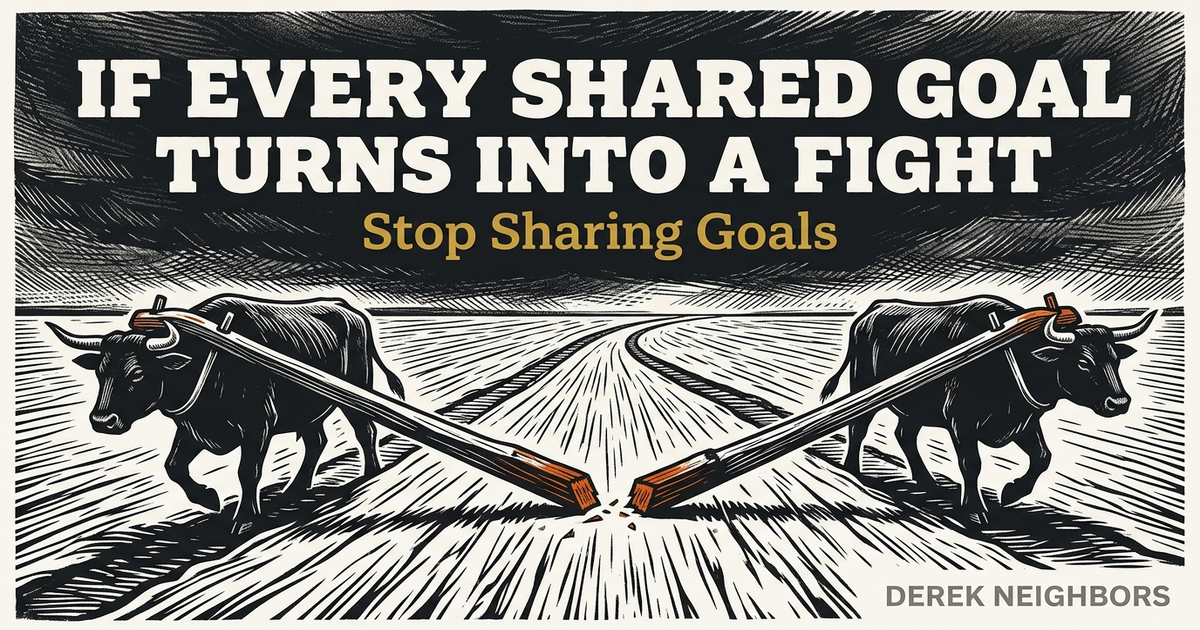
If Every Shared Goal Turns Into a Fight, Stop Sharing Goals
By Derek Neighbors on August 30, 2026
Two teams at a company I coached shared one deploy pipeline for three years.
It started as a sensible decision. One service, one release train, two teams contributing. By the third year, any failed release from either side became a Slack thread about the other side. The retros were the worst hour of the month. The VP kept both teams in the same room because, in his words, “they need to work it out,” and every joint retro made the next release worse.
What finally fixed it was the thing he had been refusing to do. He split the service in two, gave each team its own on-call rotation and its own roadmap, and told them they would not be sharing a goal for two quarters. Nine months later they shipped a feature together, and the retro for that one was boring. Time did some of that work, and I will not pretend otherwise, but time had already been given two years while they shared the room and had done nothing with it.
He had spent two years trying to heal the conflict with contact, and contact was what fed it.
Why “Work It Out” Feels Like the Only Respectable Answer
Most leaders carry a belief that conflict is resolved by proximity. Get the people in a room, facilitate, run the retro, book the offsite. Distance reads as giving up, or worse, as an admission that you could not build a culture where adults work through their differences.
The belief has a lot going for it. I have written before that the couples who fight are the couples who last, and I stand by it. Conflict that gets worked through builds a stronger bond than conflict that gets avoided. Teams that argue about the interface in March ship a better interface in June. That essay is true.
It is true up to a line. The line is the point where the conflict stops being about any shared thing and becomes about the other party. This essay is about that line.
On one side of it, one more meeting helps. On the other side, the same meeting injures. The action is identical, the outcome reverses, and nobody tells you where the line is. That is why leaders keep running the play that worked last year on a conflict that changed underneath them.
The Threshold Where Contact Stops Healing
Below the line, the conflict is about a thing: the interface, the deadline, who broke the build. Two people who disagree about a thing can be put in a room with the thing, and the thing usually gets resolved.
Above the line, the conflict is about the other party. The thing is whatever is in front of them this week. Next week it will be a different thing, and the fight will be the same fight.
You can tell which side you are on. Old history gets re-argued in every planning meeting. A win for one side is counted as a loss by the other, even when both sides needed it. A neutral engineer who joins the shared channel gets pulled onto a side within a week. Joint sessions leave both teams angrier than they arrived, and the leader walks out thinking the session needed a better facilitator, when what the session needed was to not happen.
| Below the line | Above the line | |
|---|---|---|
| What the fight is about | A thing: the interface, the deadline, the build | The other party, with this week’s thing as the excuse |
| What one more meeting does | Resolves the thing | Gives the grievance a fresh occasion |
| How wins are counted | A win for the work | A loss for whichever side did not get it |
| What a neutral newcomer does | Stays neutral | Picks a side within a week |
| The leadership move | Facilitate, retro, keep them in the room | Reduce what they share, with a date and a way back |
Thucydides watched this at scale. In 427 BC the island city of Corcyra split into two factions, oligarchs and democrats, who kept sharing the same walls, the same temples, and the same assembly while they killed each other for seven days. His account in Book 3 of the History is the coldest thing in ancient literature. Words changed meaning: recklessness was called loyalty, caution was called cowardice, and a man who tried to stay out of it was suspected by both sides. “The ties of party,” he wrote, “were stronger than the ties of blood.” Thucydides had one word for the condition: stasis, civil strife, a body that keeps sharing one set of organs while its halves tear at each other. His observation was that once a city crossed that line, every shared institution became a weapon, and the sharing itself was the accelerant.
The same mechanism runs at smaller scale, with less blood and the same shape. John Gottman’s marriage lab found that once a person’s heart rate climbs above roughly a hundred beats per minute during an argument, they stop taking in new information. He called it flooding. The only intervention that reliably worked was a break of at least twenty minutes, and couples who took the break came back with measurably less hostility than couples who pushed through. Organizations flood too. They do it on a scale of quarters instead of minutes, and the leader who keeps them in the room is asking two flooded systems to process each other.
Amanda Ripley spent a book on the difference between good conflict and what she calls high conflict, where the fight becomes about the fight and each side’s identity depends on the other side being wrong. Every exit she documented, from a California town council to a Chicago gang, involved distance from the environment that fed it. None of the people she followed argued their way out while still inside.
Aristotle saw the structural version in the Nicomachean Ethics. Complaints and reproaches, he wrote, arise chiefly in friendships of utility, the bonds people form because each is useful to the other. Two teams yoked to one pipeline are a utility bond. Each needs the other to ship. When the shared thing turns into a cost for both sides, complaint becomes the default state of the relationship, and goodwill on either team slows that without stopping it. I wrote about the three kinds of philia when work friendships end. The point here is narrower: a utility bond that has turned into a cost will produce grievance on schedule, and the grievance is structural, not a character flaw on either side. The structure explains why the grievance keeps arriving. What each person does with it in the thread, the private outage doc, the win counted as a loss, is still theirs.
That is the paradox. Contact heals conflict and contact feeds conflict, and both are true, on different sides of a line that moves. Two things move it: how long the parties have been above it, and how much they are forced to share. Every quarter spent past the line lowers it, and every new shared thing gives the grievance another place to land.
Why Leaders Keep People Yoked Too Long
If the line is that visible, why do leaders stay on the wrong side of it for years?
Separation looks like failure. Yours. If you cannot get two teams to collaborate, what does that say about the culture you built? So you book another offsite, because the offsite is a story about effort, and the split is a story about defeat.
Separation looks like picking a winner. Somebody has to end up with the pipeline. Somebody has to move. Whoever moves will read it as a verdict, and you will spend a month managing that reading. Keeping everyone in place avoids the verdict, which is why the verdict never gets delivered and the fight never ends.
Sunk cost does its usual work. Two years of facilitation, a mediator, a shared OKR that was supposed to force alignment. Cutting now means admitting all of that bought nothing.
And sometimes, honestly, the leader likes being the referee. Being the only person both sides talk to is a kind of importance. I have watched a VP defend a joint standup for a year past its usefulness, and when I asked what he would lose if it stopped, the real answer was that he would stop being needed at nine every morning.
While the leader waits, the good people leave first. They are the ones who cannot stand the thread. The senior engineer who joined to build things and found herself spending Thursdays defending a deploy she did not make reads the situation faster than anyone above her, and she reads it as permanent, because nobody has said otherwise.
If you are inside the fight and nobody above you will split anything, two things are still yours. How you conduct yourself in the thread is yours, and the fight does not excuse the private outage doc. The honest request upward is also yours: tell your lead, in plain words, that every shared goal has become the same fight and that you are asking for less shared work, not more meetings. Neither of those waits on a VP.
How to Separate as a Leader
Separation done badly is abandonment, and done well it is one of the more caring things a leader can do, because it is the only move that leaves both sides with something to come back to. Five parts.
Say it out loud. A silent reorg tells both teams the leader is ashamed of the decision, which tells them the decision is temporary and political. The announcement is short: “I am separating these two teams for two quarters. Every shared goal has turned into a fight, and I left it that way too long. That part is on me.” Naming your own share is the sentence that makes the rest believable.
Cut the structure, not the people. Separate ownership, on-call, roadmap, and the standing meeting. Give each side something whole. When Amazon mandated in 2002 that every team expose its work through a service interface and nothing else, the effect was that teams stopped needing to be in each other’s business to ship. If two teams keep fighting over an interface, give each a clean side of it and let the contract do the talking.
Set a return date and a condition. Separation without a date is exile, and both teams will treat it as one. “We revisit in April. The condition for bringing you back onto shared work is one joint project with a scope both leads sign.” A date turns the split into a break, and breaks end. The scope signature is the smaller half of the condition. Two leads who still see each other as the enemy can sign a scope. The real condition is whether each lead can say, without being coached, what the other team is trying to do well. That is what the distance is for. It gives each side back the ability to see the other as a team with its own work, rather than as the reason for every bad week.
Keep one honest channel. Two leads, thirty minutes every other week, no audience, no agenda beyond “what is true right now.” Ripley’s exits all had one relationship that survived the distance. Build it on purpose.
Own your share, and keep owning it. The leader who left it yoked carries that in the announcement and in the April conversation. If the teams come back together and it fails again, that is information about the line, not about the people.
What Separation Is Not
The same word covers things that are not this.
Ghosting does not count. Distance with no announcement and no date is a slow firing of everyone involved.
A punitive reorg does not count either. If the team that “lost” gets moved to the worse floor and the worse roadmap, you have declared a winner and hidden the declaration inside an org chart.
Neither does permanent by default. Aristotle’s advice on friendships that have gone bad was two-sided: do not dissolve them quickly, because people change back; but when the other party has changed beyond recall, dissolve, and do it as the person you want to remain. Separation with a return date honors both halves. Slowness is right, and it has a budget, because every month of it is paid for by the people on both teams who did nothing wrong and are deciding whether to stay.
And separation is never a substitute for a decision you owe. If the fight is actually one person behaving badly, splitting two teams is a way of avoiding a conversation with that person. That is a performance problem, and separating forty people to dodge it punishes thirty-nine of them.
Done right, separation is also how you keep an opponent from becoming an enemy. I wrote about what happens when leaders decide an enemy has to be destroyed. In my experience most enemies were not born that way. They were opponents who got kept in the same room past the line until the grievance calcified. Cutting the yoke early is the cheaper version of that whole story.
Final Thoughts
Reading which side of the line you are on is phronesis, practical judgment, and it cannot be delegated to a facilitator. The tells are in front of you: the re-litigated history, the zero-sum accounting, the neutral person who picked a side by Friday.
Once you see them, what is yours is the structure, the date, saying why, and your own share of how it got this far. Whether the two sides ever want each other back is not yours, and the separation was right or wrong on what you did, not on whether they reunite. Cut the yoke while each animal still has something to walk toward, put a date on it, say why, and then let the distance do the work the room could not.
If you want to practice the harder leadership moves with people who have made them, MasteryLab is where that work gets done out loud.
FAQ
When should a leader separate two teams that keep fighting?
When the conflict has stopped being about a thing and become about the other party. The signs are consistent: old history gets re-argued in every planning meeting, a win for one side is counted as a loss by the other, a neutral person who joins the thread gets pulled onto a side within a week, and joint sessions leave both teams angrier than they arrived. Below that line, contact and facilitation work. Above it, every shared goal becomes another occasion for the grievance, and the leadership move is to reduce what they share.
Is separating people in conflict the same as giving up on them?
No, if it is done as a leader and not as an escape. Real separation is announced out loud, cuts structure rather than people, gives each side something whole to own, sets a return date and a condition for revisiting, and keeps one honest channel open between the leads. Giving up looks like a silent reorg, a punitive move of whichever side lost, or distance with no date. The difference is whether a way back was built into the split.
What does stasis mean in ancient Greek?
stasis is the Greek word for civil strife: a city split into factions that keep sharing the same walls, courts, and assemblies. Thucydides described it at Corcyra in 427 BC, where oligarchs and democrats killed each other for seven days inside one city. His point was that past a certain line, shared institutions stopped restraining the conflict and started feeding it. Words changed meaning, party loyalty outranked family, and staying in the same room made everything worse.
How do you separate two teams without making it permanent?
Put a date on it and a condition. Say the separation is for a fixed period, name what would justify bringing them back together, and keep one regular conversation between the two leads with no audience. Give each team ownership of something whole so neither is waiting on the other to ship. Separation without a date is exile. Separation with a date is a break that lets both sides recover enough to want the other back.