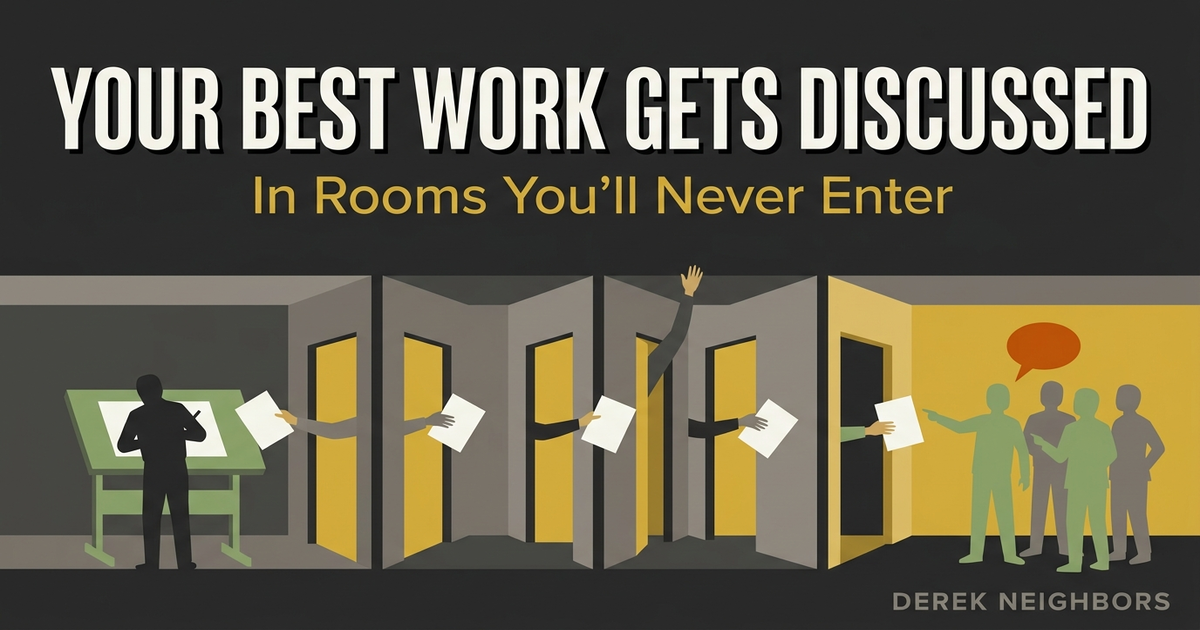
Your Best Work Gets Discussed in Rooms You'll Never Enter
By Derek Neighbors on August 29, 2026
A head of engineering I coach got a call this spring from a CEO he had never met.
The CEO had a new CTO. The new CTO had sat two desks from him four years earlier at a company neither of them works at anymore. What the CTO remembered was one thing: a database migration he ran on a Saturday that did not lose a row and did not need a rollback. That migration was never on a slide. He never wrote it up. He had mostly forgotten it.
It had been discussed in a room he was not in, by a person he had not thought about in years, and it was the reason a phone rang.
The Assumption That Runs Most Careers
The story most people run is that opportunity comes from being seen: post more, get in front of people, be in the room. Quality is table stakes and distribution is the game.
Once you believe that, the effort splits in a predictable way. The keynote demo gets the polish. The ticket for one internal user gets the version you would be embarrassed to show anyone. The favor for the adjacent team gets done late and half. You are budgeting attention by audience size, and a job with one witness, one person close enough to see how it was done, gets the leftovers.
I ran that budget for years without noticing I was running it. Then I traced where the work was actually coming from.
The Crack
Almost none of it came from a post or a pitch. It came through a person who had watched me work earlier, usually on something small that nobody was scoring at the time.
The people passing my name along had never followed me anywhere. They were witnesses. They had been in the room when a small thing got done well, then they left that room and kept moving, and years later a need showed up near them and they said a sentence.
Homer’s word for this is kleos, and it matters because of what it does not mean. kleos is usually translated as glory or renown, but it literally means “what is heard.” It is the report of your deeds in other people’s mouths. Achilles cannot manufacture his own; singers carry it. The sharpest scene is in the Odyssey, book 8. Odysseus is a stranger in a foreign hall. A blind bard stands up and sings about the horse at Troy, and the man who built the horse pulls his cloak over his face and weeps. His work had arrived in a room before he did, in a voice that was not his.
That is the whole mechanism, and it is older than any platform.
How Excellence Compounds Through Other People
Here is the same mechanism at work today.
Every piece of work you do has witnesses, and a witness is a smaller and more useful thing than an audience. Usually that means two to six people who were close enough to see how it was done: the reviewer on the pull request, the person you paired with on the ugly part, the manager who watched you hand it off, the one user who filed the ticket.
Witnesses leave. People change jobs every few years. Each one carries a compressed verdict about you, and the verdict is short. “Call her if it’s a migration.” “He does not ship things half done.” “Do not put him on anything with a deadline.” One sentence, sometimes less.
When a need shows up in a new room, the sentence gets said. The portfolio gets a glance and the sentence gets believed.
Why the sentence outranks anything you could say about yourself comes down to pistis, the Greek word for the trust a claim carries. Your own description of your work competes with every other self-description in the market and gets discounted accordingly. A witness’s sentence arrives with no competition and no discount. Polish got cheap; a person who watched did not.
Albert-László Barabási, a network scientist, put it in a formula: performance is bounded and success is unbounded, because success is a property of the network rather than of the performer. When work is hard to measure from the outside, which describes nearly all knowledge work, the network decides. The network is made of witnesses.
Two things about this mechanism are uncomfortable.
It runs both ways. Sloppy work gets carried by the same people, in the same sentence length, and in my experience the bad sentence gets repeated more often than the good one, because a warning is more useful in a hiring conversation than praise. Every phoned-in ticket is also recruiting. If the bad sentence about you is true, the fix is the next piece of work, not a rebuttal.
And it is slow, with no dashboard. Four years passed between the Saturday migration and the phone call. Nothing along the way told him the network was growing. That silence is why people quit on it and go back to being seen. Progress that compounds through other people feels like nothing for a long time.
The Revelation
Witnesses build your reputation out of the ergon you did in front of them, and then they carry it into rooms without you. You never build it yourself.
Aristotle used ergon for the characteristic work of a thing, the deed itself rather than the account of the deed. That is the unit that gets witnessed: the work itself, watched, rather than the retrospective or the slide you made about it afterward.
The compounding unit is a witnessed piece of quality work, and the small one counts as much as the loud one. Homer used kleos for great deeds sung in halls, and the word survives the shrink to a one-user ticket because the person carrying the report is answering a question that has no size. The witness does not grade for scale. The witness grades for one question: would I want this person again? A ticket for one user answers that question as clearly as a launch, and the answer travels the same distance.
Every piece of work is a recruiting event for a job you have not heard of yet.
I wrote earlier this year that reputation is a trailing indicator of character. That piece was about what reputation is made of. This one is about how it moves, and where that tells you to point your effort. It points at the job in front of you and the two people watching, not at the room you wish you were in.
One caveat is owed. kleos can be unjust. Witnesses can be wrong, prejudiced, or simply absent. Some excellent people are never named in any room. Epictetus was world-class while his reputation was “property.” The obligation to do the work well does not depend on the network paying out, and if you would only do it well when a payout is guaranteed, you were never doing it for the work. Plato put the sharper test in the republic: the ring of Gyges, which makes you invisible. Would the Saturday migration get the same version if no room would ever hear of it? The work has to pass at zero witnesses first. kleos describes what happens after, and it is not the reason. What you control is the ergon and who you let watch it. Whether anyone says the sentence is not yours.
What This Changes on Monday
Treat the one-person ticket as the keynote. The small internal fix, the one-user report, the favor for the team next door: do them as if the person watching will be a VP in four years, because they often will be, and they will remember the version they got. The VP is a description of how the work travels, not the reason to do it well. The reason is that it is your work.
Do the work where it can be witnessed. Pair on the hard part. Review in the open. Send the diff, not the summary. A witness needs to see the work, not hear your description of it. The work is the same whether zero people or six people can see it; you are opening a door, not performing for whoever walks through it. Work done alone and reported later produces admirers at best, and admirers do not carry sentences.
Finish clean, because the finish is the sentence. Witnesses repeat the ending: the handoff, the doc, the loose end you closed or did not close. The last ten percent of a job writes the verdict that travels. Ninety percent done and abandoned produces “he leaves things,” and that line outlives the good work in front of it.
Count witnesses, not followers. Once a quarter, trace where your last three pieces of work came from. Write the chain: who watched what, where they went, what they said. That chain is your actual network. If the chain is empty, being findable is the other half of the problem, and it is a different essay.
Be an honest witness yourself. The network runs on people who say true sentences about other people’s work in rooms those people are not in. Yours count, and this is the one part of the network you own outright. Honest means accurate: the hard true thing about the engineer who did the migration right, or wrong, said where it matters, even when it is uncomfortable. Flattery and gossip both corrupt the network you are relying on.
None of this requires you to stop writing or stop showing up. It changes what you protect. The work in front of two people is the thing that will be said about you by name when you are not there, so stop treating it as the leftovers.
Final Thoughts
Right now your name is being said in a room you will never enter, by someone you have not thought about in years, and what they are saying was decided by how you did a job in front of them.
arete lives in the work, done fully, whoever happened to be watching, and never in the announcement of it. Homer knew the rest would be carried by other mouths. Do the job in front of them well.
If you want a community that grades the small job as seriously as the loud one, MasteryLab is where people practice doing the work that gets talked about.
FAQ
What does kleos mean in Greek?
kleos is Homer’s word for renown, and it literally means “what is heard.” It is the report of your deeds carried by other people’s mouths. You cannot manufacture your own. Achilles earns it at Troy and singers carry it; Odysseus hears his own kleos sung by a bard in a hall he never expected to enter. In modern work, kleos is the one-sentence verdict a witness repeats about you in a room you are not in.
How does excellence compound over a career?
Every piece of work has a few witnesses. They change jobs every few years and carry a compressed verdict about you, usually one sentence, into new rooms. When a need shows up in one of those rooms, the sentence gets repeated. Quality compounds because witnesses multiply and move, and because their verdict is trusted more than anything you could say about yourself. The same mechanism carries sloppy work just as far.
Is word of mouth better than self-promotion?
For most work, yes, because of trust. A witness who watched you do a job carries credibility your own description never will. Self-promotion competes with everyone else’s self-promotion and gets discounted. A witness’s sentence arrives with no competition and no discount. The practical move is to do the work where it can be witnessed and to finish it cleanly, because the finish is what witnesses repeat.
Does doing great work guarantee opportunities?
No. kleos can be unjust. Witnesses can be wrong, prejudiced, or absent, and some excellent people are never named. Epictetus was world-class while his reputation was property. The obligation to do the work well does not depend on the network paying out. What you control is the work itself and who you let watch it. Being findable when the sentence finally lands is the other half.